
What Are Healthy Boundaries?
Healthy boundaries are the limits you set to protect your time, energy, and emotions in any relationship. They tell people what you will and will not accept, so you can show up for others without losing yourself. When your boundaries are healthy, you feel respected, less resentful, and more in control of your own life.
For years, I said yes when I meant no. I stayed in rooms that drained me. I kept the peace and lost myself in the process.
I was not weak. I just never learned that my needs were allowed to exist.
This article is not a definition lesson. It is a real, step-by-step guide on how to actually set healthy boundaries, with what worked for me, what failed, and what the research says about why this is so hard for women specifically.
Let us get into it.
Table of Contents
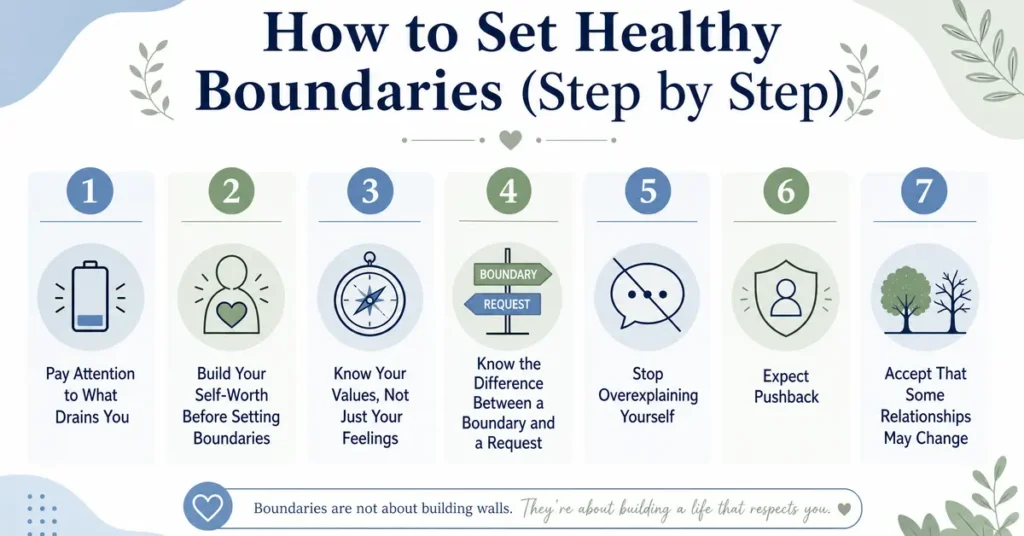
How to Set Healthy Boundaries (Step by Step)
Step 1: Pay Attention to Your Limits
The first step toward setting boundaries is awareness. You cannot set a boundary around something you have not named yet.
Before you say a word to anyone, you need to get honest with yourself. Your body already knows where your limits have been crossed. You just have to pay attention.
Ask yourself these three questions. Where do I feel resentment building? Who drains me instead of filling me up? Where am I saying yes when everything inside me says no?
According to psychologist and boundaries researcher Dr. Harriet Lerner, author of The Dance of Anger, resentment is almost always a signal that a need is going unmet or a limit is being ignored. It is not a flaw. It is a message.
What I do: I have a note on my phone. I just call it the “resentment list.” Ugly name, I know. But whenever something happens and I feel that tight, gross feeling in my chest, I open that note and just dump it out—no full sentences, no explaining myself. Just what happened and how it felt. I did this for one week straight, and when I read it back, one person’s name showed up almost every single day. That was all I needed to know.
Step 2: Build Your Self-Worth Before Setting Boundaries
Most boundary guides skip this step. It is the most important one.
If you do not believe your needs matter, you will set a boundary and abandon it the second someone gets upset. Not because you are weak, but because you have not yet built the belief that you are allowed to hold it.
You do not need full self-worth before you start. You build it by doing. Every time you hold a boundary and nothing catastrophic happens, your nervous system learns that your needs are safe to have.
What I do: For a long time, saying no would spiral me into doubt. I started writing down each time I said no or honoured a need, noting what happened next. I declined unwanted plans and enjoyed a quiet night on the couch. I ended a stressful call and felt relieved the next day. Writing it down helped me believe in my choices and gradually built my confidence.
Step 3: Know Your Values, Not Just Your Feelings
As you would be familiar with, feelings change, but values do not. And a boundary built only on feelings is easy to talk you out of.
A feelings-based boundary sounds like “I do not like it when you do that.
A values-based boundary might sound like: “I will not allow disrespect in my relationships because I value dignity.” The second one is something you can stand on. The first one, someone can argue with.
Dr Henry Cloud writes in his book Boundaries: “A boundary is where you end and someone else begins.” When your limits are rooted in who you are and what you will not negotiate on, they hold.
Sit down and write five things you refuse to compromise on in a relationship. Honesty. Rest. Safety. Respect. Autonomy. Those five things become your anchor for every boundary you set going forward.
What I do: I had a family member who used to speak to me in a way that made me feel really small. And every time it happened, I told myself it was not a big deal. I kept letting it go. Then one day, I asked myself: if someone spoke to a little-girl version of me like this, would I be okay with it? No. Absolutely not. That one question hit different. It made me realise this was not just about feelings. It was about something I genuinely will not accept. And once I saw it that way, I knew exactly what I needed to say.
Step 4: Know the Difference Between a Boundary and a Request
This is where most women get stuck, and it is not their fault. Nobody teaches us this difference.
A request is, “Please stop doing that.” It asks the other person to choose differently. It is fine, but it is not a boundary. The other person can say no.
A boundary is when that happens, here is what I will do. It puts the action back in your hands. The other person does not have to agree. You just have to follow through.
The formula is simple. When X happens, I will do Y.
When you raise your voice, I will end the call and try again later. When plans change at the last minute, I will decline rather than rearrange my day. When the conversation turns critical, I will step away until it no longer does.
Nedra Tawwab, therapist and author of Set Boundaries, Find Peace, puts it plainly: “A boundary is not about controlling what someone else does. It is about deciding what you will do.”
What I do: For years, I kept telling my mum to please stop giving me advice I did not ask for. Every time she would say, “Okay,” and then do it again at the next family dinner. I was so frustrated. But the problem was me, not her. I was making a request, not setting a boundary. Next time it happened, I just quietly changed the subject. I did it again the next time. And then something funny happened. She started asking me first. She would say, do you want my opinion on this? That small shift changed everything, and all I did was change my own behavior.
Step 5: Stop Overexplaining Yourself
Women are taught to soften everything. To apologise before stating a need. To wrap a limit in so much cushioning that the actual message disappears.
A 2010 study published in Psychological Science found that women are significantly more likely than men to preface assertive statements with apologies and qualifiers, and that this directly reduces how seriously those statements are taken.
You do not need to justify your needs. You need to name them.
I used to say things like, “I know this is probably fine, and you do not mean anything by it,” but I have been a little stressed. If that works, let’s avoid texting after 9 PM, since my sleep has been off. Nobody heard the need inside all of that.
Now I say, “I need us to stop texting after 9 PM.” I am protecting my sleep.
That is the whole sentence. The first time I said it that way, my voice shook. By the tenth time, it felt completely normal.
Step 6: Expect Pushback
You will be tested. Not because the people in your life are cruel, but because you are changing a pattern they depend on.
Psychologists call this a “change back attack.” When one person in a relationship system starts behaving differently, the system tries to pull them back to where they were. Someone may get quiet. Someone may cry. Someone may say you have changed, as if that is an accusation.
Dr. Murray Bowen, the psychiatrist behind family systems theory, described this as the natural resistance of any system to change. It does not mean you are doing something wrong. It means the limit is working.
Your job is not to manage their reaction. Your job is to stay consistent.
What I do: A close friend once told me I was becoming selfish when I stopped taking her calls during my work hours. I wanted to take it back immediately and apologise. Instead, I said, “I hear that this feels different.” I still need to keep my work hours clear. I will call you this weekend.
She called me. We are still close. Nothing broke.
Step 7: Accept That Some Relationships May Change
Some relationships in your life have only worked because you had no limits. When you develop them, the relationship may not survive. That is not failure. That is information.
Not every ending is your fault. Some endings are just the truth becoming visible.
What I do: I lost a friendship when I started saying no. She had been used to me rearranging my whole week around her needs, and when I stopped, she slowly disappeared. It hurt. It also made my life quieter, and I realised I had space I had never felt before. The grief was real. The relief was real, too.
Types of Boundaries
Mental Boundaries
Mental boundaries protect your right to think for yourself. They are crossed when someone dismisses your opinions, tells you how you feel, or pressures you to agree with something you do not believe.
This kind of violation is quiet. It shows up as a consistent pattern of correction, dismissal, or the experience of always being the wrong one. A mental boundary sounds like: I see it differently, and I am not going to keep discussing this to change my mind.
Emotional Boundaries
Emotional boundaries protect your feelings and your energy. They are crossed when someone consistently uses you as their emotional dumping ground without giving anything back or when you are held responsible for how other people feel.
An emotional boundary sounds like “I care about you, but I do not have the space to hold this tonight.” That is a full, complete, kind response.
Physical Boundaries
Physical boundaries protect your body, your personal space, and your right to comfort. They include who touches you, when, and how. They also include needing quiet, needing distance, or needing time completely alone.
There is a false belief that love means always being physically available. It does not. You can love someone deeply and still need space from them.
Material Boundaries
Material boundaries protect your money, your belongings, your time, and your labour. They are crossed when someone borrows and does not return, expects financial help without discussion, or treats your effort as freely available whenever they need it.
These feel small until you add them up. A favour that turned into a standing expectation. A loan was never mentioned again. The pattern always points to the same thing: your resources are not being treated as valuable.
A material boundary sounds like: I am not in a position to lend money right now. Or: I can help once. I cannot make this a regular thing.
Spiritual Boundaries
Spiritual boundaries protect your beliefs, your practices, and your relationship with meaning. They are crossed when someone mocks your faith, pressures you into theirs, or uses spiritual language to control or guilt you.
These violations feel especially personal because they reach the deepest part of who you are. You are allowed to believe what you believe without defending it in every conversation.
Sexual Boundaries
Sexual boundaries protect your body, your comfort, your desires, and your right to ongoing consent in any intimate relationship. They include the right to say no at any point, to change your mind, and to have your preferences respected without guilt.
These are the limits women most often feel they are not allowed to have, especially in long-term relationships.
A long relationship does not remove your right to say, “Not tonight.” That right belongs to you regardless of history.
Time Boundaries
Time boundaries protect your most limited resource. They are crossed when your schedule is treated as flexible by default, when people expect you to drop your plans for theirs, or when your rest is seen as something negotiable.
A time boundary might sound like: “I need 48 hours’ notice for schedule changes.” Or: I keep my evenings free. I am not available for calls after 7 PM.
12 Signs You Have Unhealthy Boundaries
I have lived through most of these. That is exactly why I recognise them.
1. You say yes and feel immediate regret. The word is barely out, and something in you sinks. That feeling is your body telling you that you just left yourself behind.
2. You feel responsible for other people’s reactions to your choices. Their disappointment becomes your guilt. You spend more energy managing their feelings about your decision than you spent making the decision itself.
3. You do not know what you actually want. When someone asks what you need, you go blank. Years of prioritising everyone else’s preferences can genuinely erode your ability to access your own.
4. You over-explain every decision. Every now comes with a paragraph. Every preference comes with an apology. You are managing someone’s potential reaction before they have even had one.
5. You avoid conflict even when you are being hurt. The other person’s comfort has become more important to you than your own wellbeing. You absorb the harm to keep the peace.
6. Most relationships leave you exhausted. When you rarely feel refuelled after spending time with people, it usually means you are consistently giving more than you are receiving, and there is no limit in place to protect that.
7. You absorb other people’s moods. Someone nearby is anxious, and suddenly you are too. Someone is angry, and you feel guilty even though you did nothing. This is emotional enmeshment, which occurs when emotional limits disappear.
8. You cannot say no without an excuse. You believe no requires a justification. So you manufacture reasons because a simple no does not feel like enough.
9. People consistently take more than you offered. This is not because those people are uniquely terrible. It is because there is no visible line showing them where enough is.
10. You stay in things that make you feel small. You return to situations or relationships that consistently diminish you. The staying itself is a signal that a boundary is overdue.
11. You feel angry but cannot name why. Generalised, low-level resentment with no clear cause is almost always the result of needs that have not been named or defended. The body keeps the score even when the mind is still catching up.
12. You give to avoid discomfort, not because you want to. Generosity feels like relief, not like giving. That is not generosity. That is self-protection dressed up as kindness, and it is not sustainable..
Why This Is So Hard for Women
Once you have the steps, it helps to understand why this feels so difficult. Not as an excuse, but so you stop blaming yourself for the fear.
A study found that women are penalised more harshly than men for the same assertive behaviour. Men get called confident. Women get called difficult.
The fear you feel before setting a limit is not weakness. It is a rational response to a social cost you have been trained since childhood to avoid. Understanding that separates the fear from the fact, and the fact is this: the cost of having no limits is always higher than the cost of setting them.
Bottom Line
Setting healthy boundaries is not about becoming cold, difficult, or selfish. It is about finally learning that your needs, time, emotions, and peace deserve protection too. The more consistently you honour your limits, the more honest and balanced your relationships become.
Some people may resist your growth, but the right people will learn how to meet you with respect. Boundaries do not push love away; they make healthier love possible.
If this resonated with you, you might also love: [Why You Keep Seeking Validation From People Who Will Never Give It] and [How to Stop the Comparison Spiral and Start Living Your Own Life]

Mehwish Arshad is the founder of Grow With Meh, a personal growth platform that helps women build self-awareness, emotional resilience, and a deeper understanding of themselves. For over 10 years, she has studied psychology, mindfulness, and personal development through extensive reading, research, and lived experience.