

Key Takeaways from This Article
- People-pleasing is a learned fear response, not a personality flaw
- The fawn response is your nervous system’s way of keeping the peace to stay safe
- You stop the pattern by pausing before you respond, not by forcing yourself to be blunt
- Small, consistent noes build the confidence that larger noes require
- Guilt after saying no is normal and temporary, and it fades with practice
- Real recovery means tolerating someone else’s disappointment without fixing it
To stop people-pleasing, pause before saying yes, set clear boundaries, and prioritize your own needs. Learn to say no without overexplaining, accept that not everyone will approve of you, and practice small acts of assertiveness daily. Over time, this builds confidence and reduces the need for external validation.
You have been saying yes for so long that it feels like who you are.
You agree to plans you dread. You smile through things that hurt. You carry other people’s feelings as if they were your responsibility. And somewhere inside, you are exhausted and quietly resentful. But you keep going because the alternative, saying no, feels like a risk you cannot afford.
This article will show you exactly how to stop people-pleasing. Not with a quick tip or a mindset quote. With eight real, honest steps that work.
What Is People-Pleasing Exactly
People-pleasing is a behavior pattern where you say yes to others out of fear rather than genuine desire. A fear of rejection, conflict, or disapproval drives it. Unlike kindness, which is a free choice, people-pleasing is a coping mechanism rooted in the need for external approval to feel safe and worthy.
Psychologists call this the fawn response. It is one of four ways your brain reacts to perceived danger. The other three are fight, flight, and freeze. “Fawn” means you try to neutralize the threat by making the other person happy. You appease instead of acting.
It has also been called the “disease to please.” Because it does not feel like fear from the outside, it feels like niceness. And that is exactly what makes it so hard to catch.
Why Women and Girls Are Conditioned to Please People
From a very young age, girls are taught that likability is safety. You hear things like “be sweet,” “don’t make a fuss,” and “you are so helpful.” You get called bossy for leading. You get called dramatic for having feelings. You get called difficult for saying no.
So you learn to shrink. You learn to put your needs last. You learn to apologize for taking up space. You learn that your value comes from what you do for others, not from who you are.
That is not a character flaw. That is conditioning. And it runs very deep. Breaking free from it is not a small thing. It is a quiet act of rebellion that every woman and girl deserves to make.
What Are the Root Causes of People-Pleasing Behavior?
Why do you do this? The answer lives in your nervous system.
People-pleasing is a survival mechanism. Your brain learned early on that conflict is dangerous. If you grew up with a parent who got angry easily, you learned to walk on eggshells. You learned to predict their moods and manage their feelings. That was how you stayed safe.
Now your adult brain still runs that old program. Even when you are nowhere near that danger, your nervous system does not know the difference. It treats a disappointed coworker the same way it once treated an angry parent.
The fears underneath are simple. Fear of rejection. Fear of being disliked. Fear of upsetting someone. These fears feel enormous because, to a child, rejection from a caregiver was a form of survival threat. Your body still carries that memory even when your mind knows better.
Low self-esteem also plays a role. When you do not feel secure in your own worth, you borrow it from other people’s approval. You need them to say you are good because you do not yet fully believe it yourself. That is exhausting work. And it never feels like enough.
What Are 5 Common Signs Of People-Pleasing Behavior?
You cannot change what you cannot see. Here are five signs worth recognizing.
- You say sorry for everything. You apologize when someone bumps into you. You say sorry for having an opinion. You apologize for existing loudly in a room. Excessive apologizing is one of the clearest signs of chronic people-pleasing.
- You feel resentful after saying yes. You agree to something with a smile on your face. Then inside, you feel used and quietly angry. That resentment is a signal. It means you said yes when you should have said no.
- You do not know what you want. When someone asks where you want to eat, your mind goes blank. You only know what other people want. Your own preferences feel buried somewhere you cannot reach.
- You feel emotionally exhausted all the time. You are always doing, always helping, always available. You take on too much. You never fully rest. That burnout is the price of living according to everyone else’s needs.
- You go quiet to keep the peace. You have opinions, but you swallow them. You tell yourself it is not worth the conflict. You feel invisible. That is self-erasure, not peace.
The Fawn Response and Your Nervous System
Here is why stopping people-pleasing is hard. Your nervous system does not distinguish between a disappointed friend and a physical threat. It treats social danger the same way it treats real danger.
When someone looks upset or raises their voice, your body reacts. Your heart speeds up. Your muscles tighten. Your brain screams, “Fix this.” The fastest way to fix it is to make that person happy again. So you apologize. You back down. You say yes. The fawn response fires before you even realize it happened.
You do not consciously decide to say yes. Your nervous system decides for you. Then your brain creates a reason afterward, something like “I am just a nice person” or “it was not a big deal.”
This is not a character flaw. This is biology. The good news is that you can retrain your nervous system. It takes practice. It takes repetition. And it takes a willingness to stay with discomfort long enough for a new pattern to form.
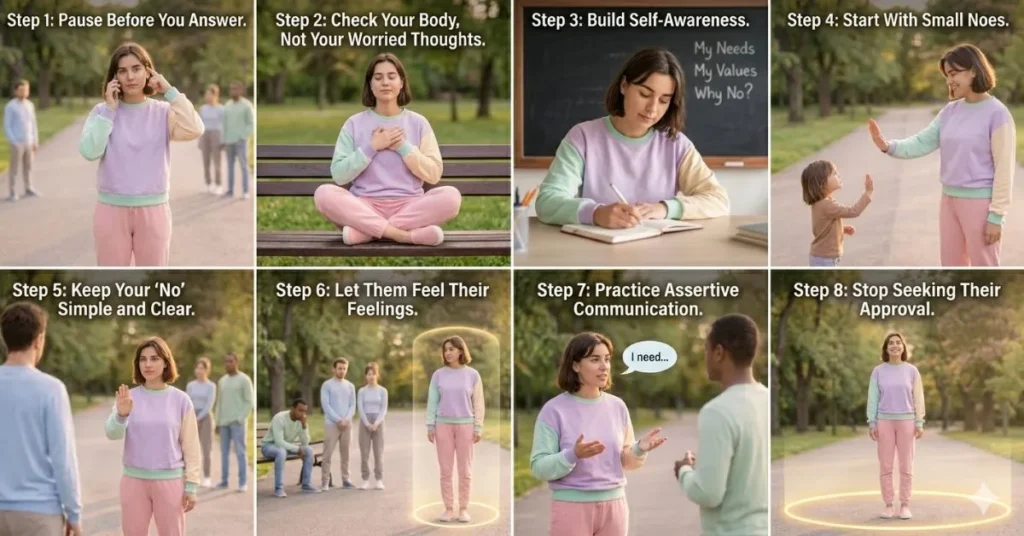
8 Steps to Stop People-Pleasing for Good
Take these one at a time. You do not need to do everything at once.
Step 1: Pause Before You Answer
This is the single most important step. You do not have to respond right away. When someone asks you for something, stop before you speak. Your first instinct will be to say yes automatically. That is the old pattern, not your real answer.
Instead, say this: “Let me think about it and get back to you.” Or “Can I check my schedule first?” These phrases sound small. They are not. They break the automatic yes before it leaves your mouth. They give you the space to figure out what you actually want.
Make this pause your new default. Every time someone asks for your time, your help, or your presence, you wait. Even if you already know the answer, you wait. Your brain needs to learn that responding is a choice, not a reflex.
Practice this with low-stakes moments first. A coworker asks for help. Say you need to check your schedule. A friend asks about weekend plans. Say you will let them know by tomorrow. The pause gets easier and faster every time you use it.
Step 2: Check Your Body, Not Your Worried Thoughts
After you pause, check your body. Not what you think you should feel. What you actually feel.
Is your stomach calm or knotted? Is your chest tight or open? Does the idea of saying yes feel light or heavy? Your body already knows the answer. It tells the truth before your thoughts have time to talk you out of it.
Your thoughts will say things like, “But they will be upset,” or “What if they think I am selfish?” Your body says yes or no before all of that noise arrives. Trust your gut more than your fear.
Ask yourself one simple question: “Do I really want to do this?” A real yes feels easy. A fear, or yes, feels like something you have to convince yourself to do.
Step 3: Build Self-Awareness So You Can See Your Patterns
You cannot change what you do not notice. This step is about paying attention to yourself in a new way.
Start keeping a simple note on your phone. Each time you say yes but mean no, write it down. Each time you paused and made a different choice, write that down too. After a few weeks, you will start to see your own patterns clearly. You will notice which people trigger the automatic yes. You will notice which situations make you shrink.
This is not about judging yourself. It is about seeing yourself honestly. Awareness is not the same as criticism. It is the first act of self-respect.
Ask yourself regularly: “What do I actually want here? What do I actually need?” These questions feel strange at first when you have spent years not asking them. But they become natural with practice.
Step 4: Start With Small Noes to Build the Muscle
You do not start with the hardest conversation. That is too much too soon. You start with tiny noes that carry no real risk.
A cashier asks if you want a bag. Say no. A sales assistant asks for your email. Say no. A waiter offers more water, but you do not need it. Say no, thank you.
Each small noise proves something to your nervous system. Nothing bad happened. The world kept moving. You are still safe. After enough small noes, your brain begins to update its belief about what happens when you decline. That is when the medium noes become possible.
Try one new, slightly harder one each week. A plan you do not really want to attend. A genuinely inconvenient favor. A commitment someone assumed you would take on. Watch what happens. Usually, far less than you feared.
Step 5: Keep Your “No” Simple and Clear
You do not owe anyone a long explanation. A clear, kind no is enough. In fact, the more you over-explain, the more room you create for negotiation and guilt.
Here are phrases that work:
“I cannot do that today.” “That does not work for me.” “I am not available for that.” “I need to pass on this one.” “I am going to sit this one out.”
Say the words. Then stop talking. Silence after a no is not rude. It is just a complete sentence. Adding reasons gives people something to argue with. A quiet, clear “no” gives them nothing to push against.
You might feel the urge to fill the silence. Resist it. Let the “no” stand on its own.
Step 6: Let Them Feel Their Feelings Without Rushing In
This is the hardest step for most women. When you say no, the other person might look sad, hurt, or annoyed. Your first instinct will be to fix it immediately. To say, “Okay, fine, I will do it after all.” To apologize, explain, or soften what you just said until it means nothing.
Do not do that. Their feelings belong to them. You do not need to manage them.
Take a breath. Stay quiet. Let the feeling be there. It will pass faster than you think. The discomfort of watching someone be disappointed is real. But it is survivable. And it gets smaller every time you let yourself sit with it instead of running from it.
You might also feel guilty afterward. That is completely normal. Guilt after saying no is almost universal for recovering people-pleasers. Let the feeling be there for a few minutes. Notice that nothing catastrophic has happened. Notice that you are still okay. The guilt shrinks each time you push through it without acting on it.
Step 7: Practice Assertive Communication
Being assertive does not mean being aggressive. It means being clear and honest while still being respectful. It means speaking your truth in a calm, direct way.
Use simple “I” statements. These are sentences that describe your experience without blaming the other person. For example:
“I feel overwhelmed right now, so I need to say no to this.” “I need some quiet time this evening.” “I cannot take on more this week.” “I care about you, and I also need to put myself first here.”
Keep your voice calm and steady. Look at the person you’re speaking to. You do not need to raise your voice or justify yourself at length. Clear is kind. You are not being mean. You are being honest.
If someone pushes back, you do not need to argue. You can acknowledge their feelings without abandoning your position. Say, “I understand you are disappointed, and my answer is still no.” Then stop. You do not need to win the debate. You just need to hold your ground long enough for the moment to pass.
Step 8: Stop Seeking Their Approval and Reconnect With Yourself
You cannot control what other people think of you. Some will respect your no. Some will not like it. Neither outcome changes whether your no was right.
Start shifting the question you ask yourself. Not “will they like me?” but “do I like this choice?” Not “will they be upset?” but “is this honest?” Move your focus from their reaction to your own integrity.
This is where the real inner work lives. Underneath the people-pleasing pattern is a real you with real preferences, opinions, and needs. She has been quiet for a long time. Reconnecting with her takes gentleness and patience.
Sit alone for ten minutes a few times a week. No phone. No background noise. Just you. Ask yourself what you genuinely like. What you actually want. What feels true to who you are. You might find that some of your preferences surprise you.
As you rebuild this connection with yourself, something shifts. External approval starts to matter less. Not because you become indifferent to others, but because you finally have your own approval to stand on. That is not selfishness. That is wholeness.
How to Stop People-Pleasing in a Relationship
Romantic relationships are where people-pleasing does the most quiet damage. You give too much. You receive too little. You pretend to be fine when you are not. Over time, the resentment builds into a wall you cannot explain to anyone, including yourself.
Start by noticing where you shrink in your relationship. Do you always defer on small decisions like where to eat or what to watch? Do you pretend to enjoy things you actually dislike? Do you avoid certain topics entirely because you fear the reaction?
Write these patterns down. Be honest with yourself. Then pick one small thing to change this week. Next time your partner asks where to eat, say what you actually want. Next time a plan gets made that you have feelings about, say something instead of going along quietly.
Healthy relationships can handle honesty. In fact, honesty is what builds real intimacy. When you speak your truth, you give your partner the chance to know the real you. That is not risky. That is a connection.
Pay attention to how your partner responds when you set a boundary. A secure partner respects your “no,” even if they are momentarily disappointed. If someone consistently punishes you for having needs, that is important information about the relationship itself.
Inner Work That Supports the Healing
The eight steps change your behavior. But inner work changes how you see yourself, and both matter.
Self-compassion when you slip. You will say yes when you mean no. You will apologize for things you did not do wrong. That is not failure. That is the old pattern doing what patterns do. When it happens, say to yourself, “There is that old habit again.” ” I know what to do differently next time.” Treat yourself the way you would treat a friend who is learning something hard.
Releasing shame and perfectionism. Shame says there is something wrong with you. That is a lie. You learned a survival behavior. That does not make you broken. Perfectionism says you have to get this right every time. That is also a lie. Progress matters far more than perfection. Expect a mess. Expect backsliding. Expect growth anyway.
Rebuilding self-worth from the inside. Your worth does not come from what you do for others. You have worth because you exist. That sounds simple. Most people-pleasers have to practice believing it every single day. Start small. Keep small promises to yourself. Say you will rest at 3 PM, then do it. Say you will say no to one thing this week, then do it. Each kept promise builds something solid.
Reconnecting to your body. Your body holds the truth that your mind talks you out of. A tight chest means something is wrong. A knot in your stomach means no. A feeling of lightness means yes. Try a simple body scan. Sit quietly for two minutes. Start at your feet and work your way up. Notice each part without judging it. Just notice. This practice builds the skill of listening to yourself.
What to Expect on the Recovery Path
People-pleasing recovery is not a straight line. You will have days where saying no feels natural and free. You will have days where the old pattern fires, and you are already three sentences into a yes before you catch yourself.
Both kinds of days are part of the process.
When you catch yourself people-pleasing, do not punish yourself. Just notice it. “There is that pattern again. I see it. I can choose differently next time.” That noticing is the work. Over months, the pauses get faster. The noes get easier. The guilt gets quieter.
The goal is not to become selfish or cold. The goal is to become real. To have your ‘yes’ mean ‘yes’ and your ‘no’ mean ‘no’. To stop performing a version of yourself that exists only to keep others comfortable. To find out who you actually are underneath all that pleasing.
Final thoughts
You have been trying to earn love by making yourself small. That strategy worked once. It kept you safe in moments when safety was not guaranteed. But it is not working anymore. It is making you invisible. And ‘invisible’ is not the same as ‘safe. ‘It is just quiet.
You can stop. One pause at a time. One small no at a time. One moment of letting someone else be disappointed while you stand. That is how every recovering people-pleaser starts. Not with a dramatic change. With one honest choice. And then another. You can do this.
-
How do I know if I am a people-pleaser?
You feel resentful after doing favors you did not want to do. You struggle to name what you actually want. You feel anxious when someone is upset with you, even when you did nothing wrong. Also, you constantly apologize for small or imaginary offenses. If several of these feel familiar, people-pleasing is likely a pattern for you.
-
Is people-pleasing a trauma response?
Yes. It is called the fawn response. Your nervous system learned to keep you safe by appeasing others rather than resisting them. This coping strategy often develops in childhood, particularly when a caregiver is unpredictable, critical, or emotionally volatile.
-
How do I say no without feeling guilty?
You cannot avoid the guilt entirely at first. Guilt after saying no is almost universal for people-pleasers because your nervous system has been trained to equate your no with danger. Say no anyway. Let yourself feel guilty for a few minutes. Notice that nothing terrible happened. The guilt shrinks a little each time you do this without acting on it
-
How do I set boundaries without causing conflict?
You cannot control whether someone else chooses to start a conflict. You can only control your own response. State your boundary clearly and calmly. If they become angry, do not argue or explain yourself further. Simply repeat your boundary once and, if necessary, end the conversation. Their anger is not yours to fix.
-
Does people-pleasing come from low self-esteem?
Very often, yes. When you do not feel secure in your own worth, you try to earn it through other people’s approval. You need them to affirm that you are good because you are not yet fully convinced of it yourself. As your self-worth builds from the inside, the need for external approval naturally decreases.
Stop People Pleasing
Pause before saying yes, set boundaries, and accept that not everyone will be happy. Your needs matter too.

Mehwish Arshad is the founder of Grow With Meh, a personal growth platform that helps women build self-awareness, emotional resilience, and a deeper understanding of themselves. For over 10 years, she has studied psychology, mindfulness, and personal development through extensive reading, research, and lived experience.