
Quick Answer
Start by treating yourself with the same care, respect, and compassion you give to other people. Self-love improves when you practice small daily habits like setting healthy boundaries, replacing negative self-talk, prioritizing rest, journaling, practicing self-care, and letting go of constant comparison. Real self-love is about building self-worth, emotional resilience, and inner peace through consistent daily actions.
I had spent years showing up for everyone else. When it all fell apart, I looked in the mirror and did not recognize the woman looking back.
That was when I started learning how to improve self-love. Not the Instagram kind. The real, slow kind that quietly rebuilds your worth from the inside out.
I had chased external validation my whole life. I tied my self-esteem to what I achieved and to how others perceived me. When that disappeared, I had nothing left to stand on.
So I built something new. Something that came from inside me instead. Here are 15 simple ways to build self-love that genuinely helped me begin.
1. Make Self-Care a Daily Habit
Self-care is not something you earn after a good week. It is something you do because your mental and emotional health matters every single day.
Start with the basics: sleep, water, and food that nourishes you. These small acts send your body and mind one powerful message. You are worth taking care of.
Think of self-care as a daily habit, not an occasional reward. When you build it into your routine, it stops being something you have to earn. It becomes something you simply do for yourself.
2. Practice Self-Compassion Every Day
Most of us respond to our own mistakes with harshness. We replay what went wrong and say things to ourselves we would never say to someone we love.
Self-compassion means choosing a softer response. Try saying out loud, “I am human, and this is hard,” when you mess up. That one small shift can genuinely change your thought patterns over time.
Self-compassion is not about making excuses. It is about building the emotional health that lets you grow without constantly tearing yourself apart.
3. Set Healthy Boundaries to Find Peace
Boundaries are one of the clearest acts of self-respect you can practice. When you say no to something that drains you, you tell yourself your peace matters.
So many women struggle with this because they were taught that being good meant being available. However, running on empty to keep others comfortable quickly leads to burnout.
Every boundary you hold is a quiet act and practice of self-love. It says, “I know what I need, and I protect it.”
4. Replace Negative Self-Talk With Positive Self-Talk
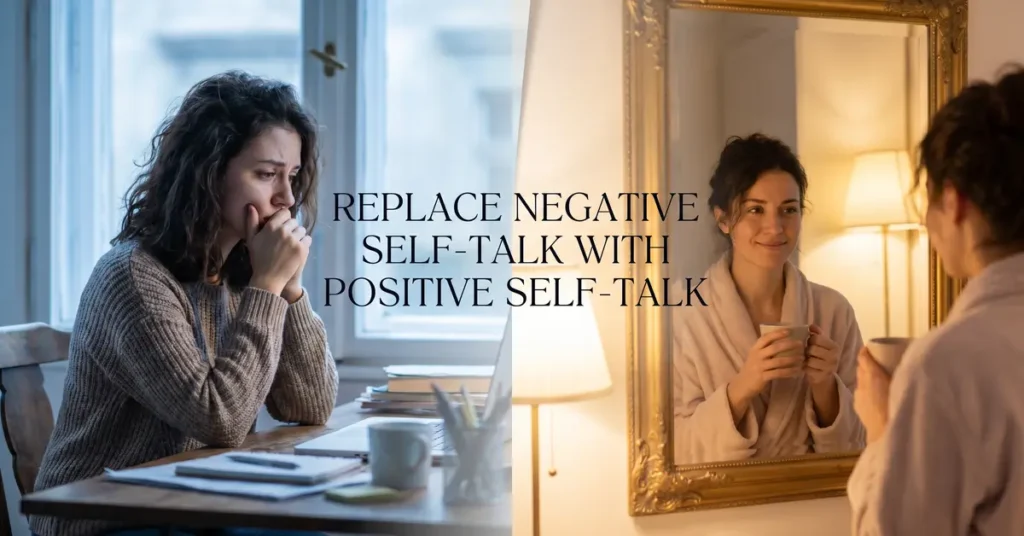
Spend one full day paying attention to how you talk to yourself. You will catch a lot of negative self-talk that you no longer even notice because it has become so normal.
Replacing negative self-talk with positive self-talk is not about pretending everything is fine. It is about interrupting thought patterns that quietly destroy your self-confidence. When the harsh inner voice starts, gently ask yourself: Is this actually true?
Even saying “I am doing my best today” is enough to start shifting things.
“You are not saying it because it is already true in your heart. You are saying it to teach your brain a new way of thinking.”
On Positive Self-Talk5. Journal to Build Emotional Awareness
Journaling is one of the most powerful tools for self-discovery. When you write what you feel without editing yourself, you understand your emotional needs in a way that is hard to access any other way.
It also helps with emotional regulation. Getting your anxiety and stress out on paper takes away some of its power. You see it clearly, rather than feeling buried by it.
Even five minutes of honest writing a day builds emotional awareness over time. You start noticing your patterns, your triggers, and what actually brings you peace.
6. Use Affirmations For Self-Love to Build Internal Validation
For most of your life, you have probably looked for external validation. You waited for someone else to tell you that you were enough. Affirmations help you build that source of validation inside yourself instead.
They feel strange at first. Saying “I am worthy of love and good things” when you do not fully believe it yet feels almost silly. But you are not saying it because it is already true in your heart. You are saying it to teach your brain a new way of thinking.
The key is quiet consistency. Say your affirmations daily. Over weeks and months, you will notice your thought patterns beginning to shift.
7. Stop Comparing Yourself to Other Women
Comparison is one of the most common forms of self-sabotage. It is also hard to avoid when you scroll through other women’s highlight reels every single day.
Here is what comparison is really doing. It tells you that someone else’s life is the standard against which yours should be measured. It is not. You are on a completely different path with a completely different story.
Letting go of comparison is a core part of building self-acceptance. You stop measuring yourself against everyone else and start measuring yourself against who you were yesterday.
8. Prioritize Rest as an Act of Self-Love
Rest is not laziness. It is a biological need and, more importantly, an act of self-love. When you rest without guilt, you acknowledge that you are a human being, not a machine.
Many women push themselves to the point of exhaustion trying to do everything. They run on stress until burnout forces them to stop. Rest is self-love: choosing to slow down before you crash.
This is also part of slow living. Life does not always have to be rushed. You are allowed to be still sometimes. That is not giving up. That is taking care of.

9. Move Your Body in a Way That Feels Good
Your relationship with your body is a big part of how you feel about yourself. When movement comes from shame rather than care, it ceases to be self-love entirely.
Find movement that makes you feel good in your body. Walk somewhere beautiful. Dance around your kitchen. Stretch in the morning just because it feels nice.
When you move your body as a form of care rather than punishment, it quietly improves your self-confidence. It also deepens your sense of connection to yourself.
10. Make Your Relationships Intentional
Intentional living means making choices deliberately instead of just going along with whatever happens. One of the most important places to practice this is in your relationships.
Some people make you feel seen. Some people make you feel small. The energy you absorb from the people around you has a real effect on your emotional health and sense of self-worth.
You do not have to make big, dramatic changes. Just start being more intentional. Spend more time with people who lift you and gently pull back from those who drain you.
11. Celebrate Who You Are, Not Just What You Do
One of the quietest traps women fall into is tying all their self-esteem to what they achieve. When things go well, they feel great. When they do not, their whole sense of worth crashes.
This is why your identity outside of achievement matters so much. You are not only valuable because of what you produce. You are valuable because of who you are. Your kindness, your resilience, your ability to love people well. These things matter.
Celebrate the small wins, too. The hard conversations you had. The days you got through, even when they were rough.
12. Practice Simple Mindfulness Every Day
Mindfulness practice does not have to mean sitting cross-legged for an hour. It just means slowing down enough to be present in your own life instead of always rushing past it.
Even five minutes of quiet in the morning counts. One mindful cup of tea where you actually taste it and sit with it counts. These small moments of stillness build your capacity for emotional regulation. They help you respond to life instead of just reacting to it.
In addition, a simple mindfulness practice builds self-trust over time. When you slow down and listen to yourself regularly, you start to trust what you hear.
13. Stop Apologizing for Your Needs
Notice how often you say sorry. Sorry for having a need. Sorry for speaking up. Sorry for asking for something. Sorry for existing in someone else’s space.
This habit is deeply connected to self-respect. When you constantly apologize for yourself, you quietly teach yourself that you are a burden. That your needs are too much. You are not a burden.
Your needs are valid. Letting go of the constant apologizing is one of the most freeing things you can do for yourself.
14. Practice Inward Gratitude Every Day
Gratitude is well known for improving emotional well-being. But most people focus it outward, on circumstances and things and other people. Try turning it inward, too.
Be grateful for your courage. For your softness. For the way you keep showing up even when it is hard. For the parts of you that love deeply and care genuinely.
This kind of gratitude builds self-acceptance. It teaches you to look at yourself and find things worth appreciating, not just things that need fixing.
15. Learn to Receive Love Without Deflecting It
Many women are very good at loving others and very uncomfortable receiving love themselves. When someone compliments you, do you immediately deflect it?
Learning to receive love is a real part of improving self-love. It means believing you are worthy of care and kindness, not just responsible for giving it. It means letting people in instead of keeping the wall up.
Self-trust plays a big role here, too. When you know your own values and your own worth, it becomes easier to let good things in without waiting for them to disappear.
“Learning to receive love means believing you are worthy of care and kindness, not just responsible for giving it.”
On Receiving LoveThe Quiet Truth About Self-Love
Self-love is not something you figure out once and keep forever. You build it through quiet consistency. Small choices, made again and again, that say, “I matter.” I am worth this. I am enough.
Some days you will feel really at peace with who you are. Other days, perfectionism will creep back in, or anxiety will make everything feel harder, or the inner critic will get loud again. All of that is part of it.
What matters is that you keep coming back to yourself. That is how to improve self-love. That is the real thing. And you, exactly as you are right now, are more than worth it.
Frequently Asked Question
What is the difference between self-love and self-esteem?
Self-esteem is how you feel about yourself based on what you do and how well you do it. Self-love goes deeper. It is the unconditional belief that you have worth simply because you exist. Self-love stays steady even when your self-esteem takes a hit.
How do I improve self-love after a breakup or divorce?
Start by permitting yourself to grieve. Then, slowly and gently, begin rediscovering who you are outside that relationship. This is where real self-discovery happens. You find out what you like, what you want, and who you are when nobody else is defining you.
What is the connection between self-love and boundaries?
Boundaries are one of the most practical expressions of self-love. When you hold a boundary, you show yourself that your emotional needs matter and that your inner peace is worth protecting. Without self-love, boundaries are almost impossible to hold.
Why do affirmations help with self-love?
Affirmations work by slowly replacing old thought patterns with new ones. When you have spent years relying on external validation to feel good about yourself, affirmations help you build internal validation instead. Your brain learns what it hears most often.
How do I start practicing self-love when I feel really low?
Start with the smallest possible thing. One act of self-care. Be one kind thought about yourself—one moment of stillness. You do not need to do everything at once. You just need one small choice that says you matter.

Mehwish Arshad is the founder of Grow With Meh, a personal growth platform that helps women build self-awareness, emotional resilience, and a deeper understanding of themselves. For over 10 years, she has studied psychology, mindfulness, and personal development through extensive reading, research, and lived experience.