
Definition:
Self-love affirmations are short, positive statements in the present tense that you repeat to yourself to build a healthier relationship with who you are. It is a tool for replacing harsh inner talk with something kinder and truer. Things like “I am enough,” “I deserve to take up space,” or “I am worthy of good things.” These positive affirmations strengthen the kind, gentle voice inside you. The one that gets drowned out by years of self-criticism, comparison, and not feeling like enough.
You have probably heard that you should love yourself. But nobody really tells you what that looks like on a hard Tuesday morning when you are staring at the mirror and picking yourself apart. That gap, right there, is exactly where self-love affirmations come in.
I know because I lived in that gap for a long time. I would try to say something kind to myself, and my brain would immediately argue back. Not because I was broken. Because nobody had ever taught me how actually to do this.
This post is what I wish I had found back then. You will find out what self-love affirmations actually do, why your brain needs them, and 78 affirmations you can start using today. Whether you are dealing with low self-esteem, healing from something hard, or just tired of being your own worst critic, this is for you.
Table of Contents
Start Here: The Bridge Thought
Before you can use a self-love affirmation that feels true, you need something called a bridge thought.
A bridge thought is a statement that is honest, gentle, and actually believable to you right now. It is not the destination. It is the first small step toward it.
Instead of “I am beautiful and worthy,” you try “I am learning to be kinder to myself.” Instead of “I love everything about who I am,” you try “I am willing to see myself more gently today.”
Your brain can accept those. And that acceptance is where real change begins.
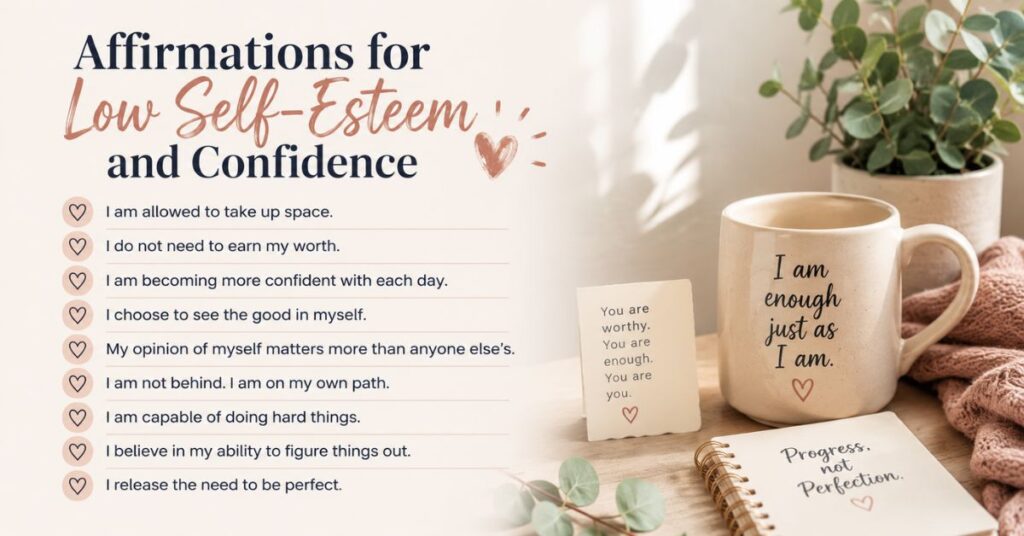
Affirmations for Low Self-Esteem and Confidence
If you have spent a long time not feeling good enough, start here. These affirmations are grounded and honest. They meet you where you are, without asking you to fake a feeling you do not yet have.
Say them slowly. Let them settle for a second after each one.
- I am allowed to take up space.
- I do not need to earn my worth.
- I am becoming more confident with each day.
- I choose to see the good in myself.
- My opinion of myself matters more than anyone else’s.
- I am not behind. I am on my own path.
- I am capable of doing hard things.
- I believe in my ability to figure things out.
- I release the need to be perfect.
- I am proud of how far I have come.
- I have flaws, and they do not make me less worthy.
- I am enough, exactly as I am right now.
- I forgive myself for the times I was not kind to myself.
- I am allowed to start again.
- Confidence grows every time I choose myself.
Affirmations for Self-Love & Healing
Healing is not one moment. It is a thousand small moments of choosing yourself again after something hurt you.
Whether you are healing from a painful relationship, a hard chapter, a loss, or years of not feeling good enough, these are for you. They do not ask you to pretend you are already okay. They just ask you to keep going.
- I am healing, even when it does not feel like it.
- I am gentle with myself during hard seasons.
- My pain does not define who I am.
- I am allowed to feel what I feel without shame.
- I give myself permission to rest and recover.
- I release what no longer serves my growth.
- I am worthy of love, especially from myself.
- My past does not decide my future.
- I am building a safe and kind relationship with myself.
- I trust my body and my feelings.
- I am not broken. I am in the middle of becoming.
- I choose to nourish my mind, body, and heart.
- I am at peace with where I am right now.
- I deserve the same compassion I give to others.
- I am coming home to myself, one day at a time.
If you want to go deeper into self-love and what it really looks like to come home to yourself, I wrote a whole ebook about exactly that. You can find it right here.
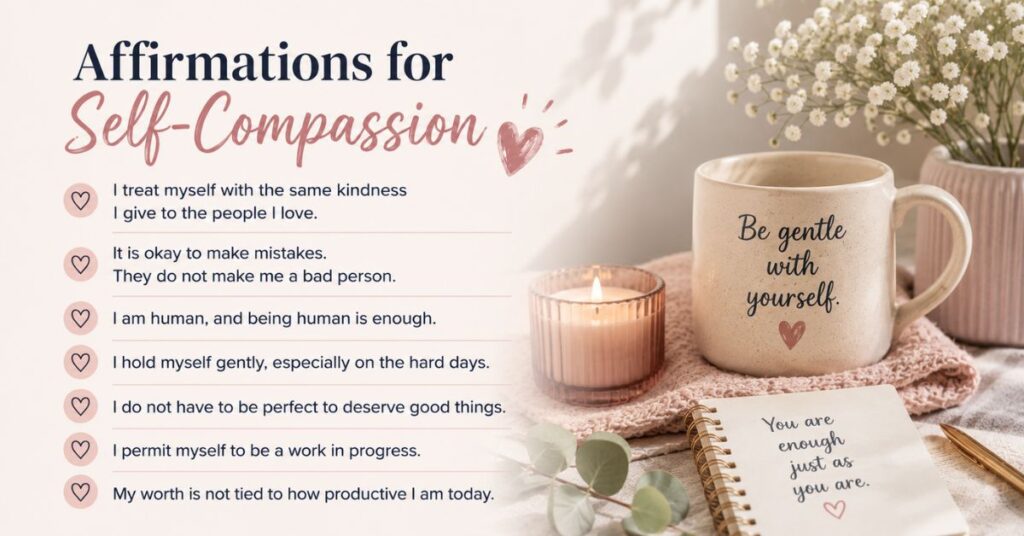
Affirmations for Self-Compassion
Self-compassion is not weakness. It is one of the bravest things you can practice, especially if you grew up believing that being hard on yourself was the only way to grow.
Dr. Kristin Neff’s research shows that self-compassion actually makes you more resilient, not less. It is the foundation that lets you get back up faster. These affirmations help you treat yourself with the same warmth you would offer someone you truly love.
- I treat myself with the same kindness I give to the people I love.
- It is okay to make mistakes. They do not make me a bad person.
- I am human, and being human is enough.
- I hold myself gently, especially on the hard days.
- I do not have to be perfect to deserve good things.
- I permit myself to be a work in progress.
- My worth is not tied to how productive I am today.
- I speak to myself the way I would speak to a younger version of me.
- I am deserving of patience, especially from myself.
- I soften toward myself instead of pushing harder.
Affirmations for Women Who Are Too Hard on Themselves
This one is personal for me. If you are the kind of woman who holds herself to an impossible standard, who replays every mistake, who doesn’t forgive herself for her past mistakes, and who gives everyone else grace but forgets to give it to herself, these are for you specifically.
- I am doing better than I give myself credit for.
- I am not the worst version of myself that I sometimes imagine.
- I am kind, capable, and worthy of rest.
- I let go of the pressure to have everything figured out.
- I celebrate small wins because they are real wins.
- I am allowed to say no and still be a good person.
- I trust myself to handle what comes next.
- I do not have to earn my place. I belong here.
- I am proud of the woman I am growing into.
- I am loved, and I am lovable.
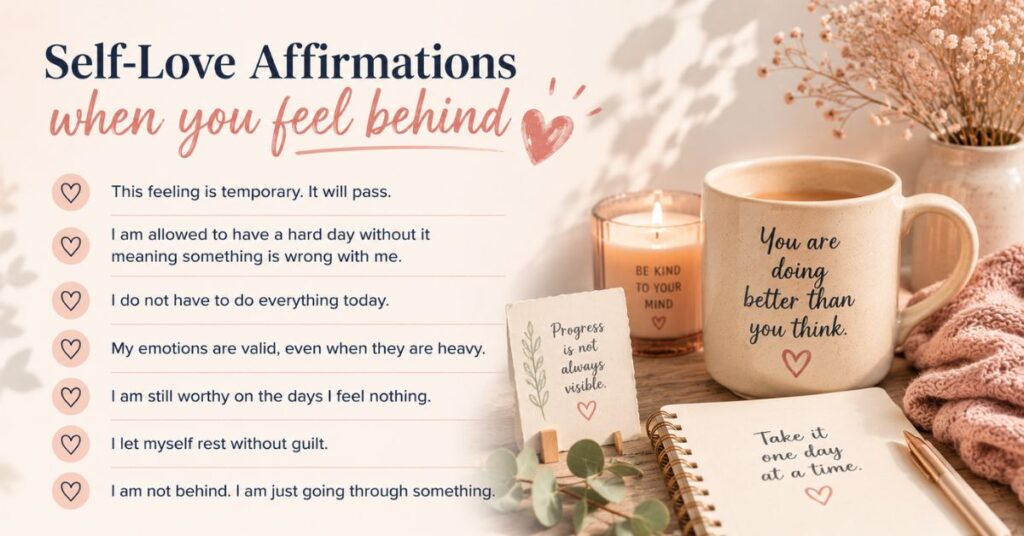
When You Feel Emotionally Low or Behind in Life
Some days you wake up, and the heaviness is just there. No reason. No warning. On those days, you do not need a pep talk. You need permission.
These affirmations are not about forcing yourself to feel better. They are meant to remind you that this moment is not forever.
- This feeling is temporary. It will pass.
- I am allowed to have a hard day without it meaning something is wrong with me.
- I do not have to do everything today.
- My emotions are valid, even when they are heavy.
- I am still worthy on the days I feel nothing.
- I let myself rest without guilt.
- I am not behind. I am just going through something.
- Even on my worst days, I deserve gentleness.
- I have survived hard days before, and I will survive this one too.
- I am more than my bad days.
When You Are Comparing Yourself to Others
Comparison is one of the quietest ways self-worth gets chipped away. You scroll through someone’s life and suddenly your own looks smaller. Your wins feel less real. Your progress feels slow.
But you are seeing their highlight reel and living your full story. Those two things are not comparable at all.
- My journey is not in competition with anyone else’s.
- What is meant for me will not pass me by.
- I celebrate others without shrinking myself.
- Someone else’s success does not take anything away from mine.
- I am exactly where I need to be right now.
- I focus on my own growth, not someone else’s timeline.
- I do not need to compare my chapter one to someone’s chapter ten.
- My life is unfolding in its own way.
- I choose to be inspired by others, not threatened by them.
- I have my own gifts. They matter.
For Setting Boundaries and Inner Peace
A lot of women find boundaries terrifying because somewhere along the way, they learned that saying no meant they were difficult, selfish, or unkind. They were taught that love means always saying yes.
But a boundary is not a wall. It is a statement of what you need to feel safe and okay. It is one of the most loving things you can do, for yourself and for the people around you.
- I am allowed to protect my peace without having to explain myself in detail.
- Saying no is a complete sentence.
- I can love someone and still say no to them.
- Their discomfort with my boundary is not proof that I am wrong.
- I release the need to control what I cannot control.
- I return to myself after every storm. That is my anchor.
- Not everything needs my energy. I get to choose where I pour myself.
- Peace is not something I find outside myself. It is something I return to within myself.
Roy Baumeister and colleagues published a paper titled “Bad Is Stronger Than Good” (2001) in the Review of General Psychology. It found that negative events, bad feedback, and harmful interactions have a greater impact on a person’s mental state than equally positive ones. This is the scientific backbone of the negativity bias.
Benefits of Self-Love Affirmations
You might wonder if saying words to yourself can really make a difference. The answer is yes. Here are the benefits of self-love affirmations in real life.
- You start catching your negative thoughts faster. Once you practice choosing better thoughts, you notice when your inner critic is being unfair.
- Your confidence builds slowly but steadily. You stop waiting for outside approval because you start giving it to yourself.
- You feel calmer in your own skin. Affirmations help settle your nervous system when anxiety kicks in.
- You treat yourself with more kindness. The way you speak to yourself internally starts to shift, changing how you feel day to day.
- You heal old wounds more gently. For women recovering from heartbreak, trauma, or long periods of feeling not enough, affirmations are a soft but powerful tool in the healing process.
- You build a more secure sense of self-worth. Not the kind that depends on how you look or what you achieve. The kind that is just there, steady and quiet.
Daily Self-Love Affirmation Routine
Most people read a list of affirmations, think “that’s nice,” and move on. That is why affirmations get a bad reputation. They do not work if you just scroll past them. They work when you use them with a little bit of intention.
Here are some simple ways to make them a real part of your life.
- Say them out loud. Reading them in your head helps, but speaking them out loud is more powerful. Your body hears it differently when the words actually leave your mouth.
- Use a mirror. It feels awkward at first. But looking at yourself while saying an affirmation is one of the most effective ways to let it actually land.
- Do it in the morning. Your brain is most open right after waking up. Starting your day with a few affirmations sets a softer tone before the day’s noise begins.
- Add a physical anchor. Put your hand on your heart when you say your affirmation. Take one slow breath first. Your body holds beliefs differently from your mind does. Grounding the words into something physical makes them settle faster.
- Write them somewhere visible. A sticky note on your bathroom mirror. A reminder on your phone. The notes app you open every morning. Visual repetition matters just as much as verbal repetition.
- Pick 3 to 5 that feel real to you. Do not overwhelm yourself with a list of fifty. Choose a few that feel both true and a little tender. Those are the ones that need the most attention.
- Be patient with the process. You will not believe them fully on day one. That is normal. Keep going anyway.
A Gentle Reminder Before You Go
Loving yourself is not a destination you arrive at one day. It is a practice you return to, again and again, even after you forget, even after a bad week, even after you say something unkind to yourself and catch it too late. The fact that you are here, looking for a softer way to talk to yourself, means something. It means you are already on the path.
Pick one affirmation from this list. Just one. Say it out loud tonight. Not because it will fix everything, but because you deserve to hear something kind, and right now, that voice has to be yours. That is where it all begins.
Frequently Asked Questions
How long does it take for self-love affirmations to work?
Most people notice small shifts in their thinking within 2 to 4 weeks of consistent practice. Full belief in an affirmation can take longer, especially if you are working through deep-rooted self-esteem issues. The key is repetition and patience. Think of it like building a muscle. You do not see results after one workout, but you keep going anyway.
What is the best time to say self-love affirmations?
Morning is the most powerful time because your mind is fresh and more open to new thoughts. You can also use affirmations before bed to end the day on a gentler note. Some women find it helpful to use them during stressful moments, such as before a hard conversation or during anxiety. There is no wrong time. The best time is whatever time you will actually do it.
Do self-love affirmations really work for low self-esteem?
Yes, with an important note. Affirmations work best when they feel at least a little believable. For very low self-esteem, start with gentler affirmations, such as “I am learning to be kind to myself,” rather than jumping to “I am completely confident.” Meeting yourself where you are makes the practice more effective and less frustrating.
How many affirmations should I use at once?
Three to five is a good number to start with. Choosing fewer affirmations means you give each one more attention and repetition. Pick the ones that feel most relevant to what you are working through right now. You can always swap them out as you grow and your needs change.
Should I say affirmations out loud or in my head?
Both work, but saying them out loud is generally more powerful. When you speak words, your brain processes them both as thought and as sound. That dual experience makes them feel more real and helps them sink in deeper. If speaking out loud feels uncomfortable, start with a whisper. Work your way up to saying them to yourself in a mirror.
Can self-love affirmations help with anxiety?
Affirmations can help calm anxious thoughts by giving your mind something grounded and safe to return to. They are not a substitute for therapy or professional support, but they are a useful daily tool. Affirmations like “I am safe right now” or “I can handle what comes my way” can help slow down a racing mind during stressful moments.

Mehwish Arshad is the founder of Grow With Meh, a personal growth platform that helps women build self-awareness, emotional resilience, and a deeper understanding of themselves. For over 10 years, she has studied psychology, mindfulness, and personal development through extensive reading, research, and lived experience.