
There is a moment most women recognize instantly. Someone gives you a compliment, and instead of just receiving it, you immediately wonder if they actually meant it. Or you make a decision that feels completely right, then spend the next three days quietly waiting for someone else to confirm it was okay.
That is not a confidence problem. That is a validation habit. And it runs deeper than most people realize.
When your sense of worth is quietly outsourced to the opinions, reactions, and approval of others, you are not really living your life. You are performing it. You are editing yourself in real time based on what you think people want to see, and that kind of editing is exhausting.
Here is what nobody tells you about seeking external validation: it never actually fills the gap it is trying to fill. You can collect approval all day long and still go to bed feeling unsettled. That is because the need for validation is not about information. It is about trust. Specifically, the trust you have not yet built with yourself.
Learning how to stop seeking validation from others is not about becoming cold or indifferent to feedback. It is about building an inner reference point that is stable enough that you do not collapse the moment someone withholds their approval or offers a lukewarm response.
This article breaks down exactly how that shift happens, what are the signs in particular, and what practical steps actually move the needle.
Key Takeaways: How to Stop Seeking Validation from Others
- Seeking validation from others is a learned habit, often shaped by childhood and social conditioning.
- Your brain is wired to seek approval because validation triggers dopamine, making it feel rewarding.
- Common signs of validation seeking include people-pleasing, over-explaining, and needing reassurance.
- Fear of rejection and low self-worth are the main drivers behind approval-seeking behavior.
- The first step to stop seeking validation from others is simply noticing the pattern without judgment.
- Building self-trust helps reduce dependence on other people’s opinions over time.
- Knowing your personal values makes it easier to make decisions without outside approval.
- Learning to sit with discomfort is essential for building real confidence and independence.
- Setting small boundaries helps break people-pleasing habits and strengthens self-respect.
- The goal is not to stop caring completely, but to trust your own voice more than others’ opinions.
Why Women Fall Into the External Validation Trap?
It Starts Early
Most women are not taught to trust themselves from a young age. Instead, they are praised for being agreeable, quiet, and helpful. When you grow up hearing “good girl” every time you fit into what others expect of you, your brain starts to associate others’ approval with feeling safe and loved. This is childhood conditioning at work, and it runs deep.
The brain actually releases dopamine, a feel-good chemical, when you receive a compliment or a thumbs-up. Over time, you start to crave that feeling. This is why approval seeking can act like an addiction. The relief you feel when someone validates you is real, but it fades fast, so you need to go looking for more.
Anxious Attachment Plays a Role
If you grew up in an environment where love felt unpredictable or conditional, you may have developed an anxious attachment style. This means you learned to read other people’s moods very carefully to keep yourself emotionally safe. Seeking validation became a survival skill, not a character flaw.
Feminine conditioning also adds pressure. Society often tells women that their worth lies in how others see them. Whether it is their body, their choices, their career, or their relationships, the message is clear: get other people’s approval or feel less than. That message shapes how women relate to their own sense of self.
Fear of Rejection Keeps It Going
The deeper fear underlying approval-seeking is usually rejection or abandonment. You worry that if you stop performing for people, they will leave, judge you, or stop loving you. So you keep trying to earn their approval, even when it costs you your peace.
Imposter syndrome also feeds this cycle. When you do not feel sure of your own value, you naturally look outside yourself for proof that you are good enough. The result is a pattern in which your confidence depends on what others think, rather than on what you actually know to be true about yourself.
You were never meant to outsource your worth to other people.
Grow With MehSigns You Are Seeking External Approval Without Realizing It
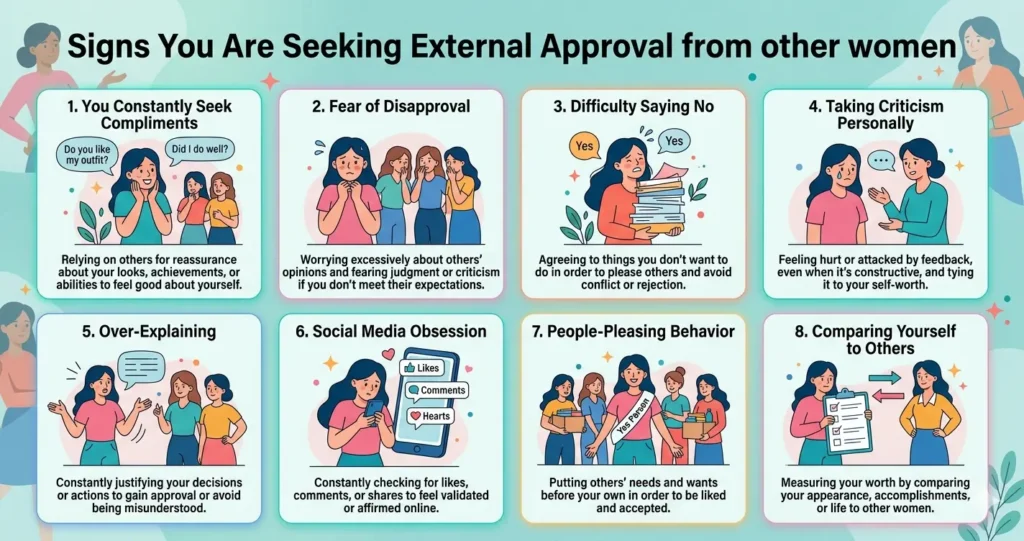
Validation seeking does not always look obvious. Sometimes it hides inside habits that seem totally normal. Here are some quiet signs worth noticing.
1. Over-Explaining
You feel the need to justify what you did, even when no one asked. Whether it is what you ordered for lunch or why you turned down a plan, you add extra reasons to make sure no one thinks badly of you. That urge to explain is often less about being clear and more about managing what people think of you.
2. Changing Your Mind Fast
You have an opinion, a clear one, until someone disagrees. Then suddenly you are not so sure. You soften your words, backtrack, or agree with them just to avoid the tension. This is not open-mindedness. It is approval-seeking, wearing the mask of being easy to get along with.
3. Checking Reactions Constantly
You share something online and then spend the next hour refreshing to see who liked it, who commented, and how people responded. The way you feel about what you posted changes based on the reaction it gets. If that sounds familiar, the likes are doing emotional work that belongs to their own self-worth.
4. Saying Yes When You Mean No
You agree to things that drain you, take up your time, or go against what you actually want, because saying no feels too risky. You worry people will think you are selfish, difficult, or unkind. So you keep saying yes and quietly resenting it later. That pattern is people-pleasing, and it is exhausting.
5. Comparing Yourself Often
You scroll through someone’s life and immediately measure yours against it. Her career, her relationship, her body, her choices. You use other people as the measuring stick for whether you are doing well enough. Social comparison drains your sense of self because there is always someone whose highlight reel looks better than your real life.
6. Hiding Parts of Yourself
You tone down your personality, opinions, humor, or struggles depending on who you are with. You have a version of yourself you show to people you want to impress and a more real version you keep mostly hidden. That gap between who you perform and who you actually are is one of the clearest signs of approval seeking.
7. Anxious About Others’ Reactions
The moment you sense that someone might be annoyed or disappointed in you, your whole mood shifts. You replay the conversation, wonder what you did wrong, and feel an urgent need to fix it or smooth things over. Even if you did nothing wrong. That anxiety lives in the belief that other people’s feelings about you determine your safety and your worth.
8. Fishing for Compliments
You say things like “I am not sure if this is any good” or “This probably sounds silly, but” before sharing something, hoping someone will reassure you. You downplay your work or ideas so someone else can take the credit. This habit feels like humility, but it is actually a quiet way of asking for external validation.
9. Needing Approval to Decide
You know what you want, but you still text three people before committing. You need someone to confirm that your choice is the right one before you feel settled. When you cannot trust your own judgment without outside input, it is a sign that your inner approval system needs some rebuilding.
10. Taking Criticism Personally
When someone gives you feedback, even gentle and constructive feedback, it feels like a comment on your worth as a person rather than on the task. You spiral, feel defensive, or replay it for days. This happens because your sense of self is tied too tightly to other people’s assessments, which makes every critique feel like rejection.
If you saw yourself in even two or three of those, take a breath. Self-awareness is the first step. You cannot change what you have not yet noticed.
How to Build an Internal Approval System
Internal validation means you become your own primary source of reassurance. It does not mean you stop caring entirely what people think. It means their opinion no longer decides how you feel about yourself. Here is how to build that.
1. Notice When You Look Outside Yourself
Start paying attention to the moments when you reach for someone else’s approval. You do not have to fix anything right away. Simply noticing the pattern, without judging yourself for it, already starts to loosen its grip on you.
Try keeping a small journal to record moments when you sought external validation and what triggered them. Over time, you will start to see the same situations come up. That pattern is useful information about where you need to build more trust in yourself.
2. Get Clear on Your Own Values
Approval-seeking thrives when you lack a strong sense of your own values. When you do not know what matters to you, you borrow other people’s standards to judge yourself by. Start asking yourself simple questions like “What do I actually think about this?” What would I choose if no one were watching?
Write your core values down. They do not have to be fancy. Words like honesty, kindness, rest, and creativity work just fine. When you have something concrete to come back to, other people’s opinions carry less weight.
3. Practice Giving Yourself the Approval You Seek
When you finish something and feel the urge to share it for validation, try pausing first. Ask yourself: Do I feel good about this? What do I think of it? This is not about being arrogant. It is about being your own witness before you go looking for one outside.
Self-compassion is a core part of this. Treat yourself the way you would treat a good friend. If you would offer her kindness after a mistake, you deserve the same from yourself. That inner voice matters more than you may realize.
4. Sit With Discomfort Instead of Running From It
A lot of validation seeking is really about avoiding discomfort. You want reassurance because the uncertainty of not knowing what others think feels unbearable. Learning to sit with that discomfort, even for a few minutes, is one of the most powerful ways you can support your emotional growth.
Try delaying the reach for reassurance. Post something and close the app. Make a decision and let it stand without checking if everyone agrees. Each time you do this, you prove to yourself that you can handle not knowing, and that is where real confidence begins to grow.
5. Set Small Boundaries and Watch What Happens
People pleasers often believe that saying no will ruin relationships. But boundaries do not push good people away. They actually create more honest, respectful connections. Start with a small no, something low stakes, and notice that most of the time, you find your purpose in life.
Each time you hold a boundary, you send yourself the message that your needs matter. That message, repeated often enough, starts to become something you actually believe.
6. Reduce Social Comparison Habits
Social comparison is one of the fastest ways to drain your self-esteem. When you constantly measure your life against what you see on social media or in other women’s choices, you will always find a reason to feel less than. Remember that you are seeing a highlight reel, not a full story.
Try a comparison detox for one week. Every time you catch yourself comparing, redirect your attention to something you appreciate about your own life or progress. This is not toxic positivity. It is a real practice of returning to your own lane.

A Compassionate Place to Start
If this feels heavy, that is okay. The self worth content on growwithmeh.com walks you through this gently, without pressure or perfection.
Read MoreBottom Line: You Are Enough Without the Proof
Seeking validation is not something to feel ashamed of. It is something to understand. Now that you see where it comes from and what it looks like, you can start making different choices. Not perfectly. Not all at once. But steadily, one moment of self-trust at a time.
Your worth is not a number decided by other people’s responses. It is something you already carry with you. This work is about clearing away the noise so you can finally hear it.
Start small. Be patient with yourself. And know that every time you choose your own approval over someone else’s, you are building a foundation that no one can take from you.
Frequently Asked Questions
-
Why do I keep seeking validation even when I know I should not?
Your brain is wired to seek social approval. It releases dopamine when others validate you, which makes the behaviour feel rewarding and hard to stop.
On top of that, childhood conditioning and cultural messaging around women’s worth can make external approval feel necessary for safety. This is not a willpower problem. It is a deeply learned habit that takes consistent, gentle practice to change. -
What is the difference between wanting feedback and seeking validation?
Wanting feedback is about getting useful information to improve something. Validation seeking is about getting emotional reassurance to feel good enough. The key difference is what happens when you do not get it. If you feel okay either way, that is healthy curiosity. If the absence of approval leaves you anxious, deflated, or unsure of yourself, that points to validation seeking.
-
Can you ever fully stop seeking other people’s approval?
Not entirely, and that is actually normal. Humans are social creatures, and caring about what others think is part of how we stay connected. The goal is not to stop caring completely. The goal is to make your own opinion the loudest voice in the room, so other people’s approval becomes something you enjoy but no longer depend on for your sense of worth.
-
How does low self-worth connect to validation seeking?
When your self-worth is low, you do not trust your own judgment about your own value. So you borrow other people’s opinions to fill that gap. The more you depend on outside approval, the less you practice trusting yourself, which keeps your self-worth low. It is a cycle. Building inner confidence is the way to break it, and it starts with small acts of self-trust repeated over time.
-
Is seeking validation on social media the same thing?
Yes. Posting to get reassurance, anxiously checking likes, or shaping your content around what will get the most approval are all forms of external validation-seeking. Social media is designed to feed this loop. You can still enjoy sharing your life online. The shift happens when you post because you want to, not because you need the response to feel good about yourself or your choices.
-
What is the first step to stop seeking approval from others?
The first step is simply noticing when you do it, without shame. Awareness breaks the automatic cycle. Once you can catch yourself in the moment of reaching for someone else’s approval, you create a small pause. In that pause, you get to choose a different response. That pause is where everything begins to shift.

Mehwish Arshad is the founder of Grow With Meh, a personal growth platform that helps women build self-awareness, emotional resilience, and a deeper understanding of themselves. For over 10 years, she has studied psychology, mindfulness, and personal development through extensive reading, research, and lived experience.

Pingback: How to Get Out of a Toxic Relationship Before It Breaks You