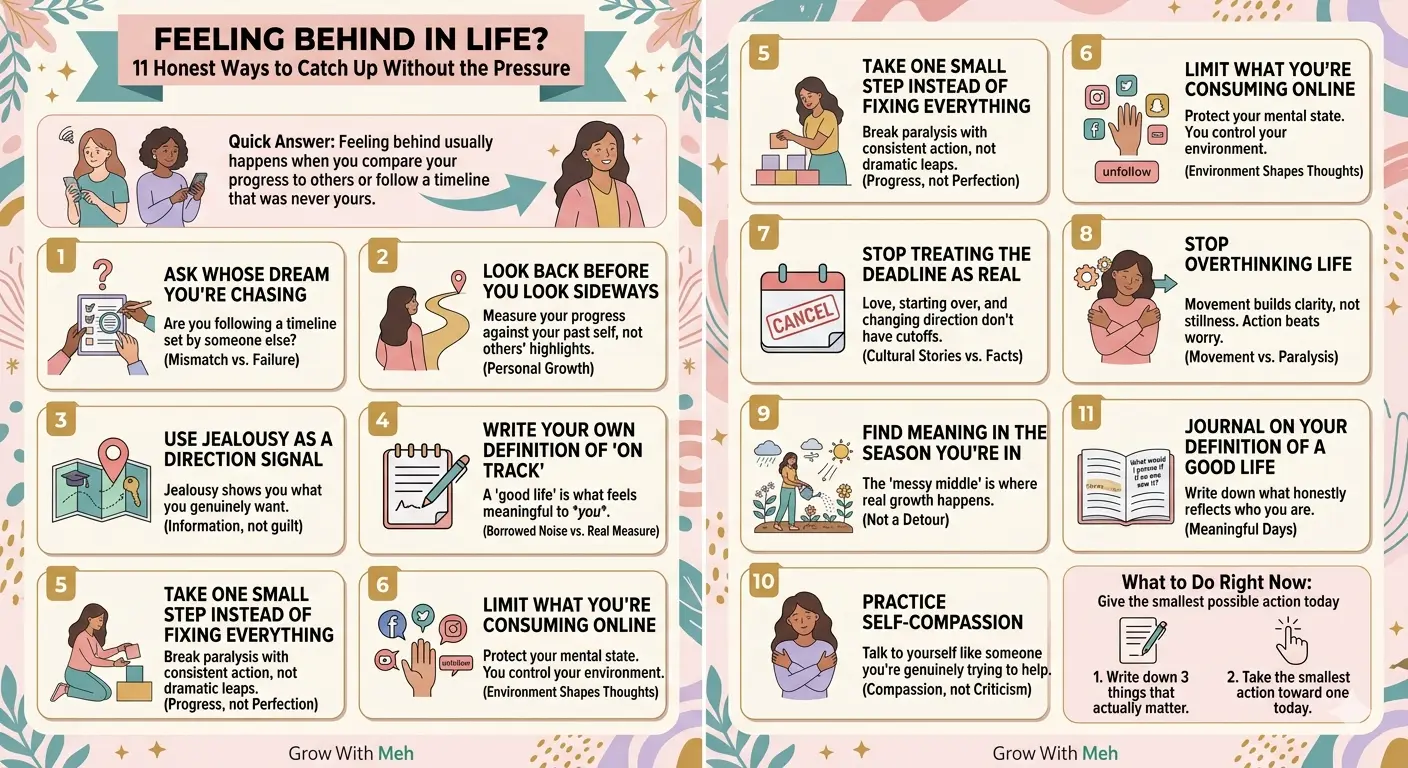
Feeling behind in life usually happens when you compare your progress to others or follow a timeline that was never yours. The truth is, there is no fixed schedule for success. Everyone moves at a different pace. When you focus on your own path and take small, honest steps forward, that heavy feeling starts to lift.
You open your phone. Someone your age just got promoted. Another one is buying a house. A girl from your hometown is pregnant with her second child. And you are sitting there, still trying to figure out how to get your life together, quietly wondering why everyone else seems to have already figured it out.
If you have felt this way, you are not alone. And you are not as far behind as you think.
In this article, I am going to talk about why so many women feel like they are falling behind in life, what the research actually says about it, and 11 honest ways to stop feeling behind in life without pretending the pressure does not exist.
Table of Contents
What Does “Feeling Behind in Life” Actually Mean?
Feeling behind in life is not about where you actually are. It is about where you think you should be by now.
It shows up differently for every woman. For some, it is career pressure, watching others get promoted while they feel stuck in the same place. For others, it is relationship milestones, wondering why everyone else seems settled while they are still figuring things out.
Feeling behind in life is a comparison-based feeling, not a fact. There is no universal scoreboard. There is no finish line. There is just a story you absorbed about how life is supposed to go, and the gap between that story and your reality.
Why Do We Feel Behind in Life?
Your Brain Was Built to Compare
One of the major reasons is that we compare ourselves to others. And it’s very natural and common. We compare our progress, our life events, and our journey to others’. We’ve always done that. It’s not a character flaw; it’s wired in.
In 1954, psychologist Leon Festinger’s social comparison theory found that people naturally compare their own abilities and opinions with those of others, especially when there is no clear, objective way to evaluate themselves.
However, social media plays a major role, making this comparison constant and relentless. Research suggests that as much as 10 percent of our daily thoughts involve comparisons.
A 2024 study on young women found that frequent passive social media use is directly linked to higher levels of psychological anxiety.
The Social Clock
In the 1960s, psychologist Bernice Neugarten introduced the concept of the social clock. The social clock is the culturally agreed-upon schedule for major life events, like when to start a career, when to marry, and when to have kids.
And this social clock exerts invisible pressure, making us feel “on time” or “late” based on how we measure up to external markers. For women, this pressure tends to hit harder and earlier.
A Cambridge University review found that women are almost twice as likely to experience anxiety as men. Part of that gap comes from the extra layer of social pressure women carry around life milestones, from marriage to motherhood to career status.
Milestone Anxiety
There is a specific kind of stress called milestone anxiety. It hits when you feel like you have not reached the checkpoints you were “supposed” to hit on schedule. First job, marriage, a house, financial independence. When these things do not happen at the “right” time, your mind reads it as a sign of falling behind in life.
But these checkpoints were not set by you. They were inherited. And inheriting a checklist does not obligate you to live by it.
Overthinking Life
Overthinking life is one of the fastest ways to turn a passing feeling into a permanent identity. You wake up a little anxious, start replaying every choice you have made over the past five years, and by lunchtime, you have convinced yourself you’ve failed.
Anxiety about life progress feeds on rumination. The more you turn the thoughts over, the bigger and more permanent they feel. And the more permanent they feel, the harder it is to take any kind of action. This is one of the most common ways feeling stuck in life becomes truly sticky.
What Are the Effects of Constant Comparison?
Feeling lost in life because of ongoing comparison does not just feel bad. It actively gets in the way of living.
- It lowers self-esteem
- Increases anxiety and depression
- Make small wins invisible
- Keep you living someone else’s story
Research shows that upward social comparison, comparing yourself to someone who appears to be doing better, is consistently linked to lower self-esteem and higher rates of anxiety and depression.
Moreover, a meta-analysis of 98 studies covering over 102,000 participants found that problematic social media use is linked to lower well-being and poorer sleep, and that women report higher rates of social comparison and more negative outcomes from that comparison than men.
How You Can Stop Feeling Behind In Life
1. Ask Whose Dream You Are Actually Chasing
The first honest question is not “why am I so far behind?” It is “behind what, exactly?”
Behind a timeline someone else set for you? Behind a version of success you saw in a magazine at sixteen? Behind a checklist you inherited but never actually chose.
When you get clear about whose goals you have been carrying, the pressure starts to feel less like personal failure and more like a mismatch. And a mismatch is something you can actually work with.
2. Practice Self-Based Comparison
Instead of measuring yourself against someone else’s life, measure yourself against your own. Look at who you were one year ago. Two years. Five. Have you healed something? Made a hard decision? Survived a season that nearly broke you? That is personal growth. It is just the kind that does not get announced online.
Research consistently shows that this kind of self-based comparison is far better for your mental health than upward comparison to others. That is not just something that sounds nice. The data backs this up.
3. Use Jealousy as a Direction Signal
Here is something nobody tells you: jealousy is not always a bad thing. It is information.
When you feel a sting while watching someone else’s life, it often points directly to something you actually want. Instead of feeling guilty about it, get curious. What is the feeling showing you? What does it reveal about what matters to you?
This is one of the most honest ways to find direction in life when everything feels foggy and unclear.
4. Write Your Own Definition of “On Track.”
There is no universal track. I know that sounds like something printed on a coffee mug. But the idea that a good life follows one specific sequence is one of the most quietly harmful beliefs passed down through generations.
Some women feel completely lost through their 30s and find real direction at 45. Some build something new at 50 that did not exist when they started.
Write down what a good life actually feels like for you. Not what it looks like on paper. What it feels like in your chest on an ordinary Tuesday. That is your real measure. Everything else is borrowed noise.
5. Take One Small Step Instead of Fixing Everything
Anxiety about life progress thrives when you feel overwhelmed and stuck. Big goals feel heavy. But one small action today, one email sent, one application submitted, and one hour spent on something that genuinely matters to you break the paralysis.
Personal growth and self-improvement do not happen in dramatic leaps. They happen in small, consistent moves that add up quietly over time. This is also how to get your life together: not all at once, but one honest step at a time. That step, however small, is the opposite of standing still.
6. Limit What You Are Consuming Online
This is one of the most practical things you can do. You do not need to delete everything. But you do need to be honest about what is feeding your anxiety and what is feeding your actual growth.
Unfollow accounts that make you feel smaller. Limit scrolling on days when you are already low. Create a little more space between you and the highlights of other people’s lives.
Learning how to stop comparing yourself is not just a mindset shift. It starts with changing what you are regularly exposed to. Your environment shapes your thoughts. And you have more control over that environment than you are currently exercising.
If you want to go deeper into self-worth and how it shapes every part of your life, this article on self-worth vs self-esteem at Grow With Meh is a great next step
7. Stop Treating the Deadline as Real
Social clock anxiety leads you to believe that certain things are only possible before a certain age. That love has a cutoff. That starting over has a cutoff. That changing direction has a cutoff.
Most of those cutoffs are cultural stories dressed up as facts. The urgency you feel is real. The deadline, most of the time, is not. Permit yourself to be fully in the season you are actually in, instead of rushing through it to reach a place you think you should already be.
8. Stop Overthinking Life
Overthinking life is one of the most common ways women stall. We plan, analyze, worry, and wait for certainty before we act. But certainty rarely comes before the first step. It comes after.
If you are sitting in the “I do not know what to do with my life” phase, the answer is rarely more thinking. It is usually one small, honest action in a direction that feels even slightly true. Movement, even imperfect movement, builds more clarity than any amount of stillness.
9. Find Meaning in the Season You Are In
How to find direction in life is not a question you answer once and move on. You answer it slowly, through experience. Through the seasons that feel like nothing is happening. Through the choices that do not work out. Through the long, quiet years that later turn out to be the most important ones.
The messy middle is not a detour. It is where most of the real growth happens. I learned more about myself in one slow, unimpressive year than in three years where everything looked fine from the outside.
10. Practice Self-Compassion
Think about what you say to yourself on the hard days. “I am wasting my life. I am so far behind. Everyone has it together except me.” Now ask yourself: Would you say those things to a woman you care about?
Self-worth grows in the presence of compassion, not criticism. The more harshly you speak to yourself about where you are right now, the harder it becomes to move forward. Start talking to yourself the way you would talk to a woman you were genuinely trying to help through a hard season.
11. Journal On Your Actual Definition Of A Good Life
Not the Instagram version. Not your mother’s version. Yours. Try these prompts:
- What does a meaningful day look like for me, specifically?
- What would I pursue if no one could see it or congratulate me for it?
- Where am I already ahead in ways I never give myself credit for?
What to Do Right Now If You Feel Completely Stuck
- Write down three things that actually matter to you right now.
- Then pick one of those three.
- Lastly, take the smallest possible action toward it today.
That is how to get your life together. Not in a massive overhaul. One real step in a direction that is actually yours.
Before You Close This Tab
I spent a few years feeling like I was running late. Like everyone around me had a map I had never been given. And looking back now, I was not late at all. I was just on a different schedule than the one I had borrowed from everyone else without realizing it.
If you came here because you want to stop feeling behind in life, here is what I hope you carry with you: a good life is not measured by how closely it matches a timeline someone else built. It is measured by how honestly it reflects who you actually are and what you genuinely want.
Frequently Asked Questions
What does “feeling behind in life” mean?
Feeling behind in life means you feel like you are not where you are “supposed” to be according to a life timeline. It often shows up as anxiety, low self-worth, and constant comparison to others who appear further ahead in traditional milestones like marriage, career, or homeownership. It is one of the most common and least talked about forms of everyday anxiety.
Why do I feel like everyone is ahead of me?
The social comparison trap, social media, and cultural messages about how life “should” look all contribute to this feeling. Your brain is wired to compare. But it is comparing your real life to other people’s curated highlights, which is never fair. What you see online is a selection, not someone’s full story.
Is milestone anxiety a real thing?
Yes. Milestone anxiety is the stress that comes from feeling like you have not reached major life events on the expected timeline. It is especially common among women due to social pressure around marriage, children, and career success. You are not being dramatic. The pressure is real, even if the deadline is not.
How do I stop comparing my life to others?
You can stop comparing by changing your mindset, practicing gratitude for what you already have, practicing self-compassion, and building your self-esteem and self-confidence. Praise your journey and admit that you are on your own path, which can be a dream for anyone else. You also need to cut off activities that are becoming a constant source of comparison, such as social media, negative environments, and criticism.
How to Find Your Path in Life?
First, determine your life goals and objectives and your actual passions and interests; then, conduct a time audit and set your priorities for what matters most to you at the present time. After deciding all these, you can develop practical strategies and steps to achieve your goals and find your direction in life.
- Sometimes it’s okay to feel behind or low; it’s human nature. But don’t let that feeling define your journey.
- Shift your mindset.
- Use jealousy as a direction, criticism and comparison as a motivation.
- Audit your timeline.
- Remember: you’re on your own unique path.
- You don’t have to follow anyone else’s timeline.
- Practice self-compassion and recognize self-worth.
- You are exactly where you’re meant to be.

Mehwish Arshad is the founder of Grow With Meh, a personal growth platform that helps women build self-awareness, emotional resilience, and a deeper understanding of themselves. For over 10 years, she has studied psychology, mindfulness, and personal development through extensive reading, research, and lived experience.