I know this from the inside, not just from years of reading about it. For nearly a decade, I have studied psychology and mindfulness independently because I needed answers that actually worked. I was not looking for a theory. I was looking for a way out of the quiet, exhausting belief that I was simply not enough.
Low self-esteem does not announce itself loudly. It shows up in the way you stay quiet in a room full of people. It shows up when you say yes to something that costs you everything.
I spent years doing exactly that. I kept myself small, dismissed my own needs, and mistook self-erasure for being easy to be around. It took time, honest self-reflection, and a lot of unlearning to understand that my worth was never up for negotiation.
If you have been feeling stuck in self-doubt, you are not alone. Discovering ways to improve your self-esteem is not about becoming a different person. It is about finally becoming yourself.
Table of Contents
What Is Self-Esteem and Why Does It Matter?
Self-esteem is the value you place on yourself. It shapes how you treat yourself, what you believe you deserve, and how you move through the world every day.
When it is low, even small challenges can feel impossible. When it is healthy, you handle hard things with more grace and less shame.
According to Morris Rosenberg, a sociologist who developed the Rosenberg Self-Esteem Scale in 1965, self-esteem reflects a person’s overall sense of self-worth. His scale is still one of the most widely used tools in psychology research today.
Self-esteem is not vanity. It is the quiet foundation that holds everything else up.
What Are the Physical Signs of Self-Esteem?
Your body tells a story before you say a single word. The physical signs of self-esteem are worth knowing because they reveal where you are starting from.
People with healthy self-esteem tend to stand tall and hold eye contact. They speak at a steady pace, occupy space without apologising, and move through rooms without shrinking.
Low self-esteem physical signs shows up differently. It can look like hunched shoulders, a voice that trails off, avoiding eye contact, or constantly deferring to others, even when you know what you want.
These patterns are not permanent. They shift as your inner world begins to change.
Noticing your physical posture is a useful starting point for self-help. Research by Amy Cuddy, a social psychologist at Harvard Business School, published in Psychological Science in 2010 with Dana Carney and Andy Yap, found that body posture can influence how confident you feel from the inside out.
What Are The 5 C’s of Self-Esteem?
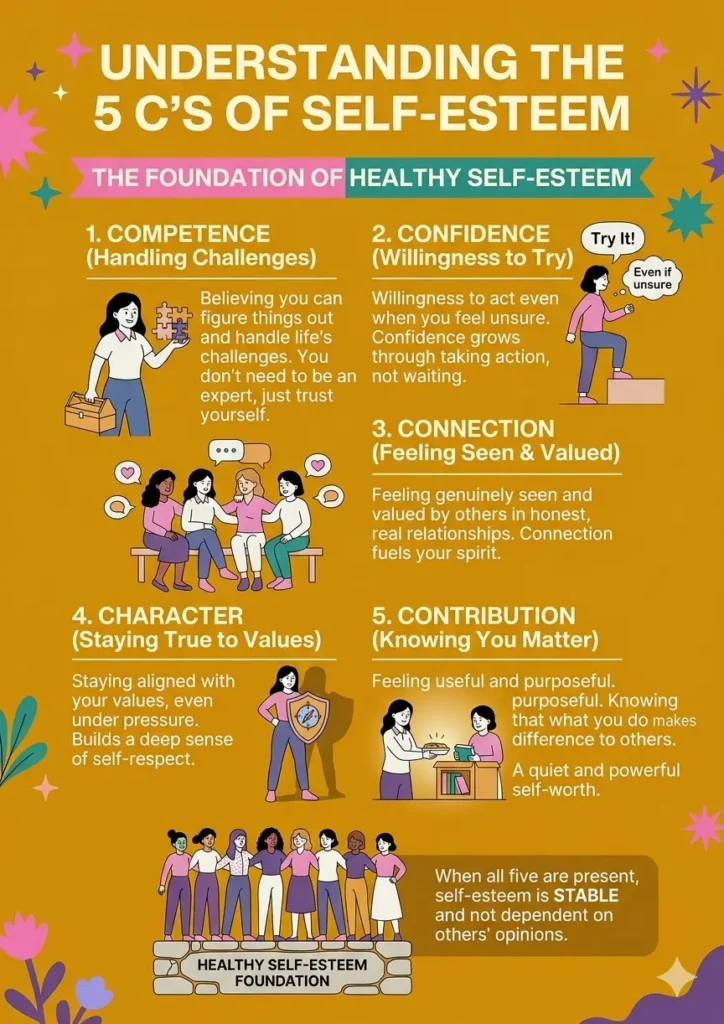
Before you work on improving your self-esteem, it helps to understand what healthy self-esteem is actually made of. The 5 C’s of self-esteem give you a clear picture.
The 5 C’s of self-esteem are: Competence, Confidence, Connection, Character, and Contribution.
Competence is the belief that you can handle challenges when they come. You do not need to be an expert. You just need to trust that you can figure things out.
Confidence is the willingness to try even when you feel unsure. It grows through action, not through waiting until you feel ready.
Connection is feeling genuinely seen and valued by others. Relationships where you can be honest and real are powerful fuel for self-esteem.
Character is staying true to your values even under pressure. Living in alignment with who you are builds a deep sense of self-respect.
Contribution is knowing that what you do matters. Feeling useful and purposeful is one of the quietest and most powerful forms of self-worth.
When all five are present, self-esteem becomes a stable foundation rather than something that depends on what other people think of you.
What are the Causes of Low Self-Esteem and Confidence?
Low self-esteem rarely appears out of nowhere. It usually grows from specific experiences, patterns, and environments that quietly chip away at how you see yourself.
Understanding the causes is the first step. When you know where low self-confidence comes from, it loses some of its power over you.
1. Difficult Childhood Experiences and Early Criticism
The way you were spoken to as a child shapes the way you speak to yourself as an adult. Harsh criticism, emotional neglect, or a home where love felt conditional can leave deep marks on your self-worth.
You may have grown up believing you were not enough. That belief did not come from truth. It came from people who were doing their best with their own unhealed wounds.
2. Toxic or Critical Relationships
Spending years in a toxic relationship where you are constantly criticized, dismissed, or undermined teaches you to doubt yourself. This applies to romantic relationships, friendships, and even workplace environments.
Over time, you start to internalize the other person’s voice. You begin to believe their opinion of you is the truth.
3. Comparing Yourself to Others
Comparison is one of the fastest routes to low self-confidence. You look at someone else’s life and measure your quiet, messy reality against their curated highlight reel.
This comparison is never fair because it is never equal. You are seeing their best moments and judging yourself by your worst ones.
4. Past Failures and Unresolved Regret
Failure is a part of growth, but low self-esteem turns failure into an identity. Instead of saying “I failed at that,” you start saying “I am a failure.”
Carrying regret without processing it keeps you stuck in moments that are already over. Your past does not define your worth today.
5. Social Media and Unrealistic Standards
Social media constantly shows you a filtered, staged, and edited version of life. Seeing this repeatedly sends your brain a message that everyone else is thriving while you are falling behind.
These standards are not real. They are performances. Measuring your worth against them will always leave you feeling like you are not enough.
How Low Self-Esteem Affects Your Daily Life
Low self-esteem does not just live in your thoughts. It shows up in the choices you make, the opportunities you avoid, and the way you relate to the people around you every single day.
Here are five ways low self-esteem quietly shapes your daily experience.
1. You Find It Hard to Make Decisions
When your self-esteem is low, making decisions becomes exhausting. You second-guess yourself constantly because you do not fully trust your own judgment. Even small choices feel heavy because you are afraid of getting things wrong.
2. You Pull Away from New Opportunities
Low self-confidence makes you believe that you are not ready, not qualified, or simply not good enough for what you want. You miss opportunities because saying yes feels too risky. Over time, that habit of stepping back becomes your default setting.
3. Your Relationships Start to Suffer
When you do not believe you are worthy of love and respect, it shows in how you show up in relationships. You may tolerate behaviour that hurts you, struggle to ask for what you need, or constantly seek reassurance from others. This creates dynamics that feel draining rather than nourishing.
4. You Feel Mentally and Physically Drained
Carrying the weight of constant self-doubt takes a real toll on your energy. You spend so much mental effort managing fear, shame, and negative thoughts that there is little left for the things you actually want to do. Many women with low self-esteem also experience disrupted sleep, tension, and persistent fatigue.
5. You Stop Believing in Your Own Future
Perhaps the deepest impact of low self-esteem is the way it dims your sense of possibility. You stop setting goals because you cannot picture yourself achieving them. You settle for less at work, in love, and in life because somewhere inside, you have decided that more is not meant for you.
8 Ways to Improve Your Self-Esteem and Confidence
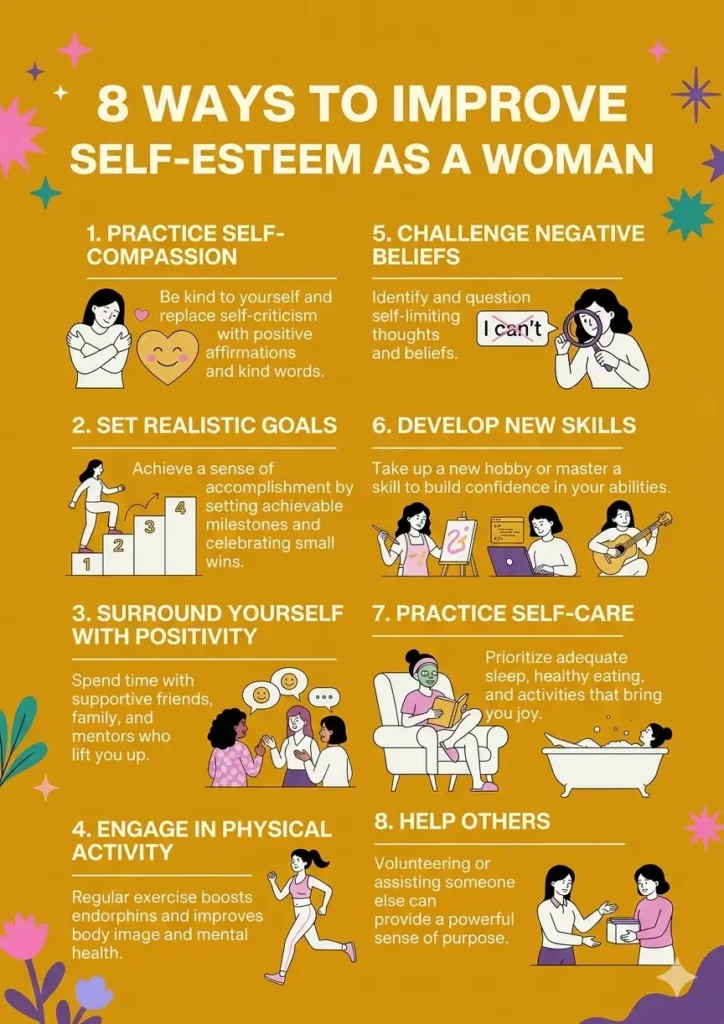
These ways to improve your self-esteem are grounded in psychology and designed for real life. You do not need to do them all at once. Start with what feels most honest to where you are right now.
1. Recognise the Positives and Get Good at Something
Your brain is wired to notice what goes wrong. This is called the negativity bias, and it is one of the biggest reasons low self-esteem is so hard to shake.
One of the most effective self-help habits you can build is learning to intentionally and consistently recognise your own positives. It sounds simple, but it genuinely rewires how you see yourself over time.
Each evening, write down three things you did, felt, or handled well that day. They do not have to be impressive. Finishing a task, being patient, and choosing to rest without guilt all count.
Now go one step further. Choose something you want to become genuinely good at. It does not matter what it is. It could be cooking, writing, painting, running, organising, or learning a new skill.
When you invest time in getting good at something, your brain starts to produce evidence that you are capable. You stop waiting for permission to feel confident. You earn that confidence through practice and progress.
2. Work on Your Dressing and Body Language
The way you dress and carry yourself directly affects how you feel inside. This is not about vanity or performing for others. It is about sending yourself a message before the day even starts.
When you put on something that feels like you, your energy shifts. You stand a little taller, you feel a little more ready, and the world feels slightly less intimidating.
Start paying attention to how your body language reflects your inner state. Are you making yourself small in conversations? Do you avoid eye contact, speak quietly, or hold your breath in social situations?
Research by Amy Cuddy, a social psychologist at Harvard Business School, published in Psychological Science in 2010, found that expanding your posture sends signals to your brain that boost confidence and reduce stress. Your body and your mind are in constant conversation with each other.
You do not need a new wardrobe to do this. Start with wearing something that makes you feel present in your own skin. Then practice standing with your shoulders back and your chin level. These small physical choices compound over time.
3. Positive Self-Talk
Low self-confidence often lives in the stories you repeat about yourself. “I am not smart enough.” “I always mess things up.” “No one takes me seriously.”
These are not facts. They are thoughts that have been given too much power for too long.
Start catching them. When a harsh thought appears, pause and ask yourself: Would I say this to someone I love?
Then reframe it. Swap “I am terrible at this” for “I am still learning, and that takes courage.” This is not toxic positivity. It is choosing to be fair to yourself instead of cruel.
Research by Aaron Beck, a psychiatrist at the University of Pennsylvania who founded cognitive behavioral therapy in the 1960s, showed that challenging distorted thinking patterns is one of the most effective ways to shift how people feel about themselves.
4. Build Self-Confidence Through Small Daily Wins
Self-confidence does not arrive before you try something. It grows because you tried. That distinction changes everything.
You do not wait to feel ready. You act, and readiness follows.
Start with goals that feel manageable today. Make your bed. Send the email. Finish the task you keep putting off. Each completed action sends your brain a message that you are capable.
Albert Bandura, a psychologist at Stanford University, introduced the concept of self-efficacy in his 1977 paper in Psychological Review. He found that people build genuine confidence through repeated experiences of success, even small ones.
Stack enough small wins and your self-image begins to change from the inside out.
5. Learn From Your Mistakes
Many women with low self-esteem treat every mistake as proof that they are not enough. They replay what went wrong, hold it close, and use it as evidence against themselves.
But mistakes are not the opposite of growth. They are part of it.
Start shifting the question you ask yourself after something goes wrong. Instead of asking “What is wrong with me?” ask “What can I take from this?” That single shift moves you from shame into learning.
Mistakes tell you what you need to know, not what you are worth. There is a real difference between the two.
When you allow yourself to learn from what went wrong without turning it into a verdict on your character, you build the kind of resilience that low self-esteem cannot survive. You stop being afraid of imperfection because imperfection becomes a teacher rather than a punishment.
6. Surround Yourself with People Who See You Clearly
The people you spend the most time with shape how you feel about yourself. This is not dramatic. It is just true.
If the people around you criticise more than they encourage, dismiss more than they listen, or make you feel small, your self-esteem will reflect that environment.
Connection is one of the 5 C’s of self-esteem because it matters deeply. Feeling genuinely seen and valued by another person is one of the most healing experiences you can have.
You do not need a large social circle. You need honest, safe relationships where you can be real. Even one person who truly sees you can shift how you see yourself.
Seek those people out. Invest in them. Notice how your inner world responds.
7. Work on Your Thought Pattern
Your thought patterns are not fixed. They are habits. And like any habit, they can be changed with the right conditions and consistent effort.
A positive mindset does not mean pretending everything is fine. It means training your attention toward what is possible rather than what is threatening.
The environment you place yourself in every day quietly shapes those patterns. Spend time with people who think constructively, who talk about ideas rather than tearing others down, and who believe in possibility. Their energy will influence yours more than you realise.
Reading is one of the most underrated tools for changing your inner world. Choose books that expand how you think about yourself and the world around you. Authors like Brene Brown, Gabor Mate, and Thich Nhat Hanh write in ways that genuinely shift perception. When you fill your mind with ideas that challenge your limitations, your old thought patterns start to lose their grip.
Your perceptions of yourself and of life are not truths handed down from above. They are conclusions you drew, often long ago, from limited information. New input creates new conclusions. That is how real change happens.
8. Replace Self-Criticism with Self-Acceptance
Self-criticism feels productive. It feels like you are holding yourself accountable, staying sharp, and keeping yourself in check. But chronic self-criticism is not accountability. It is punishment.
And punishment does not grow anything.
Self-acceptance does not mean you stop wanting to grow or improve. It means you stop making your worth conditional on how well you perform. You allow yourself to be a work in progress without letting that make you ashamed.
Dr Kristin Neff, a researcher at the University of Texas at Austin, published a foundational study in Self and Identity in 2003. She found that self-compassion and self-acceptance are stronger predictors of emotional well-being than self-esteem built on external achievement.
When you catch yourself being harsh, pause. Acknowledge what is hard. Remind yourself that struggle is part of being human. Then choose a kinder response, the same one you would offer someone you genuinely love.
Accepting yourself as you are right now is not giving up. It is the first real act of growth.
Final Thoughts
Building self-esteem is not a one-time decision. It is a daily practice of choosing to recognise your own worth even when it feels hard to believe.
These eight ways to improve your self-esteem work because they are grounded in how the mind actually changes. They ask you to notice, learn, act, connect, think differently, and be kind to yourself.
You do not have to do them all at once. Pick one that feels true to where you are today. Do it. Then come back tomorrow and do it again.
You were never as broken as you believed. You were just waiting to come home to yourself.
Frequently Asked Questions
What causes low self-esteem in women?
Common causes of low self-esteem in women include difficult childhood experiences, toxic or critical relationships, comparing yourself to others, carrying unresolved regret from past mistakes, and absorbing unrealistic standards from social media.
How does low self-esteem affect your daily life?
Low self-esteem makes decision-making harder, causes you to avoid opportunities, strains your relationships, drains your mental and physical energy, and quietly erodes your belief in your own future.
How do I start improving my self-esteem today?
Start by writing down three things you did well today. This simple self-help habit trains your brain to recognise the positives about yourself rather than focusing only on what went wrong.
Why is self-confidence different from self-esteem?
Self-confidence is your belief in your ability to do specific things. Self-esteem is your overall sense of worth as a person. They influence each other, but self-esteem is the deeper root.

Mehwish Arshad is the founder of Grow With Meh, a personal growth platform that helps women build self-awareness, emotional resilience, and a deeper understanding of themselves. For over 10 years, she has studied psychology, mindfulness, and personal development through extensive reading, research, and lived experience.