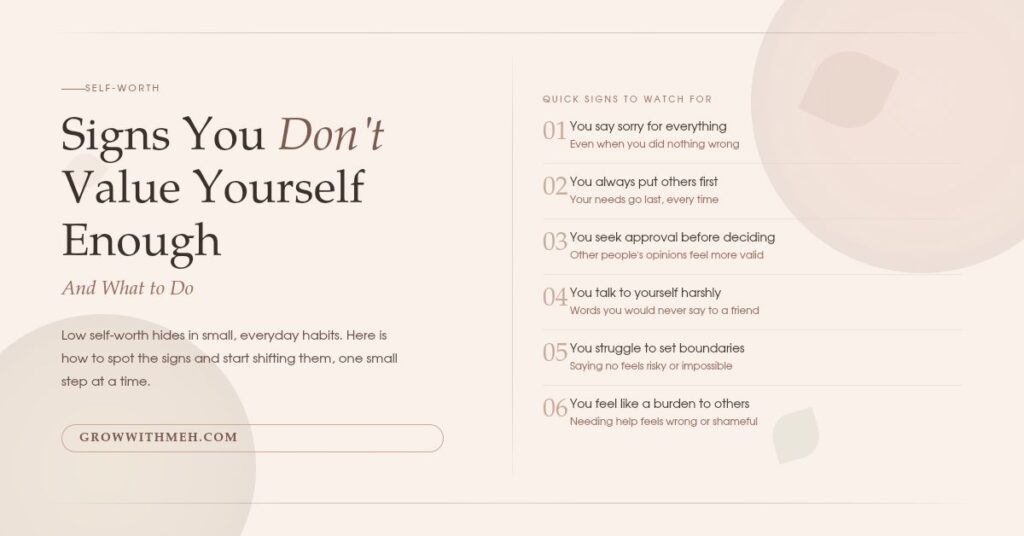
If you say sorry for things that are not your fault, feel guilty for resting, or keep putting everyone else first, you may not be valuing yourself the way you deserve. Low self-worth does not always look obvious. It hides in small, everyday habits that feel completely normal because you have been doing them for so long.
Many women grow up learning to be agreeable, helpful, and easy. Over time, those habits turn into beliefs. And those beliefs start to feel like the truth about who you are. But they are not the truth. They are patterns. And patterns can change.
This article will help you spot signs of low self-esteem in a woman. For each one, you will also find a simple, honest step to start shifting things.
Key Takeaways
- Low self-worth often shows up in small daily habits, not obvious behaviors.
- Constant apologizing, people-pleasing, and guilt are major signs you don’t value yourself.
- Many women learn these patterns early—but they can be unlearned.
- Self-worth grows through small, consistent choices—not big changes.
- You don’t have to earn your value—you already deserve it.
1. You Say Sorry for Everything
You apologize when someone bumps into you. You say sorry for sharing your opinion or for simply taking up space. This is one of the clearest signs of low self-esteem in women.
Constant apologizing is your mind’s way of saying, “I am too much” or “I should not be here.” It is not politeness. It is a habit that grew out of not feeling worthy enough to exist without excuse.
What to do: Before you say sorry, pause and ask yourself if you actually did something wrong. If you did not, try saying “thank you” instead. For example, “thank you for your patience” instead of “sorry I took so long.”
2. You Put Everyone Else First, Always
Your needs always go last. You take care of everyone around you, and by the end of the day, there is nothing left for you. You might even feel guilty when you rest or do something purely for yourself.
This is a very common pattern in women with low self-worth. Your value starts to feel tied to how useful you are to others. But you are a person, not a service.
What to do: Name one thing you need today. It does not have to be big. Ten quiet minutes, a meal you actually enjoy, or saying no to one thing that drains you is a good place to start.
3. You Settle for Less Than You Deserve
You stay in a relationship that makes you feel small. You stay in a job that drains your energy. You keep a friendship going even when it feels completely one-sided. You tell yourself this is just how things are.
Settling is a sign that part of you does not believe you deserve better. That belief is not true, but it feels very real when your self-worth is low. Low self-esteem often keeps women stuck in situations they have outgrown.
What to do: Ask yourself, “Would I be okay with someone I love being treated this way?” If the answer is no, that question alone is a starting point.
4. You Constantly Seek Approval
You check other people’s faces to see if they are happy with you. You change your opinion the moment someone pushes back. You need someone else to confirm your choice before you feel okay about it.
Seeking approval hands your sense of worth over to other people. When they approve, you feel fine. When they do not, you fall apart. That is an exhausting way to live.
What to do: Make one small decision today without asking for anyone’s opinion first. Start small and build from there, one choice at a time.
5. You Talk to Yourself in a Way You Would Never Talk to a Friend
You call yourself stupid when you make a mistake. You tell yourself you are not good enough, not smart enough, not doing enough. Your inner critic is loud and unkind.
Negative self-talk is one of the biggest signs of low self-worth. The words you repeat to yourself daily shape how you see yourself, and most of us would never say those things to someone we care about.
What to do: When you notice yourself being harsh, pause and ask, “Would I say this to my best friend?” Then try saying something kinder, even if you do not yet fully believe it.
6. You Shrink Yourself Around Others
You stay quiet in group settings. You hold back your ideas because you think they are not good enough. When something good happens to you, you downplay it so others do not feel uncomfortable.
Shrinking yourself is a quiet sign of low self-esteem. It is your mind saying, “I am not sure I am welcome here.” Many women do this without even realizing it.
What to do: Pick one moment today to take up space. Share an opinion, mention something you are proud of, or stop yourself before you brush off a win.
7. You Feel Guilty for Having Needs
You feel like you are asking for too much when you need help. Resting feels lazy. Wanting things for yourself feels selfish. So you push your needs down and keep going.
Having needs is not a flaw. It is human. But when your self-worth is low, needing things can feel like evidence that something is wrong with you.
What to do: Remind yourself that your needs are not a problem. You are allowed to need rest, connection, support, and care. Write it down if it helps you believe it.
GENTLE REMINDER
You don’t have to earn rest, love, or respect. You are allowed to slow down, take up space, and care for yourself without guilt.
8. You Accept Poor Treatment
Someone speaks to you in a way that does not feel right, and you let it go. You make excuses for people who hurt you. You tell yourself you are being too sensitive or that they did not mean it.
Accepting poor treatment is a sign that you do not fully believe you deserve better. It is not your fault that you learned this. But recognizing it is the first step to changing it.
What to do: Start by simply noticing when something feels wrong. You do not have to act on it right away. Just naming it to yourself is the beginning.
9. You Cannot Take a Compliment
Someone tells you that you did a great job, and you immediately say, “Oh, it was nothing” or “I just got lucky.” “You brush off kind words because part of you does not believe them.
When your self-worth is low, compliments feel uncomfortable. They do not match the story you have told yourself for years about who you are and what you deserve.
What to do: The next time someone compliments you, say “thank you.” That is it. Let it land without explaining it away or handing it back.
10. You Feel Like a Burden to Others
You hesitate to reach out when you are struggling. You over-explain your feelings so people do not find you too much to handle. You hide what you are going through because you do not want to bother anyone.
Feeling like a burden is one of the more painful signs of low self-worth. But the people who love you actually want to be there for you. That is not a burden. That is what a real connection looks like.
What to do: Let one person in this week. You do not have to share everything. Just let someone know you are having a hard time and see what happens.
11. You Constantly Compare Yourself to Others
You scroll through your phone and feel behind. You look at what other women are doing and use it to measure how well you are doing. You feel like everyone else has it more together than you.
Comparison is a sign that you are looking outside yourself for proof of your worth. But your worth is not something you can find in someone else’s life.
What to do: When comparison starts, gently bring your attention back to your own life. Ask yourself, “What is one thing I am doing well right now?” and answer it honestly.

12. You Have a Hard Time Setting Boundaries
You say ‘yes’ when you mean ‘no.’ You worry that a firm no will make people angry or cause them to leave. So you keep giving, even when you have nothing left to give.
Struggling to set boundaries is one of the most common signs of low self-worth in women. When you do not value yourself, other people’s comfort consistently feels more important than your own well-being.
What to do: Think of one simple, low-risk boundary you can set this week. It could be not answering messages after a certain time or saying no to one extra task that is not yours to carry.
13. You Downplay Your Achievements
You worked hard for something, and when someone notices, you say it was luck or give the credit to everyone else. You feel like you do not quite deserve the recognition.
Downplaying your wins keeps you small. It also tells your brain that what you do does not really matter, which, over time, further feeds low self-esteem.
What to do: At the end of each day, write down one thing you did well. It does not have to be impressive. Just write it down and sit with it for a moment.
REALITY CHECK
Constantly putting others first doesn’t make you kind—it slowly teaches people that your needs don’t matter.
14. You Tolerate Friendships That Drain You
You have friendships where you give far more than you receive. You leave certain conversations feeling worse about yourself than when they started. But you stay because you are afraid of being alone or hurting the other person.
Staying in draining friendships is a sign that you place other people’s feelings above your own peace. You deserve relationships that feel good, not just familiar or safe.
What to do: After spending time with someone, check in with yourself. Do you feel lighter or heavier? That feeling tells you more than you might think.
How Self-Worth Actually Grows
Self-worth does not arrive in one big moment. It grows through the small choices you make every day. Each time you speak up, rest without guilt, or treat yourself with a little more kindness, you are building something real.
You will not feel a shift right away. Some days will feel harder than others. But those small, steady choices add up over time, and that is how real change happens.
Conclusion
You do not have to fix all of this at once. Go back and pick one sign that felt familiar. Then try the one small step that comes with it.
Valuing yourself is not selfish. It is not something you have to earn or prove. It is something you deserve, right now, exactly as you are.
Quick Definitions
Self-worth is the deep belief that you are valuable, deserving of love, respect, and care—simply because you exist.
Self-esteem is how you feel about yourself based on your thoughts, experiences, and achievements, and it can change over time.

Mehwish Arshad is the founder of Grow With Meh, a personal growth platform that helps women build self-awareness, emotional resilience, and a deeper understanding of themselves. For over 10 years, she has studied psychology, mindfulness, and personal development through extensive reading, research, and lived experience.