Self-awareness is important for women because it helps them understand who they truly are beneath all the roles they carry every day. When you know your values, your emotional triggers, and your behavioral patterns, you stop reacting from fear or other people’s expectations. You start making choices that actually fit your life.
Research by psychologist Tasha Eurich confirms that only 10 to 15 percent of people are genuinely self-aware, even though most believe they are.
For women, that gap is wider because social conditioning, emotional labor, and constant external pressure make it harder to look inward. This guide covers the barriers, the real benefits, and what changes when you build this skill.
Table of Contents
Why Self-Awareness Is Harder for Women
These are not excuses. They are real barriers worth naming so you can work through them honestly.
The “Good Woman” Script
From a young age, many women are taught to be agreeable, accommodating, and selfless. Over time, suppressing your authentic emotions becomes automatic. You stop asking yourself what you feel because you were never encouraged to in the first place.
Chronic People-Pleasing
When your default is to manage everyone else’s comfort, you gradually lose access to your own internal signals. You know how everyone else feels, but you have stopped noticing how you feel.
Imposter Syndrome
Women experience imposter syndrome at higher rates than men. It creates a distorted kind of self-awareness, one that is painfully self-critical but not accurate. Imposter syndrome is not honest self-knowledge. It is internalized doubt dressed up as self-reflection.
Emotional Labor and Depletion.
Women carry a disproportionate share of emotional labor at home and at work. Being constantly tuned into other people’s emotional states drains the energy you need to tune into your own.
The Superwoman Myth
The cultural pressure to manage a career, a family, relationships, and personal health all at once leaves almost no space for honest self-reflection. Busyness often functions as a way to avoid looking inward.
Inherited Self-Narratives
Many women carry beliefs about themselves passed down from their mothers, grandmothers, and cultural norms. These beliefs become invisible filters through which you interpret your own identity, and most of them were never yours to begin with.
Hormonal and Cyclical Changes Dismissed
Shifts in mood and identity during the menstrual cycle, perimenopause, and postpartum periods are real and significant. When society dismisses these as “just hormones,” women learn to distrust their own emotional signals, which weakens self-awareness over time.
The Benefits of Self-Awareness for Women
Personal Benefits
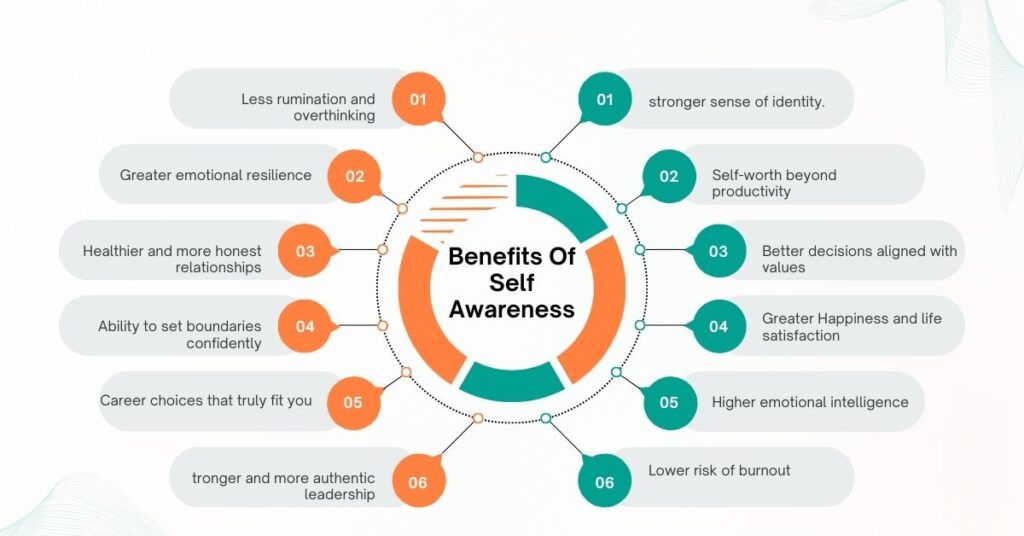
A stronger sense of identity. Self-awareness helps you understand who you are beyond your roles as a mother, partner, employee, or daughter. Your core identity stays stable even when your circumstances change. Women who have this inner groundedness are far less destabilized by criticism or major life transitions.
Self-worth that does not depend on performance. Many women tie their value to how productive they are or how much they do for others. Self-awareness reveals the beliefs driving that pattern. Once you see those beliefs clearly, you can separate your worth as a person from what you produce or sacrifice.
Better decisions rooted in real values. Self-aware women make decisions based on what they actually want, not on what they are expected to want. When your values are clear, the filter for making choices already exists inside you. This significantly reduces decision fatigue and regret.
Higher levels of happiness and life satisfaction. Research consistently links self-awareness with greater personal well-being. When you understand your own needs, you are better equipped to meet them and to ask for help when you cannot. Living in alignment with your actual values produces a sense of meaning that external success rarely does.
Emotional and Mental Health Benefits
Stronger emotional intelligence. Self-awareness is the first pillar of emotional intelligence, as confirmed by Mayer, Salovey, and Caruso (2008). When you understand your emotional triggers, you respond thoughtfully rather than impulsively. You also develop emotional granularity, which is the ability to name exactly what you feel, and this precision is directly linked to better mental health outcomes.
Reduced risk of burnout. Women’s burnout is often rooted in a deep disconnection from self, not just overwork. When you are unaware of your emotional state or energy levels, you miss the early warning signs. Self-awareness acts as an internal monitoring system that helps you make changes before you hit a wall.
Breaking the rumination cycle. Women are clinically more prone to rumination than men, and it is a key driver of anxiety and depression. Self-awareness shifts your thinking from “Why is this happening to me?” to “What is happening here and what do I need?” That shift, from ‘why’ questions to ‘what’ questions, is one of the most practical mental health tools that self-awareness provides (Eurich, 2017).
Greater resilience after setbacks. Self-aware women understand their coping patterns and can recover more quickly from failure and rejection. When you know what restores you versus what depletes you, setbacks become useful information rather than verdicts on your worth.
Relationship Benefits
More honest, healthier relationships. Women who know themselves communicate their needs directly instead of hoping others will figure it out. That shift alone changes the quality of relationships in a meaningful way. You stop building up quiet resentments and start having real conversations.
Boundaries without the guilt. Boundaries are nearly impossible to set if you do not know where your own needs and limits are. Self-awareness gives you that clarity. For many women, guilt follows immediately after setting a boundary. Self-awareness helps you trace that guilt back to the belief that your needs matter less than other people’s comfort, and once you see that belief, it loses its hold.
Empathy without losing yourself. Self-aware women can empathize deeply without becoming enmeshed in other people’s emotional experiences. There is a significant difference between feeling with someone and losing yourself in their feelings. This distinction matters most for women in caregiving roles, including mothers, nurses, teachers, and therapists.
Breaking repetitive relationship patterns. Many women find themselves repeatedly in the same kinds of relationships. Self-awareness reveals the underlying patterns and the unmet needs driving them. This is also how generational relationship cycles get interrupted, because you cannot change a pattern you cannot see.
Professional and Leadership Benefits
Career decisions that actually fit you. Self-aware women identify their genuine professional ambitions rather than chasing what they are supposed to want. Many women downplay their goals because of internalized messages about ambition being unfeminine.
When you can see those messages clearly, you can own your strengths and communicate your value without constantly qualifying or shrinking.
Greater job satisfaction. Women who understand their values and motivations make career choices that lead to far greater long-term satisfaction. Self-awareness prevents the costly mistake of building a career around external expectations rather than internal purpose. You also recognize sooner when a role or organization is fundamentally misaligned with who you are.
Social and Generational Benefits
Modeling emotional intelligence for children and younger women. A self-aware mother raises emotionally intelligent children because children learn to manage emotions by watching their caregivers do it. Self-aware women in leadership roles also actively develop the same skills in younger women around them.
Breaking generational cycles. This is one of the deepest benefits of self-awareness. Patterns of emotional suppression, self-sacrifice, and low self-worth do not have to keep moving through your family. When you become aware of a pattern, you can choose not to pass it on. The inner work you do does not stay inside you.
Women’s Leadership and Self-Awareness
Women in leadership face a specific challenge called the double bind. Be too assertive, and you are labeled aggressive. Be too warm, and you are dismissed as weak. Self-awareness gives you an internal compass that does not bend to those contradictory pressures. Your decisions come from your values, not from managing other people’s perceptions.
Self-aware leaders also build psychologically safe teams. When you know your own triggers, you stop leading from reactivity. Your team feels safe being honest, taking risks, and speaking up. The ripple effect of one self-aware woman in a leadership position on an entire organizational culture is significant and well-documented.
Many talented women avoid self-promotion or consistently understate their impact. Self-awareness helps you distinguish genuine humility from the socialized habit of making yourself smaller. Owning your impact clearly is not arrogance. It is accurate self-knowledge in action.
Common Myths About Self-Awareness
Myth 1: You have to fix everything you discover. Awareness comes before change, but it does not demand immediate action. Seeing something clearly is enough to start with.
Myth 2: Self-awareness makes you self-absorbed. It actually makes you more present and genuinely attuned to others, not less.
Myth 3: You either have it or you do not. Self-awareness is a learnable, developable skill that grows with consistent practice.
Myth 4: Being self-aware means controlling your emotions. It means understanding them, not suppressing them.
Myth 5: You need hours of solitude to build it. Small, honest moments of reflection throughout your day are just as valuable.
Myth 6: Self-aware women do not struggle with self-doubt. Self-awareness does not eliminate doubt. It just stops doubt from making all your decisions.
The Bottom Line
Self-awareness is not a self-improvement trend. For women, especially, it is the foundation beneath everything else: better decisions, healthier relationships, stronger leadership, and genuine well-being.
When you know yourself clearly, you stop living by other people’s scripts. You stop shrinking into roles that were never really yours.
And you start building a life that actually belongs to you.
Frequently Asked Questions
Why is self-awareness especially important for women?
Self-awareness is especially important for women because it helps them recognize emotional patterns, set healthy boundaries, and make decisions aligned with their values. It also helps women overcome challenges like people-pleasing, burnout, and identity confusion.
What are the signs of low self-awareness in women?
Common signs of low self-awareness in women include:
• feeling unexplained resentment
• constantly agreeing to things that cause exhaustion
• struggling to identify emotions
• changing behavior depending on who they are around
These patterns often indicate a disconnect from personal needs, values, and emotional boundaries.
How does self-awareness help women in leadership?
Self-awareness helps women in leadership by providing a clear understanding of their values, strengths, and emotional triggers. This allows them to make confident decisions, communicate authentically, and build trust within teams. Self-aware leaders are also better at managing feedback, navigating pressure, and creating psychologically safe workplaces.
What is the difference between self-awareness and self-criticism?
Self-awareness means observing your thoughts, emotions, and behaviors with curiosity and honesty. Self-criticism, on the other hand, involves judging yourself harshly without understanding the deeper reasons behind your actions.
Self-awareness promotes growth and learning, while self-criticism often leads to shame and self-doubt.
How does self-awareness help with burnout?
Self-awareness helps prevent burnout by allowing you to notice emotional exhaustion, stress triggers, and energy drains early.
When women understand what depletes or restores their energy, they can set boundaries, adjust workloads, and prioritize self-care before stress escalates into chronic burnout.
How can women develop self-awareness?
Women can develop self-awareness by regularly reflecting on their thoughts, emotions, and behaviours.
Practical methods include the following:
• journaling
• practicing mindfulness
• identifying emotional triggers
• asking honest self-reflection questions
• seeking feedback from trusted people
Over time, these habits help women better understand their values, patterns, and decision-making processes.

Mehwish Arshad is the founder of Grow With Meh, a personal growth platform that helps women build self-awareness, emotional resilience, and a deeper understanding of themselves. For over 10 years, she has studied psychology, mindfulness, and personal development through extensive reading, research, and lived experience.