Self-awareness activities and exercises for women are practices that help you understand your thoughts, feelings, values, and behaviors from the inside out. They give you a clear picture of who you are, what you want, and how you show up in the world. When you build self-awareness, you stop living on autopilot and start making choices that align with your true self.
Jump to Section
What Are Self-Awareness Activities?
Self-awareness activities help you understand your thoughts, emotions, values, and behaviors so you can make more intentional decisions.
These activities develop emotional intelligence, self-reflection, and personal growth, helping you make decisions that align with your authentic self.
Self-awareness activities may include:
- journaling
- mindfulness practices
- emotional reflection
- personality assessments
- self-discovery exercises
When practiced regularly, these activities help women build confidence, clarity, and stronger emotional regulation.
Why Self-Awareness Matters for Women
Many women grow up learning to focus on other people’s needs first. You learn to read the room, manage emotions around you, and keep the peace. Over time, this outward focus can disconnect you from your inner voice.
Psychologists call this gap the difference between your true identity and your self-concept. When these two don’t align, you may experience:
- imposter syndrome
- burnout
- emotional exhaustion
- identity confusion
Developing self-awareness closes this gap. It helps you understand your needs, your values, and your boundaries. And that understanding becomes the foundation for healthy emotional intelligence and personal development for women.
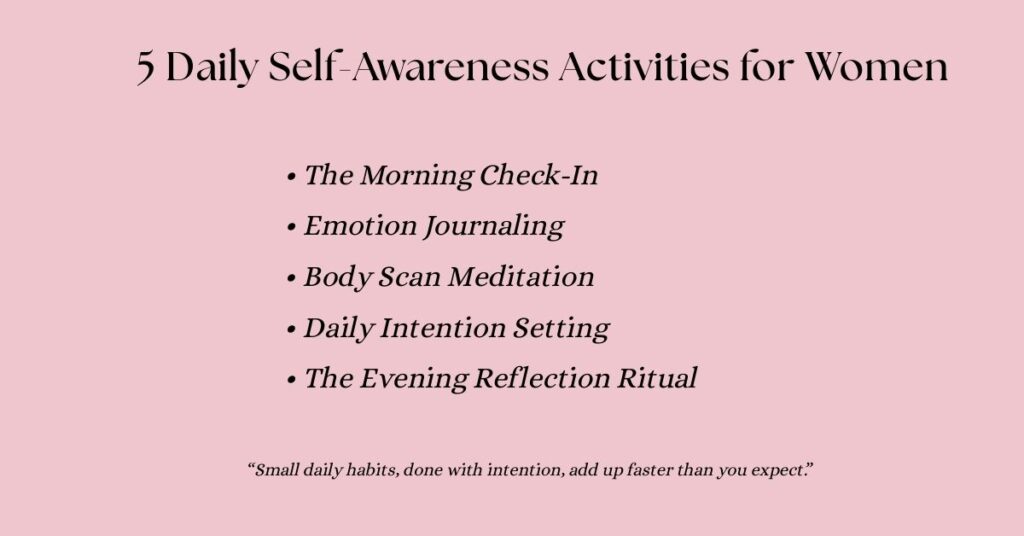
5 Daily Self-Awareness Activities for Women
You do not need hours of free time to build self-awareness. Small daily habits, done with intention, add up faster than most people expect. Start here.
Activity 1: The Morning Check-In
Before you pick up your phone in the morning, pause and ask yourself three questions.
- How do I feel today?
- What do I need today?
- What intention do I want to set?
This takes two minutes. But those two minutes shift your whole day from reactive to intentional. You stop running on autopilot and start acting from a place of genuine self-knowledge. This simple practice is one of the most powerful forms of daily self-monitoring you can build.
Activity 2: Emotion Journaling
Most people describe their emotions with one of five words: good, bad, fine, stressed, or tired. Emotion journaling pushes you past those surface words. Write one paragraph each day that names your exact emotion.
Try identifying specific emotions such as the following:
- overwhelmed
- disappointed
- hopeful
- grateful
This builds emotional awareness and strengthens emotional regulation.
Activity 3: Body Scan Meditation
Somatic awareness is your ability to notice what is happening in your body. Women are often taught to ignore or criticize their bodies, which cuts off a huge source of inner information.
A body scan takes five to ten minutes. You sit or lie down, close your eyes, and slowly bring your attention to each part of your body from your feet to your head. You notice tension, tightness, warmth, or numbness without judgment. Your body holds emotional information that your mind often tries to skip over.
Activity 4: Daily Intention Setting
An intention is different from a goal. A goal is an outcome you want to reach. An intention is a value or quality you want to bring to your day.
Each morning, write one simple sentence:
“Today I will…”
Examples:
- Today, I will speak up honestly.
- Today I will be patient with myself.
Intentions connect your daily actions to your deeper values.
Activity 5: The Evening Reflection Ritual
Before sleep, take five minutes to review your day. Ask yourself:
- What went well?
- What did I do that matched my values?
- What felt off, and why?
This daily self-reflection practice strengthens introspection and helps you notice patterns in your behavior.
6 Best Self-Reflection Exercises for Women
Some activities work on the surface. These six go deeper. They help you look at the beliefs, values, and patterns that shape how you live without you even realizing it.
Activity 6: Values Mapping Exercise
Write down every value that matters to you.
Examples:
- freedom
- creativity
- family
- honesty
- adventure
Circle your top five values. Then ask yourself:
“Do I actually live by these values?”
The gap between these two lists is some of the most important information on self-awareness you can have.
Activity 7: Shadow Work Journaling
Shadow work is the process of exploring the parts of yourself that you hide or deny. Write about emotions you struggle to accept, such as:
- jealousy
- anger
- ambition
- desire for recognition
When you push these parts underground, they run your behavior in the background without your awareness. Shadow work journaling brings them into the light so you can understand them.
Activity 8: Limiting Beliefs Audit
A limiting belief is a thought you hold about yourself that gets in your way. Common ones for women include:
- I’m not good enough
- I must please everyone
- I shouldn’t ask for more
Then challenge each belief by asking:
- Is this actually true?
- Who taught me this?
- What would I do if I did not believe this?
Your limiting beliefs are not facts. They are old stories, often inherited from childhood or culture, and you can choose to rewrite them.
Activity 9: The Johari Window Exercise
The Johari Window is a well-known self-awareness model with four areas.
- Your Open Area is what both you and others know about you.
- Your Blind Area is what others see that you do not.
- Your Hidden Area is what you know but keep private.
- Your Unknown Area holds things neither you nor others have discovered yet.
To use this exercise, ask three trusted people to describe your strengths in five words. Compare their words to the ones you would use for yourself. The gaps between their list and yours are your blind spots. This exercise builds both internal and external self-awareness.
Activity 10: The Roles vs. Real Self Separation
Take a blank page and draw two columns.
- Column 1: roles you play (mother, partner, employee)
- Column 2: qualities that describe you.
This exercise helps separate identity from responsibilities.
If the second column feels hard to fill, that is important information. It means your sense of identity has merged too closely with your roles. This exercise is a gentle first step toward separating who you are from what you do.
Activity 11: Letter to Your Younger Self
Write a compassionate letter to your younger self.
Tell her:
- What she survived
- What she did right
- What wasn’t her fault
This activity builds self-compassion and helps you see your behavioral patterns from a distance. Many women experience deep emotion as they write this letter. That is a sign you are reaching something true and important about your inner life.
Self-Awareness Activities For Relationships
How you relate to others tells you a great deal about yourself. These five activities use your relationships as a mirror for your own inner world.
Activity 12: Trigger Mapping
A trigger is something that causes a big emotional reaction in you, often bigger than the situation seems to call for. Triggers are windows into your unmet needs and older wounds. Whenever a strong emotional reaction occurs, write:
- what happened
- What you felt
- What it reminded you of
Over time, you will see patterns that point toward your deeper emotional landscape and your areas for inner work.
Activity 13: Boundaries Inventory
A boundary is a clear line between what you will accept and what you will not. Healthy boundaries are a visible sign of strong self-awareness and self-worth.
List situations where you said yes but wanted to say no. Then ask yourself what fear prevented you from setting a boundary. Healthy boundaries reflect strong self-awareness.
Activity 14: The Personal 360-Degree Feedback Method
In the business world, a 360-degree feedback process gathers input from everyone around you. You can do a personal version with people you trust.
Ask trusted people:
- What do I do well?
- What holds me back?
Read their answers without defending yourself. Look for the patterns. This combines personal growth with genuine interpersonal awareness.
Activity 15: Empathy vs. Over-Giving Check
There is a real difference between being caring and being self-abandoning. Healthy empathy keeps you present with someone else while still honoring your own needs. Over-giving means you pour yourself out until you have nothing left.
Ask yourself:
Do I give because I want to… or because I’m afraid not to?
If the answer involves fear, guilt, or keeping the peace, you may be crossing the line from genuine empathy into self-abandonment. This check connects directly to your self-worth and emotional health.
Activity 16: Accountability Partnership or Women’s Circle
Growth is faster when it is witnessed. Find one other woman who is also working on her self-awareness and agree to check in weekly.
Share what you are noticing, what patterns are coming up, and what you want to change. Being seen and heard by someone you trust is one of the most powerful tools for personal transformation. It builds both accountability and deeper interpersonal awareness over time.
4 Mind-Body Self-Awareness Practices
Your body and mind are not separate systems. These four practices use your body as a direct tool for deeper self-understanding.
Activity 17: Somatic Body Check-In
At least once a day, pause and direct your attention inward. Ask yourself:
- Where am I holding tension right now?
- What is my body telling me that my mind is ignoring?
You might notice a tight chest when you think about a difficult conversation or a relaxed jaw when you think about a hobby you love. These somatic signals carry honest information about your needs, fears, and desires. Learning to notice them is a fundamental part of emotional self-regulation.
Activity 18: Mindfulness Walking
Mindfulness is the practice of paying full attention to the present moment. Most people picture it as sitting still, but walking mindfulness works just as well for women who find it hard to sit with their thoughts.
Walk for 10 minutes without your phone. Notice:
- sounds
- physical sensations
- thoughts
This practice builds metacognition, which is the ability to observe your own thinking, and that is central to developing self-awareness.
Activity 19: Breathwork for Emotional Regulation
When you are overwhelmed, anxious, or reactive, your nervous system is in a stress response. Breathwork resets it. Try box breathing:
Inhale 4 seconds
Hold 4 seconds
Exhale 4 seconds
Hold 4 seconds
This practice does more than calm you down in the moment. Over time, it trains you to notice the early signs of dysregulation before you reach the reactive stage. That noticing skill is a core part of emotional self-regulation and one of the most practical tools for self-awareness you can develop.
Activity 20: Cycle Awareness Journaling
For women who have a menstrual cycle, hormones shift their energy, mood, creativity, and mental focus throughout the month. Most women were never taught to track these shifts or use them as information.
Track:
- energy
- mood
- focus
Many women discover clear patterns linked to hormonal cycles. You will know when to plan big decisions, when your body needs rest, and when your inner critic tends to get louder based on where you are in your cycle. This is one of the most unique and powerful self-awareness tools available, specifically to women.
4 Self-Awareness Tools Worth Using
These tools give you a structured framework for understanding yourself. Use them as mirrors, not labels. The goal is insight, not a box to fit yourself into.
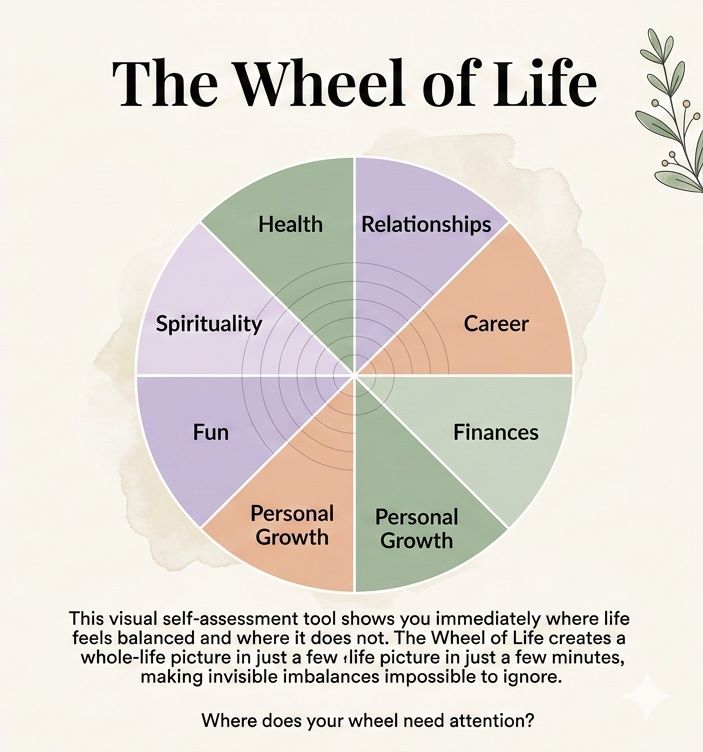
Activity 21: The Wheel of Life
Draw a circle and divide it into eight sections:
- health
- relationships
- career
- finances
- personal growth
- fun
- spirituality
Rate your satisfaction in each area from 1 to 10.
This visual self-assessment tool shows you immediately where life feels balanced and where it does not. The self-awareness wheel is widely used in coaching because it creates a whole-life picture in just a few minutes, making invisible imbalances impossible to ignore.
Activity 22: Personality Assessments (MBTI or Enneagram)
The Myers-Briggs Type Indicator (MBTI) and the Enneagram are two well-known personality inventories. They give you a shared language for understanding how you process information, make decisions, and relate to the people around you.
Use these personality assessments as starting points, not final answers. The goal is to recognize patterns in your thinking and behavior so you can work with them rather than against them. When used with curiosity instead of rigidity, these tools are genuinely useful for self-discovery.
Activity 23: VIA Strengths Assessment
The VIA (Values in Action) Strengths Assessment is a free tool developed by positive psychology researchers. This free assessment identifies your top character strengths, such as:
- curiosity
- kindness
- creativity
- bravery
Many women find it far easier to list their weaknesses than to own their strengths. This assessment gives you evidence-based language to describe what you are genuinely good at.
Research shows that self-efficacy (your belief in your own ability) grows when you identify and build on your real strengths rather than spending all your energy on weaknesses.
Activity 24: Personal SWOT Analysis
A SWOT analysis (Strengths, Weaknesses, Opportunities, Threats) is normally used in business planning. But it works powerfully as a personal self-assessment tool.
Take a single page and fill in all four areas for yourself. Be specific. Under Threats, include your limiting beliefs and unhelpful behavioral patterns, not just external factors. This exercise builds a clear, honest, and complete picture of where you stand right now and is a strong starting point for personal development planning.
Creative Self-Discovery Exercises
Not all self-awareness work happens in journals or frameworks. These three activities work well if you process life more visually or emotionally than analytically.
Activity 25: Vision Board with Intention
A traditional vision board is about picturing what you want to manifest. This version is different. Create a vision board based on values, not just goals. Focus on how you want life to feel.
Then find images that connect to the feeling of that life, not just the things or status symbols you think you should want. This process reveals the difference between your authentic self and your conditioned self. It is one of the most enjoyable self-discovery exercises you can do.
Activity 26: Morning Pages (Stream-of-Consciousness Writing)
Morning Pages come from Julia Cameron’s book, “The Artist’s Way.” The practice is simple:
Every morning, write three pages of whatever is in your head. No editing. No structure. No audience. Just you and the page.
This practice clears the mental clutter that sits on top of your real thoughts. Over weeks, your morning pages begin to reveal your inner dialogue, your deepest concerns, your genuine desires, and the patterns you repeat without realizing it. Many women describe this as the most honest writing they have ever done.
Activity 27: Create a Personal Manifesto
A personal manifesto is a short document that states your values, your commitments, and how you want to live. It is your life described in your own words, not the words of your family, your culture, or social media. Write statements such as the following:
- I believe in…
- I commit to…
- I will no longer accept…
A manifesto defines your identity in your own words.
Self-Awareness at Different Life Stages
The 27 activities above work at any life stage. But the questions you bring to them shift depending on where you are right now.
In Your 20s
Your 20s are a time of identity formation. You are figuring out your values, testing your beliefs, and navigating comparison culture in a social media world. This stage often involves borrowing your identity from others until you figure out your own.
The best activities for this stage focus on separating your own values from the ones you inherited. The Limiting Beliefs Audit (Activity 8) and the Roles vs. Real Self exercise (Activity 10) are especially useful here.
In Your 30s and 40s
This is often the decade where women feel the most identity blur. Career pressure, motherhood, relationship changes, and family responsibilities all compete for your time and inner attention. Many women describe feeling capable on the outside but hollow on the inside.
Self-awareness at this stage is about protecting your inner life while managing your outer demands. Trigger Mapping (Activity 12), the Boundaries Inventory (Activity 13), and Cycle Awareness Journaling (Activity 20) are particularly important during this phase.
Midlife and Beyond
As life roles shift (children grow up, careers change, relationships evolve), many women feel a loss of purpose or direction. But this stage is also a powerful opening for deep self-discovery.
The best activities for midlife and beyond are the deeper reflection practices: Shadow Work Journaling (Activity 7), the letter to Your Younger Self (Activity 11), and the Personal Manifesto (Activity 27).
How to Build a Consistent Self-Awareness Practice
Choose two or three activities from this list and practice them consistently. Start small:
- morning check-in
- evening reflection
- journaling
Consistency matters more than perfection. Over time, these practices strengthen self-perception, emotional awareness, and confidence.
Conclusion
You started this article looking for a list of activities. But if you have made it this far, you already sense that this is about more than a to-do list. It is about coming back to yourself.
Self-awareness activities for women are not about becoming someone new. They are about rediscovering the person you already are beneath expectations, roles, and social conditioning. When practiced consistently, these self-awareness exercises help women build emotional intelligence, confidence, and a deeper sense of direction in life.
Frequently Asked Questions
What are the best self-awareness activities for women?
Some of the most effective self-awareness activities include journaling, mindfulness meditation, values mapping, personality assessments, and emotional reflection exercises.
How can you develop self-awareness skills?
You can develop self-awareness by regularly observing your thoughts, emotions, and behaviors and understanding how they influence your actions and decisions. Practicing reflection and mindfulness and seeking feedback helps you gain a clearer understanding of yourself.
How can women build self-awareness daily?
Daily practices such as morning check-ins, emotion journaling, and evening reflections help develop consistent self-awareness.
Why is self-awareness important for personal development?
Self-awareness helps women understand their values, beliefs, and behavior patterns so they can make decisions that align with their authentic identity.
What exercises improve emotional intelligence?
Emotion journaling, body scan meditation, breathwork, and trigger mapping are powerful tools for developing emotional intelligence.

Mehwish Arshad is the founder of Grow With Meh, a personal growth platform that helps women build self-awareness, emotional resilience, and a deeper understanding of themselves. For over 10 years, she has studied psychology, mindfulness, and personal development through extensive reading, research, and lived experience.