
How to stop overthinking after a fight
You stop overthinking after a fight by calming your body first, then checking your thoughts instead of believing them, and finally taking small, clear actions instead of replaying the argument in your head. When your mind feels loud, it is not the truth; it is stress. Once you slow down, clarity returns.
You Just Had a Fight. Now Your Brain Won’t Shut Up. You replay every word. You wonder if you said the wrong thing. You worry they will leave you. Your chest feels tight. You cannot sleep.
You stop it by putting a time limit on your rumination, then moving your body to break the negative thinking loop. Give yourself 15 minutes to feel upset. Set a timer. When the timer rings, you perform a physical task, such as washing dishes or walking around the block.
This tricks your brain into letting go. Your body cannot stay in high anxiety (flooded with cortisol) while it is moving in a calm way to activate your parasympathetic nervous system.
This article walks you through exactly how to do that. No fancy words. Just real help for women who are tired of feeling stuck after every argument.
Why You Overthink After an Argument
When you fight, your body releases cortisol. This is a stress hormone. It activates your fight-or-flight response. This is a real physical reaction. It is not just “being emotional.” Your brain treats the argument like a threat. So it keeps scanning for danger. It replays the argument. It tries to solve a problem that has not yet been solved.
This mental loop is called rumination. It feels like thinking, but it is actually your nervous system stuck on high alert. You might experience intrusive thoughts or catastrophizing (“this means they will leave me forever”). These are cognitive distortions; your brain is lying to you.
Women are often taught to be the emotional caretakers. So after a fight, you do not just feel sad or angry. You feel responsible for fixing everything. This can trigger fear of rejection and abandonment sensitivity. That is not a weakness. That is your brain trying to protect you based on old patterns. But overthinking after an argument does not fix anything. It just wears you out.
1. Break the Thought Cycle : The 15-Minute Timer Rule
This is a simple way to stop overthinking after a fight and calm post-argument stress.
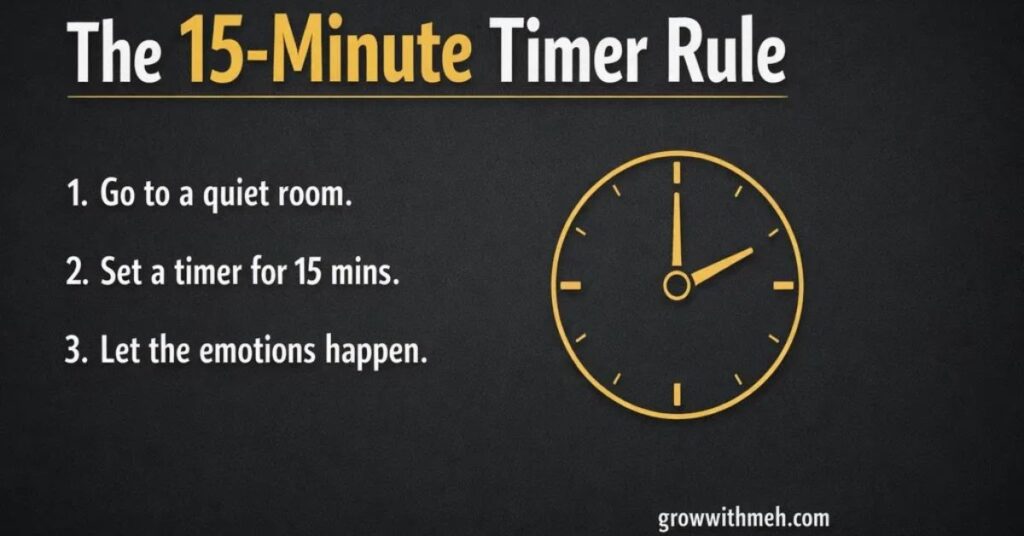
Step one: after a fight, go to a quiet room.
Step two: Set a timer for 15 minutes.
Step three: In that time, you are allowed to think about the fight as much as you want. Cry. Yell into a pillow. Write angry notes. Let the emotional overwhelm happen.
This works because your brain stops treating the fight as urgent. You limit your thoughts, so the mental loop slows down. This is a powerful emotional regulation tip for overthinking after an argument.
Now shift to your body. Stand up, shake out tension, and move. Walk, stretch, or do a few jumping jacks.
If you want to know how to stop thinking about a fight, this is key. Movement helps release cortisol and supports nervous system regulation, which calms your mind faster.
2. Emotional Regulation Tips That Work Fast
You need body-based calming techniques that work in the messy moment. Not in a yoga studio. In your bedroom at 11 PM when you cannot sleep.
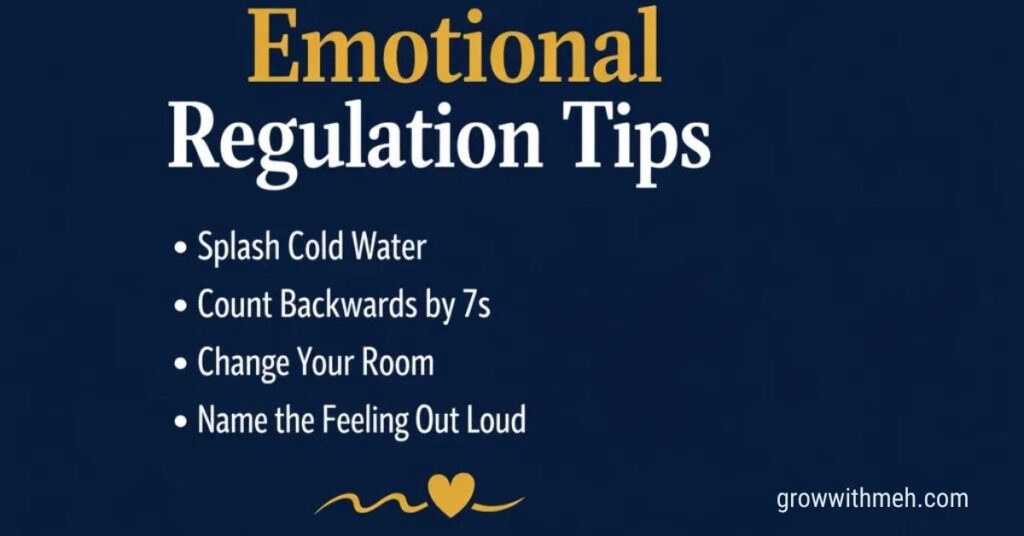
Tip one: Use cold water. Splash your face with cold water for 10 seconds. This activates your dive reflex. Your heart rate slows down. You cannot overthink when your body is busy activating the parasympathetic nervous system. This is biology, not hype.
Tip two: count backward from 100 by 7s: 100, 93, 86, 79, 72, 65. This is hard enough that your brain has to focus. It pushes the fight out of your working memory. It interrupts intrusive thoughts. Do it twice if you need to. You will feel a shift.
Tip three: change your room. Turn on a different light. Open a window. Move to a different chair. Your brain links places to feelings. If you stay in the same spot on the couch, you stay in the same fight. Shift your focus by moving your body.
Tip four: name the feeling out loud. Say, “I am scared he will leave because I got angry.” Just saying it makes it smaller. Most overthinking after an argument is actually a feeling that hasn’t yet been named. Name it. Own it. Then watch it shrink. This builds self-awareness.
3. 3-Day Rule After an Argument
The 3-day rule after an argument means giving yourself and your partner up to three days to calm down before trying to resolve the issue. This time helps reduce emotional reactions, lower stress, and think clearly about the situation.
It does not mean ignoring each other. It means using the time to regulate your emotions, reflect on what happened, and then have a calm, respectful conversation.
But for most women, three days of silence feels like torture. You will overthink every hour. Anxiety after relationship conflict will spike.
So let me change the rule for you.
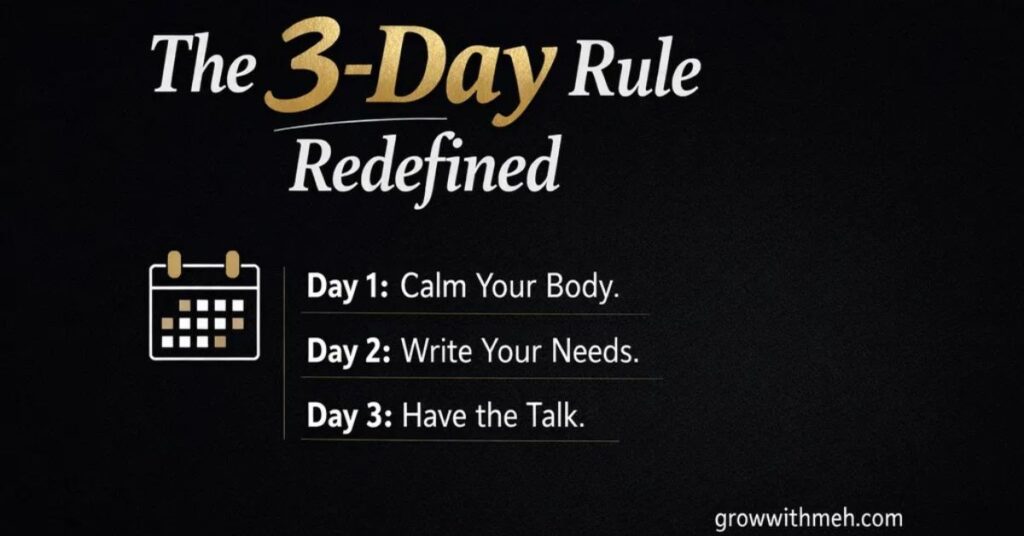
The real 3-day rule after an argument means you take three days to watch actions, not words.
- Day one: you calm your body (emotional reset).
- Day two: You write down what you actually need (mental clarity).
- Day three: you have a short talk without re-fighting.
Many therapists and conflict resolution experts support a cooling-off period. But the cooling-off period should be active, not passive. You cool off by moving, breathing, and self-soothing. Not by staring at your phone waiting for a text.
4. Fix Your Relationship Anxiety After a Fight
Relationship anxiety after a fight feels like a knot in your chest. You check your phone 20 times. You think, “They are going to break up with me.” This anxiety is loud. But you can turn down the volume.
First, name the fear out loud. Say, “I am scared he will leave because I got angry.” “Just saying it makes it smaller. This reduces insecurity in relationships.
Second, ask yourself one question. “Did he leave yet?” The answer is almost always no. He is probably watching TV or playing a game. He is not packing his bags. Your brain is catastrophizing.
Third, stop checking for proof. Do not reread old texts to see if he “seems different.” Do not ask your friends, “What do you think he means by that?” That feeds relationship anxiety after a fight. Instead, tell yourself, “I will know more tomorrow.” “Right now, I am safe.”
For some women, overthinking after a fight is connected to a deeper pattern called anxious attachment. This comes from attachment theory. It often develops from early experiences of emotional inconsistency.
If one fight sends you into a very deep mental spiral that lasts for days, it may be worth talking to a therapist about anxious attachment. Self-compassion is a key part of healing this pattern. Speak to yourself the way you would speak to a friend.
5. Communicate After a Fight: How to Talk After the Fight Without Re-Fighting
The goal is not to avoid talking. The goal is to talk without spinning out again. Use these two sentence starters for healthy arguments.
Sentence one: “When you said X, I felt Y.” For example, “When you left the room, I felt invisible.” ” Do not say, ‘You always leave.'” That starts a new fight. Stick to one fact and one feeling. This avoids overanalyzing behavior.
Sentence two: “Next time, can we try Z?” For example, “Next time, can we try a five-minute hug before we talk?” This gives your partner a clear action to take. It stops you from overthinking because you have a plan for repairing your relationship.
Never say “you never listen” or “you do not care.” Those are mind-reading statements. They make your partner defensive. Then you fight again. And you overthink for another three days. No, thank you.
A simple and direct message like “I want to talk when we are both ready” is enough. You do not need to resolve everything at once. Repair is a process, not a single conversation. How to stop overthinking in a relationship starts with better communication tools.
6. Grounding Techniques & Self-Regulation
Print this out or save it on your phone. Use it when you feel stuck.
| Feeling | What You Do · Action-Based Power Phrase |
|---|---|
| Heart racing, can’t breathe emotional flooding | Splash cold water on your face for 10 seconds. calm your mind fast |
| Checking the phone every two minutes | Put the phone in another room for 30 minutes. reset your emotions |
| Replaying the same sentence from the fight | Say that sentence out loud five times in a silly voice. break the thought cycle |
| Scared they will leave fear of abandonment | Look around the room. Name five things you see. grounding techniques |
| Can’t sleep because of racing thoughts intrusive thoughts | Do a body scan. Tighten, then relax each body part from toes to face. release emotional tension |
| Feeling guilty or ashamed guilt after a fight | Ask, “Would I say this to my best friend?” If no, stop. quiet your thoughts |
FAQs
How to stop overthinking after a fight fast?
Use the 15-minute timer rule. Set a timer for 15 minutes. Feel everything you need to feel. When the timer rings, do a physical task, such as walking or washing dishes. Your body cannot stay anxious while it is moving calmly. This is how to instantly calm anxiety after a fight.
How long does overthinking last after a fight?
For most women, intense rumination lasts 2 to 4 hours. Then it drops to a lower level. If you are still stuck after 24 hours, you likely need a physical reset, like exercise or a full night of sleep. Is it normal to overthink after an argument? Yes, very normal.
What is the 3-day rule after an argument?
The 3-day rule after an argument means giving both people about three days to calm down emotionally before having a resolution conversation. It reduces the chance of saying things you do not mean. Use those three days to watch actions, not words.
Is overthinking after a fight a sign of relationship anxiety?
Not usually. Most overthinking is normal after conflict. But if you also have panic attacks, stop eating, or cannot go to work because of the fight, that may be relationship anxiety after a fight. A therapist can help with that.
What is the fastest way to calm down after a fight?
The fastest way is slow breathing combined with cold water. Breathe in for 4 counts, hold for 4, and breathe out for 6. Do this 5 times. Then splash cold water on your face. Your heart rate will drop in under one minute. That is how to calm down after a fight using your parasympathetic nervous system.
- 1 Overthinking after a fight is your brain trying to protect you
- 2 Calming your body is the first step to calming your mind
- 3 Not every thought is true. Question your fears
- 4 The 3-day rule after an argument helps you respond better
- 5 Emotional regulation tips reduce anxiety and bring clarity
- 6 You do not need instant answers; you need calm awareness

Mehwish Arshad is the founder of Grow With Meh, a personal growth platform that helps women build self-awareness, emotional resilience, and a deeper understanding of themselves. For over 10 years, she has studied psychology, mindfulness, and personal development through extensive reading, research, and lived experience.