
You’ve probably been told to “love yourself” a thousand times. Maybe you’ve rolled your eyes at the phrase, dismissed it as Instagram wisdom, or felt a quiet ache because you genuinely don’t know how to love yourself, and no one ever explained it in a way that actually helps.
Self-love means accepting who you are, treating yourself with kindness, and choosing your well-being—without guilt or apology. It’s about setting boundaries, letting go of self-criticism, and building a life that feels safe and fulfilling from within.
In this guide, you’ll discover 8 simple yet powerful self-love tips that will help you reconnect with yourself, boost your confidence, and create a healthier relationship with your mind and emotions. Whether you’re just starting your self-love journey or trying to rebuild it, these steps will help you begin—gently and realistically.
✨ Quick Self-Love Takeaways
- Accept yourself fully—flaws and all
- Speak to yourself with kindness
- Set healthy boundaries without guilt
- Stop seeking constant validation
- Rest and recharge unapologetically
- Celebrate small wins daily
- Choose yourself every single day
💖 Start small—but start today. You deserve your own love.
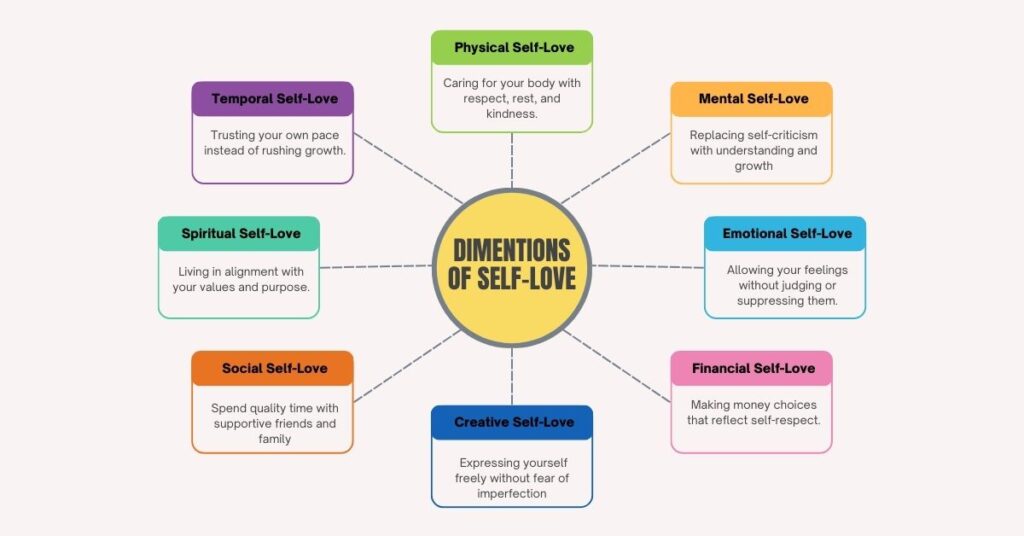
1. Physical Self Love Tips
Your body has carried you through every single moment of your life. Physical self-love means respecting it as a partner, not an enemy to be controlled.
Practical Tips:
Practice body neutrality: Instead of forcing yourself to “love” how you look, try appreciating what your body does. “My legs carried me through that difficult conversation” shifts focus from appearance to function.
Engage in gentle movement: Research shows that exercise motivated by self-care (rather than punishment) increases long-term adherence and psychological well-being. Ask yourself, “What would feel good in my body today?” rather than “What should I do to burn calories?”
Create a sensory sanctuary: Wear fabrics that feel good against your skin. Use scents that calm you. Studies in environmental psychology have confirmed that sensory comfort reduces cortisol levels and increases feelings of safety.
Rest without guilt: Sleep researcher Matthew Walker’s work shows that rest is when your body repairs, consolidates memories, and regulates emotions. Resting isn’t lazy—it’s essential maintenance.
Why it matters: When you treat your body with respect rather than contempt, you activate the parasympathetic nervous system, which reduces chronic stress and improves overall health outcomes.
2. Mental Self-Love Tips
The voice in your head can be your harshest critic or your most loyal supporter. Mental self-love is about consciously choosing the latter.
Practical Tips:
Challenge cognitive distortions: Psychologists and research centers identified thinking patterns like all-or-nothing thinking and catastrophizing. When you catch yourself thinking, “I always mess up,” ask, “Is that actually true, or is my mind generalizing?”
Practice self-compassionate self-talk: Research shows that self-compassion (treating yourself kindly when you fail) predicts greater emotional resilience than self-esteem. Try replacing “I’m so stupid” with “I’m learning, and that’s okay.”
Protect your mental space: Limit scrolling for comparison. Spend less time comparing your life to others online. Even cutting back a little on social media can help you feel calmer, less anxious, and more at ease.
Embrace intellectual humility: Permit yourself not to know everything. Saying “I don’t know, but I’m curious” demonstrates self-respect.
Why it matters: Your thoughts shape your reality. When you treat your mind with kindness, you create neural pathways that support well-being rather than self-sabotage.

3. Emotional Self-Love Tips
You don’t need to earn the right to feel what you feel. Emotional self-love means honoring your feelings without judgment.
Practical Tips:
Name your emotions: Instead of saying “I feel bad,” try putting simple words to what you feel, like “I feel sad,” “I feel anxious,” or “I feel disappointed.” Naming your feelings helps calm them and makes it easier to deal with what’s going on.
Allow all emotions: You don’t have to feel happy all the time. It’s okay to feel grateful and sad at the same time. Both feelings can exist, and both are valid.
Set emotional boundaries: You don’t have to share everything with everyone. Saying “I’m not ready to talk about this” is a healthy way to protect yourself, not a selfish one.
Comfort yourself emotionally: Have a few things that help you feel safe and calm—like soothing music, a cozy blanket, deep breaths, or kind reminders to yourself. Learning to comfort yourself helps you feel more grounded, even when others aren’t around.
Why it matters: Emotion regulation is one of the strongest predictors of mental health and relationship satisfaction. When you validate your own emotions, you become less dependent on others for that validation.
4. Social Self Love Tips
Self-love influences who you allow into your life and how you show up in relationships.
Practical Tips:
Audit your relationships: Ask yourself, “Do I feel more energized or depleted after spending time with this person?” Research on social contagion shows that emotions and behaviors spread through networks. Choose wisely.
Practice the art of disappointing others: Healthy relationships don’t mean saying yes all the time. Sometimes protecting yourself disappoints others, and that’s okay. A simple “no” is enough when your well-being comes first.
Celebrate your own company: Schedule “solo dates.” Studies show that people who enjoy solitude report higher life satisfaction and are less likely to tolerate poor treatment out of loneliness.
Seek reciprocity: Notice who asks about your life and who remembers what matters to you. Self-love means recognizing you deserve mutuality.
Why it matters: Humans are social creatures, but quality matters more than quantity. Relationships built on genuine care amplify your self-love rather than deplete it.
5. Spiritual Self Love Tips
Spiritual self-love isn’t necessarily religious—it’s about living for meaning and staying aligned with what truly gives your life purpose.
Practical Tips:
Identify your core values: Write down your top five values (e.g., authenticity, creativity, justice, connection). When facing decisions, ask, “Which choice honors my values?”
Practice self-forgiveness: Self-forgiveness is distinct from self-compassion and crucial for psychological health. Write a letter to your past self, acknowledging pain caused while recognizing you were doing the best you could with what you knew.
Find meaning in your unique path: Psychologist Viktor Frankl’s work reminds us that suffering becomes bearable when we find meaning in it. Your journey, with all its detours, is yours alone—and that’s sacred.
Embrace existential acceptance: You are impermanent, and so is everyone you love. This isn’t depressing; it’s what makes each moment precious.
Why it matters: When you live according to your values rather than others’ expectations, you build an unshakeable sense of self-worth that doesn’t depend on external validation.
6. Creative Self Love
Everyone is creative, even if you don’t identify as “an artist.” Creative self-love means valuing your unique perspective and expression.
Practical Tips:
Create without an audience in mind: Write morning pages, doodle, and sing in the shower—make things just for yourself. When we create, hoping for likes, praise, or approval, we lose the pure joy of making. The fun disappears when we’re constantly wondering, “Will people like this?”
Embrace “bad” art: Allow yourself to create work that isn’t perfect. Let yourself be messy, weird, or “not good.” Trying to make everything flawless actually blocks creativity—you can’t create freely when you’re terrified of making mistakes.
Protect your creative energy: Pay attention to what fills you up and what drains you. Maybe you’re scrolling too much and making too little. Sometimes we need to turn off the feed and turn on our own imagination.
Value the process over the product: Your ideas and the things you make matter simply because they’re yours. You don’t need anyone’s permission, a gallery show, or thousands of followers to make your creativity count. Making something is enough.
Why it matters: Creativity is linked to psychological resilience, problem-solving abilities, and life satisfaction. When you honor your creative impulses, you honor your aliveness.
7. Financial Self-Love Tips

Practical Tips:
How you handle money reflects how you value yourself and your future.
Spend on what aligns with your values: Take time to review where your money actually goes. Is it going toward things that truly matter to you or things you think you’re “supposed” to spend on? Your spending should reflect what you genuinely care about, not what looks good or what everyone else is doing.
Invest in your growth: That class you want to take, the therapy sessions, the book that might actually help—these aren’t indulgent wastes of money. Investing in yourself, your skills, and your mental health isn’t selfish. Experiences and personal growth tend to bring more lasting happiness than just buying more stuff.
Release money shame: Past money mistakes don’t make you a bad person. Most of us make financial decisions based on what we knew at the time, what we could afford, or simply trying to survive. You’re not broken or irresponsible sometimes; the system is just hard to navigate, and no one taught us how to navigate it.
Set boundaries around financial pressure: you don’t owe anyone a detailed explanation for your spending choices. “That doesn’t work for my budget right now” is a complete sentence. You get to decide what’s right for your financial situation, not your friends, family, or society’s expectations.
Why it matters: Financial stress is one of the top sources of anxiety. Treating money decisions as acts of self-respect reduces that stress and builds confidence.
8. Temporal Self Love
Time is how you spend your life. Temporal self-love means honoring your natural rhythms and not rushing your growth.
Practical Tips:
Reject the rush mindset: There’s no fixed age by which you must achieve certain things. Everyone grows at their own pace, and comparing timelines only creates unnecessary pressure.
Accept changing energy levels: Some phases of life are for growth and action; others are for rest and slowing down. Both are normal and important—you’re not meant to be “on” all the time.
Give yourself time to process: After big emotions or life changes, it’s okay to pause. You need time to understand what happened before moving forward.
Don’t rush healing: Healing doesn’t follow a schedule. Some experiences take longer to make peace with, and that’s completely okay.
Why it matters: When you respect your own timing, you reduce chronic stress and build sustainable well-being rather than burning out in pursuit of arbitrary milestones.
Start Choosing Yourself Today
Self-love isn’t a destination where you suddenly feel complete and confident every moment. It’s a practice of choosing yourself in small moments across all these dimensions, even when it feels uncomfortable or unfamiliar.
Each time you honor a boundary, rest without guilt, validate your own emotions, or spend money on something that nourishes you, you’re reinforcing a powerful message: I matter. My needs matter. I am worthy of my own care.
You deserve your own compassion. You deserve your own tenderness. You deserve to be on your own side.
And the beautiful thing? You can start right now. Not after you’ve lost the weight, landed the job, fixed all your flaws, or become “better.” Right now, exactly as you are, you are worthy of your own love.
That’s not just positive thinking—it’s the truth your heart has been waiting to hear.

Mehwish Arshad is the founder of Grow With Meh, a personal growth platform that helps women build self-awareness, emotional resilience, and a deeper understanding of themselves. For over 10 years, she has studied psychology, mindfulness, and personal development through extensive reading, research, and lived experience.