

We all mess up. Every single person on this planet has done something they wish they could take back. Maybe you said something mean to a friend. Perhaps you broke a promise to someone important. Or maybe you made a choice that hurt yourself or others. Whatever it is, that heavy feeling in your chest? That’s what happens when we struggle with guilt and regret.
Learning how to forgive yourself isn’t about pretending you didn’t do anything wrong. To forgive yourself, take responsibility for your mistake, make amends where possible, and commit to learning from it. Practice self-compassion by challenging negative self-talk and treating yourself with the same kindness you’d offer a friend. Give yourself time as you actively choose growth, healing, and change over self-punishment.
Let’s talk about how to put down that backpack and start moving forward again.
Why Self-Forgiveness Feels So Hard
Here’s something interesting: most people find it easier to forgive others than to forgive themselves. You might tell your friend, “It’s okay, everyone makes mistakes,” when they apologize to you. But when you’re the one who messed up? Suddenly, you become your own harshest judge.
This happens for several reasons.
- First, you know your own intentions. You know every thought that went through your head before, during, and after whatever happened. You replay the moment over and over, seeing all the ways you could have done things differently. Other people don’t have that inside view, so they’re often more understanding.
- Second, many of us grew up believing that beating ourselves up meant we were taking responsibility. We think that if we forgive ourselves too quickly, it means we don’t care about what we did wrong. That’s not true, but many people hold this belief without realising it.
- Third, sometimes the mistake feels too big. When we hurt someone we love, or when we fail at something important, the pain of that moment can feel permanent. We worry that forgiving ourselves means we’re letting ourselves off the hook.
But here’s what really happens when you don’t forgive yourself: you stay stuck. You can’t learn from the experience because you’re too busy punishing yourself for it.
You can’t grow because you’re frozen in that moment of failure. This is especially true when people keep asking themselves how to forgive themselves for past mistakes without ever taking the first step.
What Does It Mean to Forgive Yourself?
Forgiving yourself means consciously choosing to stop punishing yourself for a past mistake while still taking responsibility for what happened. It is not denial, avoidance, or pretending the harm didn’t exist. Instead, self-forgiveness is an active emotional and psychological process that allows learning without self-destruction.
At its core, self-forgiveness involves separating behaviour from identity. You acknowledge that you made a poor decision or caused harm, but you refuse to let that moment define your entire worth as a person. This distinction is critical because ongoing self-blame keeps people emotionally stuck, whereas forgiveness creates space for growth.
Self-forgiveness also includes self-compassion, a concept widely discussed in psychology, which means responding to your own suffering with understanding rather than criticism. It allows guilt to serve its healthy purpose, guiding change without turning into shame, which attacks your sense of self.
What self-forgiveness actually means is this: you acknowledge what happened, you understand why it happened, you take steps to make things right if possible, and then you stop punishing yourself for being human.
Why Is Self-Forgiveness So Important?
Unresolved guilt and shame don’t just hurt emotionally—they affect mental health, relationships, and decision-making. Persistent self-blame keeps the nervous system in a heightened stress response, fueling anxiety, rumination, and low self-worth.
Self-forgiveness matters because it:
- Reduces chronic shame and emotional distress
- Improves emotional regulation and resilience
- Supports healthier relationships and boundaries
- Encourages learning instead of avoidance
- Restores a sense of self-acceptance and inner peace
Forgiveness doesn’t erase consequences, but it does remove the unnecessary burden of lifelong self-punishment.
How to Forgive Yourself: A 7-Step Framework
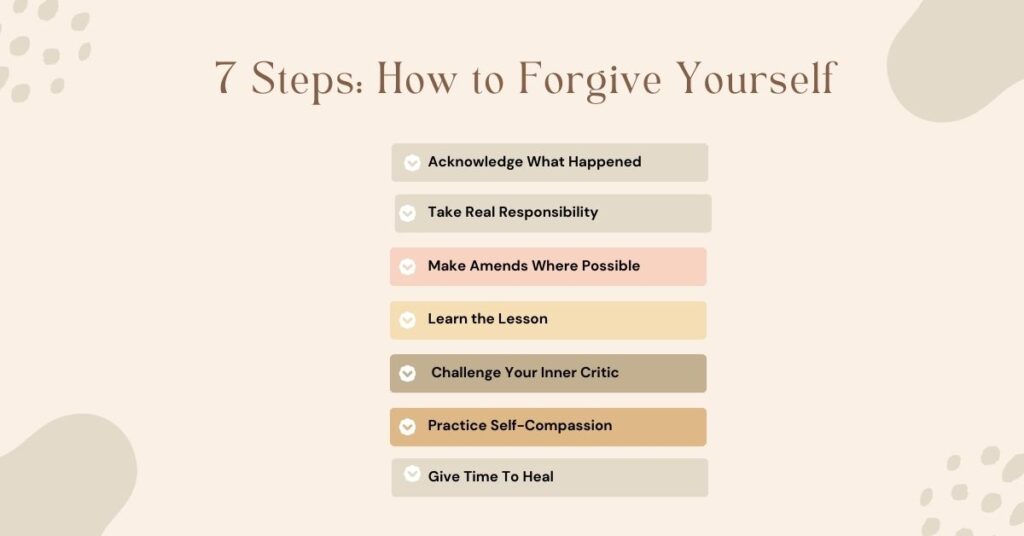
Forgiveness is not a single moment—it’s a process. The following framework integrates psychological principles, including Cognitive Behavioural Therapy (CBT) and research on self-compassion.
Step One: Acknowledge What Happened (Without Distortion)
The first step in forgiving yourself is getting clear on what actually occurred. This sounds simple, but it’s not. When we feel guilty or ashamed, we often do one of two things: we either blow the situation way out of proportion or we try to minimise it.
Name the mistake clearly and honestly. Avoid minimising it, but also avoid exaggeration.
Instead of:
“I ruined everything.”
Try:
“I made a decision that had consequences.”
This helps interrupt rumination and grounds you in reality.
Be careful here. There’s a difference between reasons and excuses. A reason helps you understand and prevent future mistakes. An excuse tries to escape responsibility entirely. When people struggle to forgive themselves for past mistakes, they often skip this crucial step: honest reflection.
Step Two: Take Real Responsibility
This step can’t be skipped. You can’t truly forgive yourself if you’re still running from what you did.
Taking responsibility means saying, out loud or in writing, “I did this thing. It was wrong (or hurtful, or a mistake). I’m responsible for my choice.”
Notice what’s not in that statement? “But I was stressed,” or “but they made me angr,y” or any other deflection. Those might be true. They might even be necessary for understanding what happened. But responsibility means owning your part fully.
If your actions hurt someone else, you often need to apologise to them. Not a “sorry you feel that way” non-apology, but a real one. “I did this specific thing. It was wrong. I’m sorry. Here’s what I’m going to do differently.”
Sometimes the person you hurt isn’t available or willing to hear your apology. Sometimes the person you hurt most is yourself. In those cases, write the apology anyway. Say it out loud to an empty room. Taking responsibility matters even when no one is there to accept the apology.
Step Three: Make Amends Where Possible
Forgiveness gets easier when you’ve done what you can to make things right. This doesn’t mean you can undo what happened. You can’t go back in time. But you can often do something now.
If you broke something, can you replace it? If you hurt someone with words, can you speak kindly now? If you let someone down, can you show up for them next time?
Sometimes making amends is direct like this. Other times it’s broader. Maybe you can’t fix the specific situation, but you can volunteer with an organisation that helps people in similar situations. Perhaps you can’t repay the person you hurt, but you can pay it forward by being extra kind to others.
Making amends also includes making changes in yourself. If you lashed out because you don’t handle anger well, getting help for that is a form of making amends.
If you lied because you were afraid of confrontation, learning better communication skills is a way to make amends. If you hurt yourself through self-destructive behaviour, taking care of your health now is making amends to yourself.
This step answers part of the question “how do you forgive yourself?” by showing that action matters. Forgiveness isn’t just about feelings or thoughts. It’s about what you do to repair the harm and prevent future damage.
Step Four: Learn the Lesson
Every mistake teaches something if you’re willing to learn it. This is where the value of forgiveness really shows up. When you’re stuck in self-punishment, you can’t know. You’re too busy feeling terrible.
But when you move toward forgiveness, you can ask better questions.
- What do I need to do differently next time?
- What warning signs did I ignore?
- What skills do I need to develop?
- What patterns am I repeating that need to change?
Write these lessons down. Seriously. There’s something about putting pen to paper (or fingers to keyboard) that makes lessons stick. You don’t need fancy language. Just “Next time I feel overwhelmed, I’ll ask for help instead of snapping at people” or “I learned that my boundaries matter and I need to speak up sooner.”
These lessons become your gift from the mistake. They’re proof that something good came from something bad. That doesn’t erase the bad, but it gives it meaning and purpose.
Step Five: Challenge Your Inner Critic
Most of us have a voice in our head that’s unnecessarily cruel. This voice often gets really loud when we’re trying to forgive ourselves. It says things like “You don’t deserve forgiveness,” “You’re a horrible person,” or “Everyone hates you now.”
Here’s the thing about that voice: it’s trying to protect you. Weird, right? But it thinks that if it means enough to you, you won’t make the mistake again. It thinks punishment equals safety.
It’s wrong.
When that voice starts up, try this: Would I say this to a friend who made the same mistake? If the answer is no (and it almost always is), then you don’t get to say it to yourself either.
Replace the harsh voice with a firm but kind one.
- Instead of “I’m so stupid,” try “I made a mistake and I’m learning from it.”
- Instead of “Everyone must hate me,” try “I hurt someone, and I need to work on repairing that relationship.”
You can acknowledge the mistake without destroying yourself in the process. This shift in self-talk is essential when trying to forgive yourself for past mistakes your inner critic won’t let go of.
Step Six: Practice Self-Compassion
Self-compassion sounds soft and fluffy, but it’s actually one of the strongest things you can do. It means treating yourself with the same kindness you’d offer a good friend.
Researcher Kristin Neff breaks self-compassion into three parts:
- Self-kindness (being warm toward yourself instead of harshly critical),
- Common humanity (recognising that everyone struggles and makes mistakes),
- Mindfulness (being aware of your pain without getting overwhelmed by it).
When you’re struggling to forgive yourself, all three parts matter. Be kind to yourself about the struggle. Remind yourself that literally billions of people have felt this same weight of guilt and regret. Notice your feelings without letting them take over completely.
One practice that helps: put your hand on your heart and take a few deep breaths. It sounds too simple to work, but this physical gesture of self-comfort actually calms your nervous system. Your body gets the message that you’re safe, even when your mind is spinning.
Another helpful practice is to speak to yourself the way you’d talk to a child who made a mistake. You wouldn’t scream at a kid who accidentally broke something. You’d help them understand what happened, guide them to make it right, and reassure them that they’re still loved. You deserve that same gentle guidance.
Step Seven: Give It Time (But Don’t Wait Forever)
Here’s a tricky balance: self-forgiveness takes time, but you can’t use that as an excuse to avoid it forever.
Some hurts and mistakes heal quickly. You snapped at someone, you apologised, and you both moved on. Forgiveness might come in days or weeks.
Other situations take longer. If you made a choice that had serious consequences, if you deeply hurt someone you love, if you violated your own values in a significant way, forgiveness might take months or even years. That’s okay. Healing isn’t a race.
But (and this is important) you still need to work on forgiveness during that time actively. Time alone doesn’t heal wounds. Time, effort, reflection, change, and compassion heal wounds.
If you notice yourself still stuck in the same place after months of trying, that might be a sign you need extra help. Talking to a counsellor, therapist, or trusted mentor can make a huge difference. Sometimes we need another person to help us see the situation clearly and find our way to forgiveness.
Professional help isn’t a sign of weakness. It’s a sign that you’re serious about healing and moving forward. Many people find that therapy is the key that finally helps them understand “how to forgive yourself for past mistakes,” which has been weighing on them for years.
How Do You Forgive Yourself When the Guilt Feels Overwhelming?
Sometimes the weight of what you’ve done feels so heavy that forgiveness seems impossible. You might think “other people deserve forgiveness, but not me. What I did was too bad.”
This is where you need to understand something important: the size of your guilt doesn’t always match the size of your mistake. Sometimes we carry enormous guilt over relatively minor things because of how we were raised or because the error touched on something we’re already sensitive about.
Other times, yes, the mistake was genuinely serious. But even then, endless self-punishment doesn’t help anyone. It doesn’t undo what happened. It doesn’t help the person you hurt. It just keeps you stuck.
When guilt feels overwhelming, try these approaches:
- Talk to someone you trust. Sometimes we need another person’s perspective to see the situation clearly. A friend, family member, therapist, or spiritual advisor can help you reality-check whether your guilt is proportional to what actually happened.
- Write a letter to yourself from the perspective of someone who loves you. What would your best friend say to you about this situation? What would a kind parent or mentor say? Write it down and read it when the guilt gets loud.
- Break the forgiveness process into smaller steps. You don’t have to forgive yourself completely today. Can you forgive yourself 1% today? Can you permit yourself to sleep tonight without replaying the mistake? Small steps count.
Remember that you’re a whole person, not just this one mistake. You’ve done kind things. You’ve helped people. You’ve tried your best in many situations. This mistake is part of your story, but it’s not the whole story.
Signs You’re Making Progress
How do you know if you’re actually forgiving yourself? Here are some signs:
- You can think about what happened without spiralling into shame. It still might sting a bit, but it doesn’t knock you flat.
- You can learn from the experience and apply those lessons to new situations.
- You’re not bringing it up constantly or using it as evidence that you’re a bad person.
- You can talk about it (when appropriate) without making excuses or deflecting responsibility.
- You’ve stopped punishing yourself through self-sabotage or self-destructive behaviour.
- You can accept compliments and good things without immediately thinking, “but I don’t deserve this because of that thing I did.”
- You’re focusing more on who you want to become than on who you were in that moment.
- You feel lighter. The constant weight of guilt has eased, even if it hasn’t completely disappeared.
- You’re kinder to yourself in general, not just about this specific situation.
Forgiveness doesn’t mean you never think about it again. It means the memory has lost its power to define you.
Final Thoughts: How to Forgive Yourself Starting Today
If you take only one thing from this article, let it be this: you are worthy of forgiveness. Not because you’re perfect, but because you’re human. You made a mistake in your past, but your past doesn’t have to be your prison.
Learning how to forgive yourself is one of the most essential skills you’ll ever develop. It affects your relationships, your career, your health, and your overall happiness. It determines whether you stay stuck in the past or move forward into the future.
You’re not alone in this. And you’re not stuck forever. Whether you’re trying to forgive yourself for past mistakes or for something that happened last week, the same principles apply: acknowledge what happened and take responsibility. Make amends where possible. Learn the lesson. Be kind to yourself. Give it time and effort.
Forgiveness is possible. It starts with the decision to try.
That decision can start right now.

Mehwish Arshad is the founder of Grow With Meh, a personal growth platform that helps women build self-awareness, emotional resilience, and a deeper understanding of themselves. For over 10 years, she has studied psychology, mindfulness, and personal development through extensive reading, research, and lived experience.