You can become more self-aware by paying attention to your thoughts and understanding your mindset patterns. It sounds simple, but most people never stop long enough to look inward.
Research by psychologist Tasha Eurich shows that 95% of people think they are self-aware, but only about 10 to 15% truly are. That gap is huge. And it costs people in their relationships, their careers, and their day-to-day happiness.
This guide breaks down what self-awareness really means, why it matters, and what you can do starting today to build it.
Table of Contents
Why Is Self-Awareness Important?

Self-awareness is a core part of emotional intelligence and helps you understand your thoughts and feelings and develop emotional balance and inner peace. When you understand your own emotions, thoughts, and behaviours, you make better choices and build stronger relationships with the people around you.
Without self-awareness, you run on autopilot and struggle with self-regulation. You react instead of respond. You repeat the same mistakes without knowing why. You hurt people without meaning to, and you struggle to grow because you cannot see what is holding you back.
Studies show that people with high self-awareness experience less anxiety and depression. They handle stress better, communicate more clearly, and are more likely to reach their personal and professional goals.
What Are The 4 Types Of Self-Awareness?
Self-awareness is not one single thing. Psychologists describe four types, and each one helps you understand yourself differently.
- 1. Internal Self-Awareness
Internal self-awareness is how clearly you see yourself from the inside. This includes knowing your own values, emotions, strengths, weaknesses, and the impact your behaviour has on others.
People with strong internal awareness often experience deeper personal growth and self-development. They know what they want, they understand why they feel the way they do, and they make decisions that line up with what actually matters to them.
- 2. External Self-Awareness
External self-awareness is the understanding of how others perceive you. It means being aware of how your words and actions come across to others, even when you had no bad intention.
This type of awareness helps you communicate better and build trust. If you only ever see yourself from your own point of view, you miss a lot of useful information about how you are actually showing up in the world.
- 3. Public Self-Awareness
Public self-awareness kicks in when you are in social situations. It is that feeling of being watched or evaluated by others, which can make you more careful about what you say and how you act.
A healthy level of public self-awareness helps you read social situations accurately. But too much of it can turn into anxiety, where you become so focused on what others think that you cannot relax or be yourself.
- 4. Private Self-Awareness
Private self-awareness is your ability to notice your own internal states, such as how your body feels when you are stressed, or to recognise when a certain thought pattern shows up in your mind.
This is the quieter, more personal side of self-awareness. It grows through practices like journaling, meditation, and honest reflection. It is about knowing yourself when no one is watching.
What Causes a Lack of Self-Awareness?
Most people are not born unaware. Lack of self-awareness builds up slowly, often because of habits, fears, or environments that discourage honest reflection. Here are the most common reasons people stay stuck.
You Live on Autopilot
When you are always busy or distracted, you never slow down enough to notice what is going on inside you. Mindfulness is the practice of paying attention on purpose, and without it, your inner world stays invisible to you.
You Skip Honest Feedback
Real self-awareness grows when you seek honest feedback from others. If you never ask for honest feedback, you only ever see yourself through your own (often biased) lens. Avoiding feedback keeps your blind spots hidden.
Your Brain Takes Shortcuts
Your brain takes shortcuts. These mental shortcuts, called cognitive biases, distort how you see yourself and make metacognition harder. They make you think you are being rational when you are actually being defensive or selective.
You Only See What You Believe
Confirmation bias is when you only pay attention to information that confirms what you already believe. You ignore facts that challenge your self-image, which makes it very hard to grow or change.
Your Memory Plays Tricks
Psychologist Daniel Kahneman described two versions of you: the experiencing self, who lives in the moment, and the remembering self, who stores and retells your life story. The remembering self can alter memories to protect your ego, making honest self-reflection harder.
You Need Others to Feel Good
If you need constant approval from others to feel okay about yourself, you stop trusting your own judgment. Your sense of self becomes tied to what others think, leaving you with little real self-knowledge.
Fear of Change
Self-awareness can be uncomfortable. This fear often appears during major life transitions. Once you see a problem clearly, you feel pressure to do something about it. Some people avoid self-reflection because they are not ready to face what they might find.
Lack of Role Models
If you grew up around people who never talked about emotions or rarely admitted mistakes, you probably did not learn how to reflect on yourself. Self-awareness is a skill, and like most skills, it is taught and modelled.
Avoidance Culture
Some families and workplaces reward people for staying busy and punish honest self-expression. In these environments, introspection is labelled as a weakness or selfishness, so people stop doing it.
You Reject Other People’s Reality
When someone tells you that your behaviour hurt them, it can feel threatening. Accepting their reality means admitting that your actions had an impact you did not intend. Many people find it hard to sit with.
Fear of Being at Risk
Knowing yourself deeply means being willing to see the parts of you that are not perfect. That takes courage. If vulnerability feels unsafe to you, self-awareness will always feel like a threat rather than a gift.
What Are the 5 Levels Of Self-Awareness
Self-awareness works on different levels. You can be aware in your body, in your emotions, in your thinking, or in your sense of purpose. Each level gives you different information about who you are.
- Physical
Physical self-awareness is noticing how your body feels moment to moment. Are your shoulders tense? Is your stomach in knots before a difficult conversation? Your body often sends signals about your emotional state before your mind catches up.
- Energetic
Energetic self-awareness is about noticing your internal energy levels and how certain situations, people, or activities either lift you or drain you. Moreover, it’s also an important part of slow living and protecting your energy. Noticing your energy patterns helps you set boundaries and protect your time.
- Emotional
Emotional self-awareness means being able to name what you are feeling, understand why you are feeling it, and recognise how your emotions affect your behaviour. This is one of the most important layers of self-awareness for your relationships and mental health.
- Mental
Mental self-awareness means self-monitoring your thoughts and noticing patterns. It includes catching cognitive distortions, recognising when you are ruminating, and seeing when your inner self-talk is helping you versus hurting you.
- Purpose/Spiritual
This level is about understanding your core values, finding your purpose in life, and seeing whether the way you spend your time aligns with what you care about. People who lack this level of awareness often feel lost or unfulfilled, even when life looks good on the outside.
12 Signs You Lack Self-Awareness
Most people who lack self-awareness do not know it. That is part of the problem. Here are some honest signs to watch for.
You Gossip Constantly
Constant gossip is often a sign that you are focusing on other people’s flaws to avoid looking at your own. It can also be a way to build social status without doing any real inner work.
You Need to Control Things
A strong need to control people and situations usually comes from unexamined fear or anxiety. Self-aware people recognise this pattern in themselves and work on it. People without self-awareness often escalate the control.
Winning Matters More Than Truth
If winning an argument matters more to you than understanding the truth, you have a self-awareness gap. Self-aware people can admit when they are wrong because their identity is not tied to always being right.
You Make Excuses
Everyone makes mistakes. But self-aware people take responsibility for themselves. If you always have a reason why something was not your fault, you are protecting your ego at the cost of your growth.
You Act Without Thinking
Impulsive decision-making often comes from not understanding your own emotional triggers. When you do not know what is driving your choices, you keep making choices that do not serve you.
You Only Focus on the Negative
A strong negativity bias can mean your self-monitoring focuses only on problems. Self-aware people notice when they are being unfair to themselves or others, and they work to rebalance their perspective.
You Chase Quick Fixes
Constantly chasing quick rewards at the expense of your long-term well-being is a sign of poor emotional self-regulation. Self-aware people can sit with discomfort long enough to make better choices.
Poor listener
Poor listening is often about being too caught up in your own thoughts and reactions to truly hear another person. It signals a lack of both self-awareness and social awareness.
You cannot say, “I was wrong.”
Admitting you are wrong requires a healthy self-concept and confidence. People who lack self-awareness often see being wrong as an attack on who they are, so they fight it rather than accept it.
You Blame Others
Chronic blame is one of the clearest signs of low self-awareness. It means you consistently see the cause of your problems as outside yourself, leaving you with no power to change anything.
Feedback Feels Like an Attack
Turning every piece of difficult feedback into a story about how you are being treated unfairly is a defence mechanism. It protects you from having to look at yourself, but it also keeps you stuck.
You Play It Safe Every Time
Growth requires seeing yourself clearly enough to know where you need to improve. If you are never uncomfortable, you are probably not learning, and that is often a sign that self-reflection is being avoided.
What Are the Ways to Cultivate Self-Awareness?
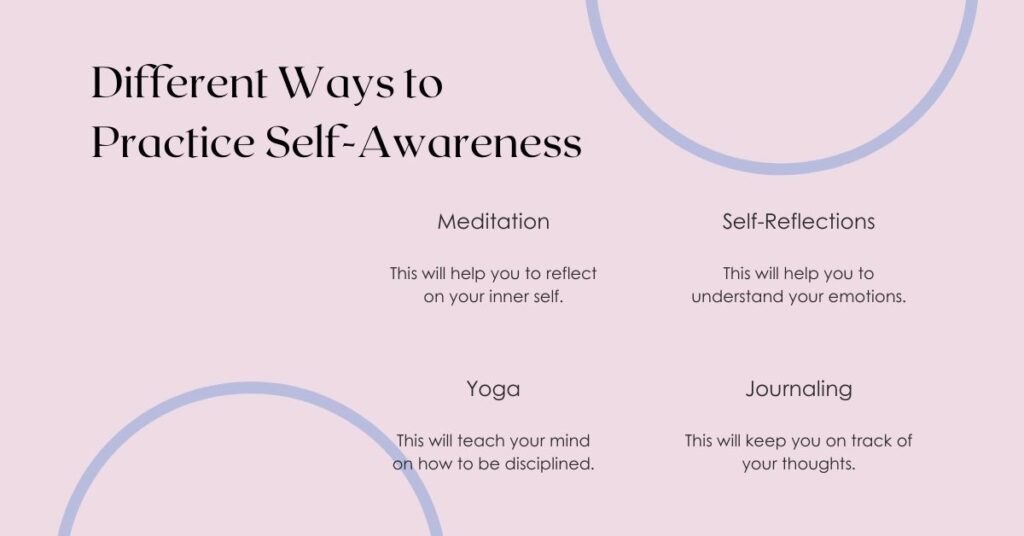
You can build self-awareness the same way you build any other skill: with practice, patience, and a willingness to be honest with yourself. Here are eight approaches that actually work.
Consult Your Loved Ones
People close to you often notice behaviour patterns you cannot seein yourself. Ask them directly: What is one thing I could do better? What do I do that sometimes makes things harder? Their answers may surprise you.
Make sure to listen without defending yourself. The goal is not to decide whether they are right or wrong. The goal is to get a clearer picture of how you come across to the people who matter to you.
Take a Personality Assessment
Personality tools such as the Myers-Briggs, Enneagram, and Big Five help you understand how you think and behave. They are not perfect, but they often put words to things you have always felt about yourself without being able to explain.
The real value is not in the label you get. It is in reading the description and asking yourself where it feels accurate and where it does not. That process of agreeing and pushing back is itself a form of self-reflection.
Journal
Writing your thoughts down is a simple self-reflection practice that helps you see them clearly. It turns vague feelings into concrete words, which makes them easier to examine. Even five minutes a day can start to shift how well you know yourself.
Try asking yourself reflection questions as you write: Why did I react that way? What was I actually feeling? What do I wish I had done differently? These questions turn journaling into an active practice of self-awareness.
Track Your Emotional Patterns
Start paying attention to how you feel at different points in your day and write it down. You might notice that you feel anxious every Sunday evening or that a certain person always leaves you feeling drained. These patterns tell you a lot about what is really going on inside you.
Over time, your notes will show you triggers and emotional cycles you never noticed before. That information gives you something real to work with, instead of just guessing why you keep feeling or reacting the same way.
Take Some Time to Think
You cannot grow in self-awareness if you are always on the move. Build short periods of quiet reflection into your day, whether that is a few minutes in the morning, a walk without your phone, or a few minutes before bed.
Reflection does not need to be complicated. It can be as simple as asking yourself at the end of the day: what went well today, what did not, and what do I want to do differently tomorrow?
Try Yoga
Yoga builds physical self-awareness by asking you to pay close attention to your body, your breath, and your limits. Over time, that attention to your physical experience starts to carry over into greater emotional and mental awareness, too.
Many people who practice yoga regularly report that it helps them stay calmer under pressure, notice their emotional reactions earlier, and feel more connected to their inner experience overall.
Spend Time Alone Without Distractions
Most people fill every quiet moment with their phone, music, or TV. When you do that, you never give your mind a chance to settle and show you what is actually going on underneath. Try sitting alone with no screen and no noise for even fifteen minutes a day.
At first, it might feel uncomfortable, and that discomfort is worth paying attention to. The thoughts and feelings that come up when everything is quiet are often the ones that need the most attention.n
Meditate Daily
Mindfulness meditation is one of the most researched self-awareness skills. It trains you to observe your thoughts and feelings without immediately reacting to them, which creates the space you need to understand yourself better.
You do not need to meditate for long periods to see the benefit. Even ten minutes a day of sitting quietly and paying attention to your breath has been shown to reduce stress and improve emotional self-regulation over time.
Conclusion
Self-awareness is not something you are born with or without. It is a skill you build by paying attention, asking hard questions, and being willing to hear honest answers.
Start small. Pick one practice from this article and try it for one week. Ask someone you trust for honest feedback, spend five minutes journaling, and sit quietly for a few minutes each morning before the day gets going.
The more you know yourself, the better your decision-making becomes. And better choices, made consistently, add up to a different kind of life.
FAQs
What is self-awareness, and give an example?
Self-awareness is the ability to see your thoughts, feelings, and behaviour clearly and improve your self-perception. For example, if you notice that you tend to get defensive when someone criticizes your work and understand that this reaction comes from a fear of failure, that is self-awareness in action.
What are the 5 elements of self-awareness?
They include emotional awareness, accurate self-assessment, confidence, reflection, and openness to feedback. Together, they help you understand yourself fully.
What are the benefits of increased self-awareness?
You build better relationships, make better decisions, handle stress well, and feel more satisfied with life. You are also better at setting limits, communicating clearly, and reaching your goals.
Is lack of self-awareness a red flag?
It can be, yes. A person who never reflects on how their behaviour affects others, who always blames external forces for their problems, and who resists honest feedback can be very difficult to be in a relationship with or to work with. That said, self-awareness is a skill that can be learned, so a lack of it is not necessarily permanent.

Mehwish Arshad is the founder of Grow With Meh, a personal growth platform that helps women build self-awareness, emotional resilience, and a deeper understanding of themselves. For over 10 years, she has studied psychology, mindfulness, and personal development through extensive reading, research, and lived experience.