
A few months ago, I caught myself going through my days on autopilot.
Nothing was terribly wrong, but nothing felt fully right either. My mornings felt rushed, my thoughts felt crowded, and I had the quiet sense that I was living slightly out of alignment with the person I wanted to be.
It wasn’t a crisis. It was a whisper.
That whisper is often where change begins, not in chaos, but in awareness. When you listen to it, even small intentional shifts can foster hope and create surprising momentum.
A 30-day reset isn’t about fixing your life. It’s about giving yourself a supportive, structured pause, a chance to step back, clear what’s heavy, and move forward with more clarity and intention.
How to Reset Your Life in 30 Days
Resetting your life in 30 days involves focusing on three steps: clearing what no longer serves you, building small daily habits, and creating a clear direction for your future.
Start by decluttering your environment and mind in week one; introduce simple routines to improve your energy in weeks two and three; and use the final week to set priorities and plan your next steps. This structured approach helps you regain clarity, momentum, and control over your life.
Why a 30-Day Reset Works
A 30-day reset works because it balances psychology, practicality, and momentum.
First, a month feels manageable. When a change has a clear timeframe, your brain treats it as a challenge rather than a permanent burden, which makes it easier to commit.
Second, thirty days is sufficient to disrupt old patterns. Repeating small actions daily begins to shift how you think and behave, and those small shifts compound quickly.
Finally, the process builds evidence. Each day you show up, even imperfectly, you prove to yourself that change is possible. That growing sense of capability is what turns a short experiment into a lasting transformation.
In simple terms, a month is enough time to build momentum, and steady progress is what drives meaningful change over time.
The 30-Day Life Reset Plan
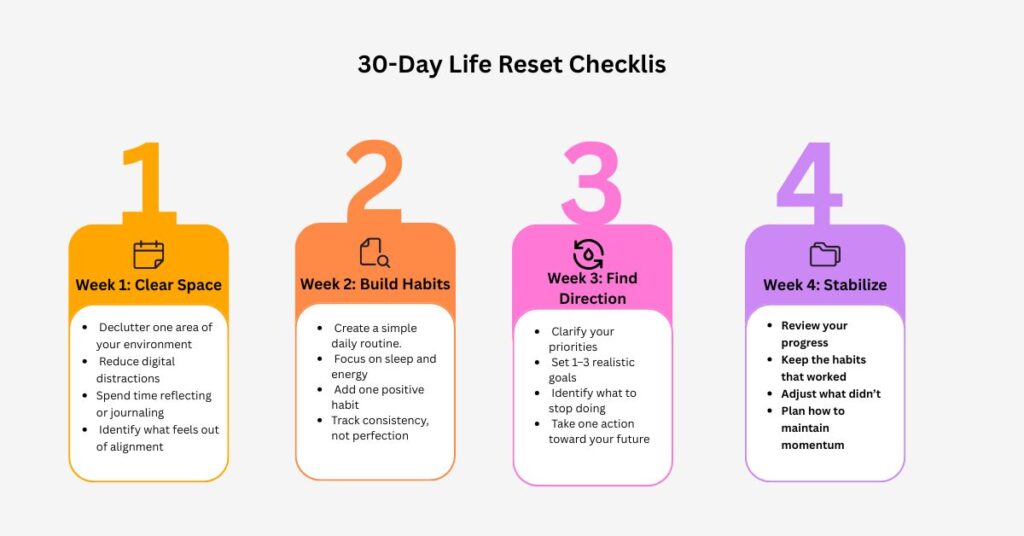
Week 1: Clear the Mental and Physical Noise
The first week is about creating space. You can’t build new habits on top of chaos.
Focus on simplifying your environment, reducing distractions, and noticing what drains your energy. This might mean decluttering a small area, limiting social media, or taking quiet time to reflect.
By the end of this week, you should feel lighter and more aware of what needs to change.
Week 2: Rebuild Your Core Habits
Once you’ve created space, start building supportive routines.
Focus on small daily actions that improve your energy and clarity. Consistency matters more than intensity. Simple habits repeated daily begin to shift how you feel and think.
This is where momentum starts to grow.
Week 3: Create Direction
With better energy and clarity, you can now focus on where you want to go.
Think about what matters to you, what you want more of, and what you want to leave behind. You don’t need a perfect life plan, just a sense of direction.
This stage transforms the reset from a short-term challenge into a meaningful shift.
Week 4: Strengthen and Stabilize
The final week is about making your changes sustainable.
Instead of adding more, focus on maintaining what’s working. Notice how you feel compared to day one. Reinforce the habits and mindset that helped you the most.
This is where the reset becomes a new baseline.
Common Mistakes to Avoid
Trying to change everything at once often leads to burnout. Another common mistake is expecting instant transformation. Real change is subtle at first, then compounds over time.
It’s also important not to compare your reset to someone else’s. Your timeline and priorities are unique.
What Happens After the 30 Days
By the end of the month, you may not feel transformed. But you will likely feel clearer, calmer, and more in control. Your circumstances might not be perfect. But your mindset, habits, and sense of direction can be very different.
That’s the real success of a reset. It gives you a new baseline from which to build.
The next step is simply continuing. Keep the habits that work. Refine what doesn’t. Set a direction for the next few months. Change compounds when you stay in motion, but you don’t need to sprint. You need to keep walking.
Conclusion
Resetting your life isn’t about becoming someone new. It’s about returning to yourself the version of you that feels intentional, grounded, and hopeful about what’s ahead.
Thirty days from now, you won’t have a perfect life. But you will have a perfect starting point. You’ll have a cleaner space, a calmer mind, a stronger body, and a clearer vision. You’ll have the tools to keep going. And most importantly, you’ll have proof that you can change.
Who will you be in 30 days?
FAQs
Q: Can you really change your life in 30 days?
You can’t transform everything, but you can build habits, gain clarity, and create momentum that leads to long-term change.
Q: What is the first step to resetting your life?
The first step is to create mental and physical space to focus on what truly needs to change.
Q: How do I stay motivated after the 30 days?
You stop relying on motivation. Motivation is a feeling, and feelings change. Instead, rely on systems. Pick ONE habit from the last 30 days that gave you the most benefit—just one. Commit to keeping that single habit for the next 30 days. Let it become automatic. When it feels easy, add another. Lasting change isn’t dramatic. It’s slow, boring, and real.
Q: What if I miss a day? Do I have to start over?
No. Never. Missing a day does not erase your progress. The only thing that kills a reset is quitting entirely. Follow the “clean restart” rule: miss one day, but do not miss two. A stumble is just a stumble. Forgive yourself, get back on track, and keep moving.
Q: Can you really change your life in 30 days?
You can change your direction in 30 days. You won’t be fluent in a new language or financially independent by day 31. But you will be someone who keeps promises to themselves. You’ll have more energy, a clearer mind, and proof that you’re capable of showing up. That proof is the foundation for everything bigger that comes next.

Mehwish Arshad is the founder of Grow With Meh, a personal growth platform that helps women build self-awareness, emotional resilience, and a deeper understanding of themselves. For over 10 years, she has studied psychology, mindfulness, and personal development through extensive reading, research, and lived experience.