
Everyone feels scared sometimes. Fear of rejection is one of those fears that can hold you back. It stops you from trying new things or talking to people. But you can beat it.
To overcome fear of rejection, start by recognizing that rejection is information, not a judgment of your worth. Practice exposure therapy by seeking small rejections, reframing negative thoughts, building self-worth independent of outcomes, and remembering that everyone experiences rejection. The key is to take action despite fear, learn from each experience, and gradually build your tolerance through repeated practice.
The good news? You can learn to handle it. This article will show you exactly how to overcome fear of rejection with practical steps anyone can follow.
What Is Fear of Rejection, Really?
Fear of rejection is worrying that people will say no to you, laugh at you, or decide they don’t like you. It’s the voice in your head that says, “Don’t try,” because trying might lead to failure.
This fear shows up everywhere. At school, when you want to join a new group. At home, when you want to share an idea, your parents might not love it. Online, when you think about posting something you created.
Your brain is actually trying to protect you. Thousands of years ago, being rejected by your tribe could mean danger. So our brains learned to fear it. The problem is, your brain can’t tell the difference between real danger and someone saying no to sitting with you at lunch.
Why Rejection Feels So Painful
Rejection hurts because it activates emotional pain in the brain. Studies show that social rejection triggers the same areas as physical pain.
That is why a simple no can feel heavy in your chest. That is why your stomach drops when you feel excluded.
Rejection also connects to self-worth. When you tie your value to how others respond, rejection feels personal.
But rejection is often about timing, preferences, mood, or limits, not about your value as a person.
Learning this difference is a key step in healing.
Signs You Have a Fear of Rejection
How do you know if this fear affects you? Look for clues in your actions.
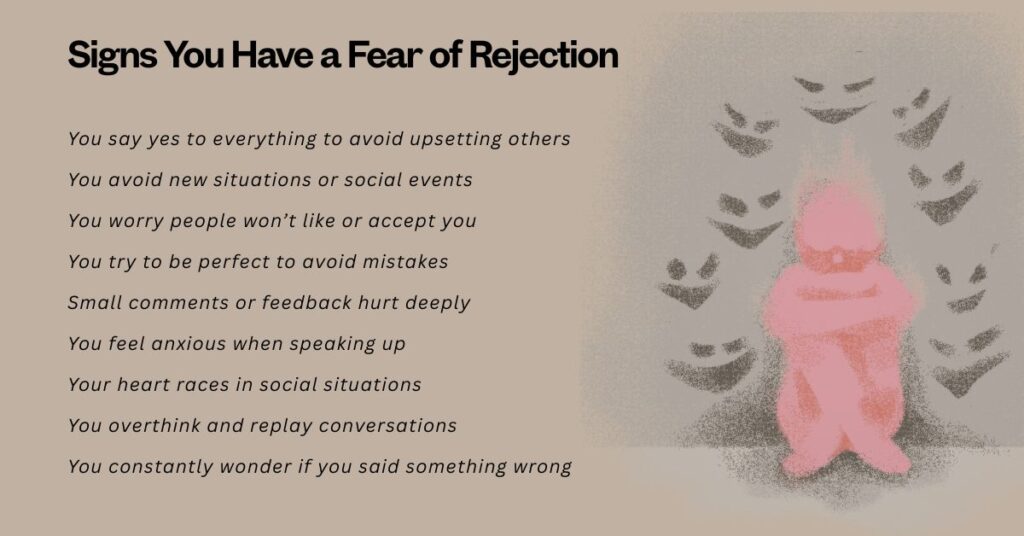
You might say yes to everything to please others. Or you avoid new situations. Like skipping a party because you worry no one will talk to you.
Perfectionism is a sign, too. You work extra hard on homework, thinking any mistake means rejection. Or you feel upset over small comments.
Inside, you might feel anxious, and your heart races when you need to speak up. Or you replay conversations, wondering if you said something wrong.
If these sound like you, do not worry. Recognizing them is the first step to change.
Unique Ways This Fear Shows Up in Kids
Most of the time, we talk about adults. But kids face it differently. At school, rejection might come from not getting picked for a game. Or when a best friend plays with someone else.
Bullying adds to it. If kids tease you, fear grows. You hide your true self.
Social media for kids is tricky. Apps like TikTok show trends. If your video flops, it feels like everyone rejects you.
Another angle: Family changes. Like parents splitting up. Kids might fear rejection from one parent. Or worry about new step-siblings.
Sports and clubs matter too. Trying out for soccer and not making it hurts. But it is a chance to learn.
These kid-specific spots are key. Adults forget them. But tackling them early builds strong habits.
10 Powerful Steps: How to Overcome Fear of Rejection
Step 1: Reframe How You Think About Rejection
Here’s a perspective shift that changes everything: rejection isn’t about you being not good enough. It’s just information.
When someone says no, they’re telling you about their preferences, their schedule, their life. Not about your worth as a person.
Maybe they’re busy. Perhaps they’re dealing with their own stuff. Maybe what you offered just isn’t a fit right now. None of that means you’re inadequate.
Professional athletes miss shots frequently. Publishers consistently reject writers. Your favorite musician likely got rejected from gigs when they were starting. Rejection is part of doing anything worthwhile.
Step 2: Start Small with Exposure Therapy
You can build your rejection tolerance like a muscle. Start with tiny risks.
Ask a store employee where something is (even if you already know). Request an extra napkin at a restaurant. Message someone online with a simple question. These are low-stakes ways to practice putting yourself out there.
Then gradually increase the difficulty. Invite one person to do something. Share an opinion in a group chat. Try something new in front of others.
Each time you survive a small rejection, your brain learns: “Oh, that wasn’t so bad. I’m still okay.” The fear starts to shrink.
This method works because you’re teaching your brain through experience, not just trying to think differently.
Step 3: Use the 10-10-10 Rule for Perspective
When you’re scared to do something because of possible rejection, ask yourself: How will I feel about this in 10 minutes? 10 months? 10 years?
Usually, you’ll realize that in 10 minutes, the worst will be over. In 10 months, you probably won’t remember the details. In 10 years, you’ll wish you’d taken more chances.
This helps you see past the immediate fear to what actually matters. It puts temporary discomfort in context with your longer-term happiness and growth.
Step 4: Intentionally Collect Rejections
Some people flip the script entirely. They set a goal to collect rejections.
Writer Jia Jiang did this. He challenged himself to get rejected once per day for 100 days. He asked strangers for unusual favors, pitched wild ideas, and requested things no reasonable person would agree to.
Guess what happened? He got way more yeses than he expected. And the nos stopped bothering him. He realized rejection was just part of life, not a commentary on him.
You don’t need to do 100 days. But aiming for one rejection per week can actually make you braver. When you’re seeking it out, it loses its power over you.
Set a goal: “I want to get rejected three times this month.” Then make it happen. Each rejection becomes a badge of courage instead of a source of shame.
Step 5: Separate Your Self-Worth from Outcomes
This is crucial. You are not your successes. You are not your failures. You’re a person with value that exists independent of what others think.
When you base your self-worth on always getting accepted, you give other people control over how you feel about yourself. That’s exhausting, and it doesn’t work.
Instead, decide that you’re worthwhile because you exist. Because you try. Because you care. The outcomes are just outcomes.
Build your identity on things you can control: your values, your effort, your kindness, your growth. Not on whether every person says yes to you.
Step 6: Create a “Rejection Recovery” Plan
It helps to know what you’ll do when rejection happens (and it will).
Maybe you’ll text a friend who always makes you laugh. Perhaps you’ll go outside and shoot hoops. Maybe you’ll watch a comfort show or listen to music that energizes you.
Having a plan means you’re not caught off guard. You already know: “Okay, that didn’t work out, but I’ve got this.”
Write down three things you can do to feel better after a rejection. Keep this list in a place you can find easily. When the moment comes, you won’t have to figure it out while feeling crummy.
Step 7: Focus Only on What You Can Control
You can control whether you try. You can control your effort. You can prevent being kind and genuine.
You cannot control what other people think, feel, or choose.
When you focus on the controllable parts, rejection becomes less personal. You did your part. The outcome was always going to be partly outside your control.
This mindset removes the sting because you’re measuring success differently. Success becomes “I tried” instead of “they said yes.”
Ask yourself before any situation: What parts of this are within my control? Focus your energy there. Let go of the rest.
Step 8: Study Rejection Stories from People You Admire
Your heroes get rejected. The popular kids get rejected. Your parents got rejected at some point.
Look up rejection stories from successful people. 12 publishers rejected J.K. Rowling’s Harry Potter. Michael Jordan got cut from his high school basketball team. Oprah was fired from her first TV job.
What is the difference between people who seem fearless and people who hide? The “fearless” ones just do it anyway. They feel the fear and act despite it.
Nobody is immune. Some people are just better at not letting it stop them. You can be one of those people, too.
Step 9: Practice Self-Compassion After Rejection
When you get rejected, how do you talk to yourself? If you’re like most people, you’re probably pretty harsh.
“I’m so stupid.” “Of course they said no.” “I never should have tried.”
Would you talk to a friend that way? Probably not.
Try this instead: treat yourself like you’d treat someone you care about. “That stings, but it’s okay. You were brave to try. This doesn’t mean anything about who you are.”
Self-compassion isn’t about making excuses or pretending rejection doesn’t hurt. It’s about being kind to yourself when you’re feeling hurt. Research shows this actually helps you bounce back faster.
Step 10: Keep a “Courage Journal”
Buy a small notebook or start a note on your phone. Every time you do something despite fear of rejection, write it down.
“Asked Sarah to study together.” “Raised my hand in math class.” “Posted my drawing online.”
You don’t need to write whether it worked out. Just that you tried.
Over time, you’ll have proof of your bravery. On days when fear feels overwhelming, you can look back and see: “I’ve done hard things before. I can do this too.”
This journal becomes evidence that you’re the kind of person who doesn’t let fear win. That identity shift is decisive.
Why These Steps Work Together
Each of these steps attacks fear of rejection from a different angle.
Some change how you think (reframing, perspective). Some change what you do (exposure, collecting rejections). Some involve changing how you treat yourself (e.g., self-compassion, separating worth from outcomes).
You don’t need to use all ten at once. Pick two or three that feel most doable right now. Try them for a week. See what happens.
The magic is in the combination. When you practice these consistently, fear of rejection loses its grip. Not because you stop feeling it, but because you get better at moving forward anyway.
What Happens When You Push Through
Here’s what happens when you start pushing through fear of rejection:
You make more friends by reaching out first. You get better at things because you’re eager to try and fail. You discover opportunities you never would have found by playing it safe.
You also develop absolute confidence. Not the fake kind where you pretend you don’t care. The real kind where you know you can handle whatever happens.
Life gets bigger. More colorful. More interesting.
You start to see rejection as feedback, not failure. Each “no” teaches you something or points you toward a better fit.
Common Mistakes to Avoid
Don’t try to eliminate fear. That’s not the goal. The goal is to act despite fear.
Don’t compare your beginning to someone else’s middle. That person who seems so confident? They’ve probably been practicing these skills longer than you.
Don’t use alcohol or substances to numb the fear. That might work temporarily, but it prevents you from actually building tolerance. You need to feel the fear and survive it for your brain to learn.
Don’t wait until you feel ready. You’ll never feel 100% ready. Start before you’re ready. That’s how everyone does it.
Frequently Asked Questions
How long does it take to overcome fear of rejection?
It varies by person, but most people notice improvement within 2 to 4 weeks of consistent practice. Building lasting confidence typically takes 3 to 6 months of regular exposure to rejection situations. The key is to practice regularly, not wait for the fear to disappear before you start.
What is the root cause of fear of rejection?
Fear of rejection usually comes from past emotional pain, childhood experiences, or repeated criticism. The brain learns to associate rejection with danger, even when no real threat exists. This fear grows stronger when self-worth depends on others’ approval.
What happens if you are afraid of rejection?
If you’re afraid of rejection, you typically avoid situations where rejection might occur, which limits your opportunities, relationships, and personal growth. Over time, this avoidance increases anxiety, lowers self-confidence, and can lead to isolation, missed career opportunities, and regret about chances not taken.
Is fear of rejection a mental illness?
Fear of rejection itself is not a mental illness but a normal human emotion. However, when it becomes extreme and interferes with daily life, it may be a symptom of social anxiety disorder or rejection-sensitive dysphoria. If fear of rejection prevents you from functioning normally, consider talking to a mental health professional.
Can therapy help with fear of rejection?
Yes, therapy can be very effective for fear of rejection. Cognitive behavioral therapy (CBT) helps change thought patterns, while exposure therapy gradually builds tolerance. A therapist can provide personalized strategies, accountability, and support, making the process easier and faster than going it alone.
Why do I take rejection so personally?
You take rejection personally when your self-worth is tied to external validation and outcomes. This often stems from childhood experiences of conditional love, critical parenting, or past rejections that reinforced the belief that one is not good enough. Learning to separate your worth from outcomes helps reduce this pattern.
Bottom Line: You Can Overcome Fear of Rejection
Fear of rejection is normal, universal, and completely manageable. It doesn’t have to control your choices or limit your life.
The path to overcoming fear of rejection isn’t about becoming fearless. It’s about building courage through practice, changing how you interpret rejection, and treating yourself with compassion along the way.
Start small. Be patient with yourself. Celebrate every moment you try, regardless of the outcome.
The world needs what you have to offer. Your ideas matter. Your presence matters. Don’t let fear keep you hidden.
Pick one step from this article. Just one. Do it this week. Then come back and pick another.
You’ve got this. And every time you push through the fear, you prove it to yourself a little bit more.

Mehwish Arshad is the founder of Grow With Meh, a personal growth platform that helps women build self-awareness, emotional resilience, and a deeper understanding of themselves. For over 10 years, she has studied psychology, mindfulness, and personal development through extensive reading, research, and lived experience.