You wake up, and your first thought is about everything you did wrong yesterday. Your stomach tightens. The day hasn’t even started, and you’re already exhausted. This is what life looks like when you’re running on empty, when you treat yourself like the enemy instead of a friend.
However, a question arises here: How does self-love actually reduce anxiety and stress?
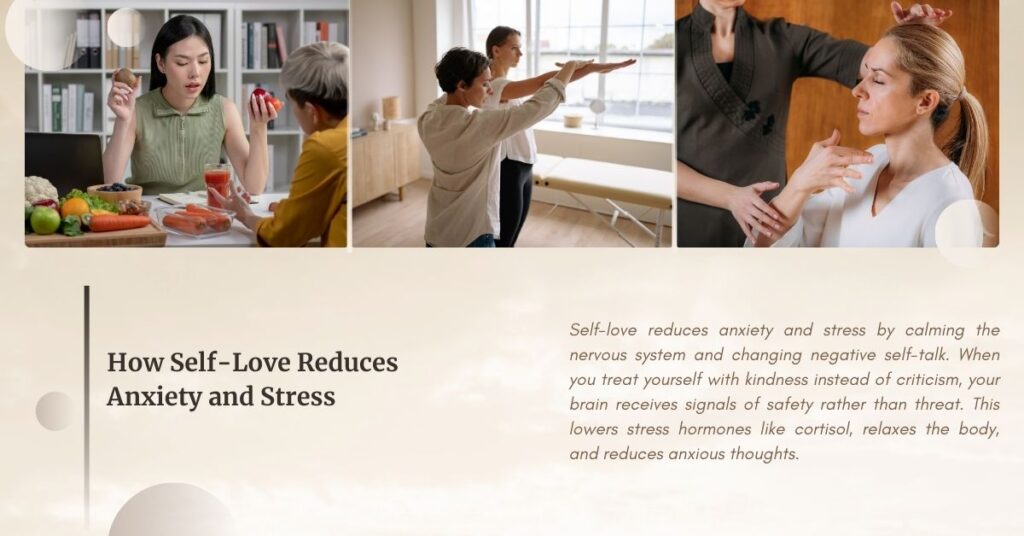
Self-love reduces anxiety and stress by calming the nervous system and changing negative self-talk. When you treat yourself with kindness instead of criticism, your brain receives signals of safety rather than threat. This lowers stress hormones like cortisol, relaxes the body, and reduces anxious thoughts.
Self-love also helps you accept mistakes, set healthy boundaries, and respond to pressure with calm instead of fear. Over time, this creates emotional balance, mental resilience, and a stronger sense of inner security.
But here’s something most people don’t realize: the way you talk to yourself directly affects how anxious and stressed you feel. Self-love isn’t some fluffy concept reserved for spa days and bubble baths. It’s a powerful tool that can genuinely change how your brain and body respond to pressure.
What Self Love Actually Means
Let’s clear something up right away. Self-love doesn’t mean you think you’re amazing at everything. It doesn’t mean you ignore your mistakes or pretend problems don’t exist.
Self-love is treating yourself the way you’d treat someone you genuinely care about. When your best friend messes up, you don’t tell them they’re worthless. You help them figure out what went wrong and how to do better next time. That’s what self-love looks like. Its compassion turned inward. It’s about allowing yourself to be human, to learn, to grow, without beating yourself up along the way.
Your Brain on Self-Criticism
Here’s what happens inside your head when you constantly criticize yourself.
Your brain has an alarm system designed to keep you safe from danger. When early humans encountered a predator, this system kicked in. Heart rate up, muscles tense, ready to run or fight.
The problem is, your brain can’t always tell the difference between a real threat and your own harsh thoughts. When you tell yourself, “I’m so stupid” or “I always fail,” your brain treats it like an actual danger. Your body floods with stress hormones. Your nervous system stays on high alert. Day after day, this wears you down. It’s like living in a house where the fire alarm never stops going off, even when there’s no fire.
Scientists have measured this. People who practice harsh self-criticism have higher cortisol levels, the body’s primary stress hormone. Over time, too much cortisol contributes to anxiety, depression, sleep problems, and even physical illness.
How Self-Love Calms Your System
When you practice self-love, something different happens in your brain.
Research shows that self-compassion activates the same neural pathways as physical comfort. When you speak kindly to yourself, your brain releases oxytocin and endorphins. These are the chemicals that make you feel safe, calm, and connected.
It’s the same response you get from a hug or from petting a dog. Your nervous system gets the message: you’re okay. You’re safe. You can relax.
This isn’t just about feeling warm and fuzzy. It’s about changing your body’s baseline stress response. When you build a habit of self-kindness, you’re actually rewiring your brain to be less reactive to stress.
Think of it like this. Self-criticism is like constantly stepping on the gas pedal of your stress response. Self-love is like taking your foot off that pedal and letting your system return to normal.
The Anxiety Connection
Anxiety thrives on fear. Fear of not being good enough. Fear of making mistakes. Fear of what others think.
When you don’t love yourself, every challenge feels like a threat to your worth. If you fail, it means you’re a failure. If someone criticizes you, it confirms what you already believe: that you’re not good enough.
This mindset creates constant anxiety. You’re always on the defensive, always trying to prove yourself, always worried about the next thing that could go wrong.
Self-love doesn’t eliminate challenges or make criticism disappear. But it changes how you respond to them. When you know your worth isn’t tied to being perfect, mistakes become learning opportunities instead of catastrophes.
You start to trust yourself more. Not because you never mess up, but because you know you’ll handle whatever comes your way. You’ve got your own back.
This shift is massive for anxiety. Instead of drowning in worry, you can acknowledge complicated feelings and move through them. You become more resilient, not because problems don’t affect you, but because you don’t collapse under their weight.
Why Being Kind to Yourself Isn’t Weak
Some people worry that self-love will make them lazy or complacent. They think they need to be tough on themselves to stay motivated.
Research proves this wrong. Study after study shows that self-compassion actually improves performance. When you treat yourself kindly after setbacks, you’re more likely to try again. You learn faster because you’re not paralyzed by shame.
Athletes who practice self-compassion bounce back from losses more quickly. Students who are kind to themselves get better grades. People who forgive their own mistakes are more likely to stick with their goals.
The reason is simple. Harsh self-criticism creates fear of failure. When you’re terrified of making mistakes, you play it safe. You avoid challenges. You give up when things get hard because the pain of trying and failing feels unbearable.
Self-love creates psychological safety. You can take risks because you know that even if you fail, you won’t destroy yourself over it. You’ll pick yourself up, learn what you can, and keep moving forward.
How Can Self-Care Help With Anxiety?
Self-care helps with anxiety by regulating your nervous system and meeting your basic physical and emotional needs. When you get enough sleep, eat nourishing food, move your body, and take breaks, you give your brain the resources it needs to handle stress.
Self-care also sends a powerful message to your brain that you’re safe and worthy of care, which calms the anxiety response.
Simple practices like deep breathing, spending time in nature, or doing activities you enjoy lower stress hormones and create space between you and anxious thoughts.

20 Practical Ways to Build Self-Love and Reduce Anxiety
You don’t need to transform completely overnight. Small changes add up.
- Notice your inner voice. Start paying attention to how you talk to yourself. Would you say these things to a child? To a friend? If not, that’s your signal to change the script.
- Reframe mistakes as information. Instead of “I’m so stupid for messing that up,” try “That didn’t work. What can I learn from this?” Same situation, totally different message to your brain.
- Take care of your body without punishment. Eat when you’re hungry. Sleep when you’re tired. Move in ways that feel good, not like penance for eating dessert. Your body deserves care, not punishment.
- Set boundaries without guilt. Saying no to things that drain you isn’t selfish. It’s essential. You can’t show up well for anything or anyone if you’re completely depleted.
- Celebrate progress, not just perfection. Did you get out of bed when you felt terrible? That took strength. Did you ask for help? That took courage. Notice these moments rather than just counting significant achievements.
- Stop the comparison trap. Other people’s success doesn’t diminish yours. Everyone is on their own timeline. Scrolling through social media and feeling inadequate is a sign to step away and reconnect with your own life.
- Practice the self-compassion break. When you’re stressed, put your hand on your heart. Take three slow breaths. Say to yourself: “This is really hard right now. Everyone struggles sometimes. May I be kind to myself in this moment?” This simple practice interrupts the stress response and activates your calming system.
- Create a worry window. Set aside 15 minutes each day as your designated worry time. When anxious thoughts pop up outside this window, write them down and tell yourself you’ll think about them during your worry time. This gives your brain permission to let go temporarily and reduces all-day anxiety.
- Use the 5-4-3-2-1 grounding technique. When anxiety spikes, name 5 things you can see, 4 you can touch, 3 you can hear, 2 you can smell, and 1 you can taste. This brings you back to the present moment and out of anxious thoughts about the future.
- Keep a self-appreciation journal. Before bed, write down three things you did well that day or three qualities you appreciate about yourself. Your brain naturally focuses on threats and problems. This practice also trains it to notice what’s going right.
- Practice progressive muscle relaxation. Tense each muscle group for 5 seconds, then release. Start with your toes and work up to your head. This releases physical tension that anxiety creates and teaches you the difference between tension and relaxation.
- Set up a self-care routine you actually enjoy. Not what Instagram says you should do. What actually makes you feel better? Maybe it’s 10 minutes of reading. Perhaps it’s drawing. Maybe it’s sitting outside with coffee. Consistency matters more than duration.
- Challenge catastrophic thinking. When your brain jumps to worst-case scenarios, ask: “What’s the evidence for this? What’s the evidence against it? What’s the most realistic outcome?” This breaks the anxiety spiral.
- Create a calming playlist. Music directly affects your nervous system. Build a collection of songs that genuinely calm you. Put it on when you feel stress building, rather than waiting until you’re overwhelmed.
- Practice saying “I’m doing my best.” When you catch yourself in harsh self-judgment, pause and say this out loud. It’s simple but powerful. It acknowledges effort instead of demanding perfection.
- Build tiny moments of joy into your day. Anxiety makes everything feel heavy and serious. Deliberately add small pleasant moments. A favourite snack. A funny video. A text to someone you love. These create positive breaks in the stress cycle.
- Use the STOP technique. When stress hits, stop what you’re doing. Take a breath. Observe what’s happening in your body and mind. Proceed with something that supports you. This creates space between stress and reaction.
- Practice self-touch for comfort. Put your hand on your chest or give yourself a gentle hug. Physical touch, even your own, releases oxytocin and reduces cortisol. Your body responds to this comfort.
- Create a permission list. Write down things you permit yourself to do. Permission to rest. Permission to say no. Permission to change your mind. Permission to be imperfect. Read it when guilt shows up.
- Talk to yourself in third person. Instead of “I’m so anxious,” try “You’re feeling anxious right now.” Research shows this small shift creates distance from overwhelming emotions and helps you respond more calmly.
The Perfectionism Problem
Perfectionism and anxiety are best friends. They feed off each other.
When you believe everything must be flawless, you create impossible standards. You avoid trying new things because you might not excel immediately. You procrastinate on projects because you’re afraid they won’t be good enough. You overwork yourself trying to meet standards that don’t exist.
This creates massive stress. You’re never satisfied because perfect doesn’t exist. You’re always anxious because failure (which is guaranteed when you aim for the impossible) feels like proof of your inadequacy.
Self-love means accepting that you’re allowed to be imperfect. Actually, you’re supposed to be imperfect. That’s how humans work. Mistakes aren’t flaws in your character. They’re part of learning and growing.
When you let go of perfectionism, stress levels drop dramatically. You can enjoy the process rather than just caring about the result. You can experiment without the weight of constant judgment crushing you.
Your Body Remembers Everything
Chronic stress doesn’t just live in your head. It settles into your body.
Headaches, stomach problems, tight shoulders, trouble sleeping, and getting sick more often. All of these connect to ongoing stress and anxiety.
As you develop more self-love, many people notice physical improvements. Their bodies don’t hold as much tension. They sleep better. They have more energy.
This makes sense when you understand the mind-body connection. When your brain feels safe, your body can relax.
When your nervous system isn’t constantly on alert, your immune system works better. When you’re not flooded with stress hormones all day, your whole system functions more smoothly.
Starting Where You Are
You don’t need to master self-love before you see benefits. Even small shifts make a difference.
Maybe you start by taking three deep breaths when you notice yourself spiralling into worry. Maybe you write down one thing you appreciate about yourself each night. Perhaps you talk to yourself the way you’d talk to someone you love, just once a day.
Pick something manageable. Do it consistently. Notice what changes.
The path forward isn’t about adding more pressure or becoming someone different. It’s often about releasing the pressure you’ve been carrying. It’s about recognizing that you deserve kindness, especially from yourself.
Self-love is a practice, not a one-time achievement. Some days feel easier than others. That’s completely normal. What matters is that you keep showing up for yourself, even when it’s hard.
Frequently Asked Questions
Does self-love help with anxiety?
Yes, self-love significantly helps with anxiety. When you practice self-love, you activate your brain’s calming response rather than its threat response. Self-compassion triggers the release of oxytocin and endorphins, which naturally reduce anxiety.
It also changes how you interpret challenges, seeing them as temporary obstacles rather than proof of your inadequacy.
Does low self-esteem cause anxiety?
Anxiety isn’t always caused by low self-esteem, but the two are closely connected. Low self-esteem can definitely contribute to anxiety because when you don’t believe in your ability to handle challenges, everything feels more threatening.
You worry more about making mistakes, being judged, or failing because you see these as confirmation of your lack of worth.
However, anxiety can also exist independently due to genetics, brain chemistry, trauma, or life circumstances. The good news is that building self-love and self-esteem can reduce anxiety symptoms regardless of the original cause.
How does doing something you love reduce anxiety and stress?
Doing something you love reduces anxiety and stress by shifting your brain out of threat mode and into a state of pleasure and engagement.
When you’re absorbed in an enjoyable activity, your mind stops ruminating on worries. Your body releases dopamine, which counters stress hormones.
Activities you love also give you a sense of control and competence, which directly opposes the helplessness that feeds anxiety. Plus, doing things you enjoy is a form of self-love that reinforces the message that you deserve good experiences, which builds resilience against stress.
How to decrease stress and anxiety?
To decrease stress and anxiety, combine physical practices with mental strategies.
Physical habits that calm the body
• Get regular, quality sleep
• Move your body daily, even light walking helps
• Practice deep, slow breathing
• Limit caffeine and alcohol intake
• Eat regular, balanced meals
Mental habits that reduce anxiety
• Challenge negative or catastrophic thoughts
• Practice self-compassion instead of self-criticism
• Set clear boundaries to protect your energy
• Limit news and social media exposure
• Use grounding techniques when feeling overwhelmed
Daily support for long-term relief
• Build a simple routine that feels stable
• Make time for activities you enjoy
• Spend time with people who support and understand you
Most important mindset shift
• Treat yourself kindly when you struggle
• Self-criticism increases stress and anxiety
• Self-compassion activates your body’s calming response and improves emotional coping

Mehwish Arshad is the founder of Grow With Meh, a personal growth platform that helps women build self-awareness, emotional resilience, and a deeper understanding of themselves. For over 10 years, she has studied psychology, mindfulness, and personal development through extensive reading, research, and lived experience.