
To love yourself, you accept who you are right now, including your flaws, and you treat yourself with the same care you would give someone you care about. Start by noticing how you talk to yourself and replacing harsh self-criticism with honest, kinder words. Set boundaries that protect your time and energy.
Moreover, stop tying your worth to your productivity or other people’s approval. Practice small daily habits like rest without guilt, honest self-reflection, and saying no when you need to. Self-love is not a feeling you wait for. It is a choice you make repeatedly, especially on the hard days.
Table of Contents
What Is Self-Love? (Not What Social Media Tells You)
Self-love means accepting yourself, treating yourself with kindness, and respecting your emotional needs. It allows you to care for your well-being without constant self-criticism or guilt.
True self-love looks like:
- Speaking to yourself with kindness, especially during failure
- Accepting your imperfections without shame
- Making choices that protect your mental and emotional health
Psychologist Carl Rogers once said, “The curious paradox is that when I accept myself just as I am, then I can change.” This perfectly captures self-love. It is not about staying stuck—it is about growing without self-hate.
Why Self Love Matters?
Loving yourself is not optional; it is foundational. Research published in Psychological Science shows that people with higher self-compassion experience lower anxiety, reduced depression, and better emotional resilience. When you respect yourself, you naturally create a healthier life.
Self-love impacts:
- Mental health: less stress, fewer negative thought loops
- Relationships: healthier boundaries and emotional balance
- Decision-making: choosing what aligns with your values
- Confidence: quiet confidence rooted in self-worth, not validation
Without self-love, people often seek external approval, tolerate unhealthy relationships, or feel unfulfilled even after achieving success.
Why Is Self-Love So Difficult For Many Women?

Most conversations about self-love treat everyone the same. But women face a specific set of pressures that make it harder to turn care inward. These are not personal failures. They are patterns built into you long before you could question them.
Emotional Labor
Emotional labour is the invisible work of managing other people’s feelings. It is softening bad news, keeping the peace, and making sure everyone feels okay, even when you do not. Sociologist Arlie Hochschild, who coined the term in 1983, found that women carry a much larger share of this work at home and at work. When your default is to regulate everyone else’s emotional world, you have very little left over for your own.
People-Pleasing
For many women, people-pleasing is not a personality trait. It is a survival strategy that started early. If love felt conditional on your behaviour growing up, saying yes and staying quiet made sense. The trouble is, it does not stop when the original pressure is gone. You keep shrinking yourself to keep others comfortable, and that comes at a real cost to how you see yourself.
Perfection Pressure
Society tells women to look a certain way, age without showing it, be ambitious but not difficult, and always be available. Those messages do not stay outside. They get internalised. When you believe you have to be perfect to deserve love, every mistake becomes proof that you have failed. You cannot practice self-love while running a mental checklist of everything wrong with you.
Relationship Expectations
Women are judged more harshly for choosing themselves. Leaving a relationship, saying no to caregiving, or simply outgrowing a friendship can bring real social cost. That pressure makes it easy to defer, wait for permission, and put your needs last. Loving yourself sometimes means choosing yourself, even when others do not understand.
Signs You May Struggle With Self-Love

It can be hard to see your own patterns clearly. Here are some signs that self-love might be a challenge for you right now.
- You constantly look for validation from others. You rely on compliments, likes, or approval to feel okay about yourself. Without that feedback, you feel unsure or anxious.
- You feel guilty when you rest or say no. Taking a break feels like laziness. Saying no to someone feels like you have done something wrong, even when the request was unreasonable.
- You struggle to set boundaries. You let people cross your limits because you are afraid of upsetting them or losing their approval. You say yes when you mean no, and then feel resentful afterwards.
- You are very harsh with yourself when you make mistakes. You talk to yourself in a way you would never talk to someone you care about. Small errors become big evidence that you are not good enough.
- You feel responsible for everyone else’s emotions. You work hard to keep everyone around you happy, even at your own expense. When someone is upset, you immediately wonder what you did wrong.
The Psychology Behind Self-Love
Psychologist Kristin Neff, one of the leading researchers on self-compassion, says that self-love has three main parts. These are self-kindness (being warm with yourself instead of being critical), common humanity (knowing you are not alone in your struggles), and mindfulness (seeing your feelings clearly without drowning in them).
Your inner critic is the voice in your head that judges everything you do. That voice usually started as someone else’s voice, like a parent, teacher, or peer who criticised you when you were young. Over time, you internalised it and made it your own. Recognising that the inner critic is not the truth about you is one of the first steps in learning how to love yourself.
Self-worth is your deep belief that you deserve care, respect, and good things in your life. Many people carry low self-worth from childhood experiences like neglect, criticism, or trauma. The good news is that self-worth is not fixed. You can build it slowly over time through new experiences, better habits, and more compassionate self-talk.
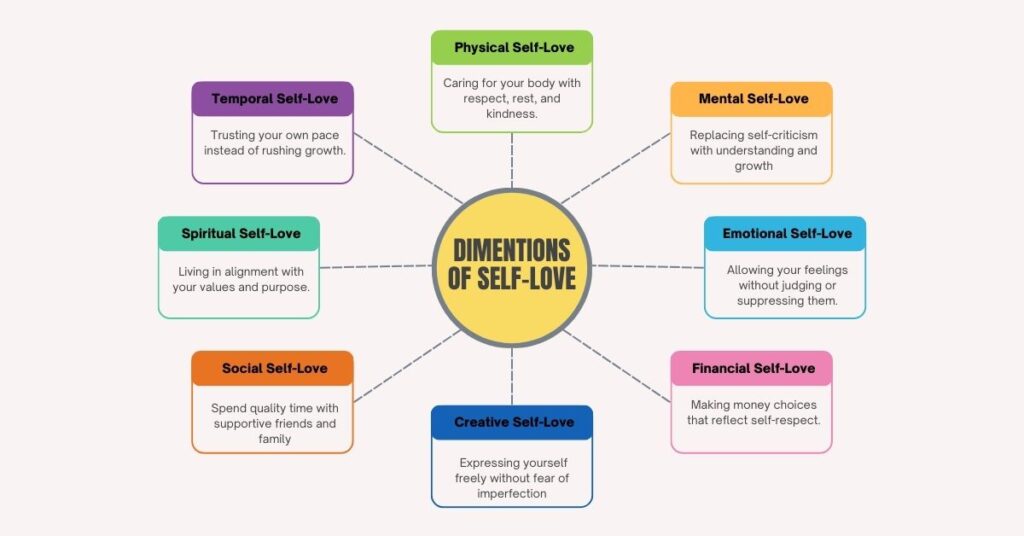
The 8 Dimensions of Self-Love (And Why All of Them Matter)
Most approaches to self-love focus only on thoughts and feelings. But self-love actually shows up across eight areas of your life, and if you’re only working on one or two of them, that’s why it doesn’t feel like it’s sticking.
1. Physical self-love means respecting your body as a partner, not an enemy. Instead of pushing yourself to “love” how you look, try body neutrality first, focusing on what your body does rather than how it appears. Move in ways that feel good, not just ways that burn calories. And rest without guilt. Sleep researcher Matthew Walker showed that rest is when your body repairs, consolidates memories, and regulates emotions. It’s not laziness; it’s maintenance.
2. Mental self-love is about the voice in your head. When you catch yourself thinking “I always mess up,” ask: Is that actually true, or is your mind catastrophizing? Psychologists call these cognitive distortions automatic thought patterns that feel true but aren’t. Replacing harsh self-talk with honest, kinder language doesn’t mean lying to yourself. It means being fair.
3. Emotional self-love means honouring your feelings without judgment. Start by naming emotions precisely. Instead of “I feel bad,” try “I feel disappointed” or “I feel anxious.” Naming your feelings calms them. You’re also allowed to feel two things at once: grateful and sad, excited and scared. All of it counts.
4. Social self-love shows up in who you spend your time with. Ask yourself: Do you feel more energised or depleted after spending time with this person? You’re also allowed to disappoint people. Sometimes protecting yourself means saying no, and that’s not a failure of kindness. It’s honesty.
5. Spiritual self-love isn’t necessarily religious. It’s about living in alignment with what actually matters to you. Viktor Frankl, whose work on meaning-making transformed modern psychology, showed that suffering becomes bearable when you find meaning in it. Knowing your core values and making choices that honour them rather than what others expect builds a kind of self-worth that doesn’t collapse when external things go wrong.
6. Creative self-love means valuing your perspective and expression even when no one is watching. Make things just for yourself. Write the journal entry nobody will read. Sing in the car. Create something messy. When you make things only hoping for praise, you lose the pure joy of making. Your creative impulses are worth honouring.
7. Financial self-love is one thing people rarely talk about, but how you handle money reflects how much you value your future self. Spend on things that align with your values, not things you’re “supposed” to buy. Invest in your growth: that course, that therapy session, that book. And release money shame. Past financial mistakes don’t make you a bad person. Most of us made decisions based on what we knew, what we could afford, or what we needed to survive.
8. Temporal self-love means respecting your own pace. There’s no fixed age by which you have to achieve certain things. Some phases of life are for growth and movement; others are for rest and slowing down. After big changes or difficult emotions, give yourself time to process before pushing forward. Healing doesn’t follow a schedule, and rushing it doesn’t make it happen faster.
Why Self-Love Is Not the Same as Selfishness
One of the most common fears people have is that if they love themselves too much, they will stop caring about others and call it selfishness. That is not how it works. When you care for yourself, you actually have more to give to the people around you.
Think of it this way. You cannot pour from an empty cup. One of the clearest tests of this is your social world. When you practice self-love, you stop tolerating relationships that consistently drain you and start building ones based on genuine reciprocity: people who remember what matters to you, who ask about your life, who show up when things are hard. That isn’t selfishness. That’s having a standard.
Setting boundaries is also not rejection. When you say no to something that drains you, you are being honest and responsible. You are not abandoning anyone. You are just being clear about what you can and cannot give right now.
The Self-Love Growth Journey
Awareness
You begin by noticing how you speak to yourself each day. Awareness helps you see patterns without judgment. You may write down your thoughts to better understand them. This simple step builds clarity and emotional insight.
Acceptance
You allow yourself to be imperfect without shame. Acceptance reduces inner resistance and stress. You stop fighting reality and start working with it. This creates a sense of emotional safety.
Compassion
You respond to mistakes with patience instead of blame. This reduces fear of failure over time. You learn to comfort yourself during difficult moments. Emotional support builds resilience.
Boundaries
You say no when something drains your energy. This protects your mental space and focus. You also communicate your needs more clearly. Respect grows when your limits are honoured.
Growth
You build confidence by keeping promises to yourself. Small, consistent actions create trust. Over time, progress feels natural instead of forced. Your self-image improves through experience.
How to Learn to Love Yourself: 15 Simple Ways
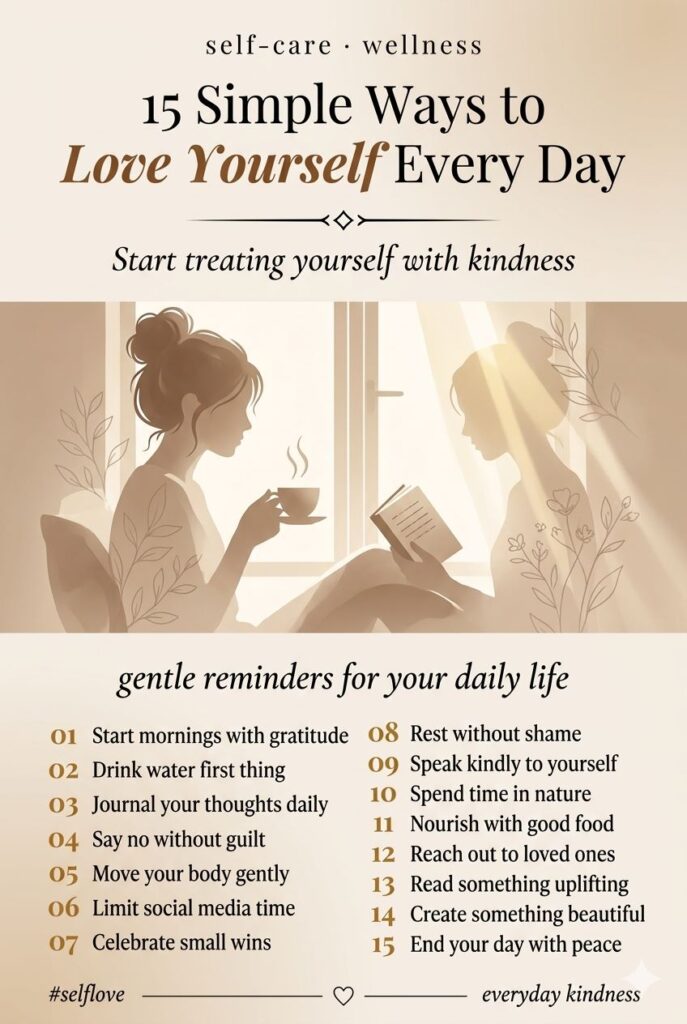
You do not need a complete life overhaul to start loving yourself more. Small, consistent actions build up over time. Here are fifteen things you can start doing today.
1. Speak to Yourself with Compassion
Notice how you talk to yourself when you make a mistake. Then ask yourself if you would say that to someone you love. If the answer is no, try softer words instead. This one shift alone can change your entire inner world.
2. Set Healthy Emotional Boundaries
You are allowed to say no for ten minutes without explaining yourself. Boundaries are not walls. They are clear, honest limits that protect your energy and your relationships.
3. Stop Comparing Yourself to Others
Comparison steals your focus from your own life and puts it on someone else’s highlight reel. When you notice comparison creeping in, bring your attention back to where you are and what you are building.
4. Practice Forgiveness Toward Yourself
You made mistakes. Everyone does. Holding onto shame about the past does not undo anything. It just keeps you stuck. Forgiving yourself means choosing to move forward rather than staying in the story of what went wrong.
5. Celebrate Small Progress
You do not need to wait until you have achieved something big to feel good about yourself. Noticing small wins, like getting through a hard day or trying something new, builds a habit of self-recognition that grows over time.
6. Protect Your Mental Space
You get to choose what you let into your mind and how you protect your inner peace. That includes social media, conversations, and news. If something consistently makes you feel worse about yourself, you are allowed to step away from it.
7. Rest Without Guilt
Rest is not a reward you earn after being productive enough. It is a basic need. When you let yourself rest, you are telling your body and mind that they matter.
8. Do Things Just Because You Enjoy Them
Not everything has to be productive or useful. Doing something simply because it brings you joy is one of the most direct forms of self-love there is.
9. Listen to What Your Body Needs
Eat when you are hungry. Sleep when you are tired. Move in ways that feel good, not just ways that burn the most calories. Your body gives you signals. Practising self-love means you pay attention to yourself.
10. Ask for Help When You Need It
You do not have to handle everything alone. Asking for help is a sign of self-awareness, not weakness. It means you know your limits and you respect them.
11. Stop Trying to Please Everyone
You cannot make everyone happy, and trying to do so will exhaust you. Focus on being honest and kind. That is enough.
12. Spend Time with People Who Feel Good to Be Around
The people in your life affect how you feel about yourself. Notice how you feel after spending time with different people. Then make choices about who gets your time and energy.
13. Say No to Things That Cost You Too Much
Not every opportunity, invitation, or request deserves a yes. Saying no to things that drain you is a form of self-respect. Your time and energy are yours to decide about.
14. Keep Small Promises to Yourself
When you say you will do something for yourself and then you actually do it, you build trust in yourself. That trust is a big part of self-love. Start small and be consistent.
15. Practice Mindful Self-Talk
Pay attention to the words you use about yourself throughout the day. When you catch yourself being harsh, pause and replace the thought with something more neutral or kind. You do not have to go from “I am terrible” straight to “I am amazing.” Just moving toward kinder, more honest work.
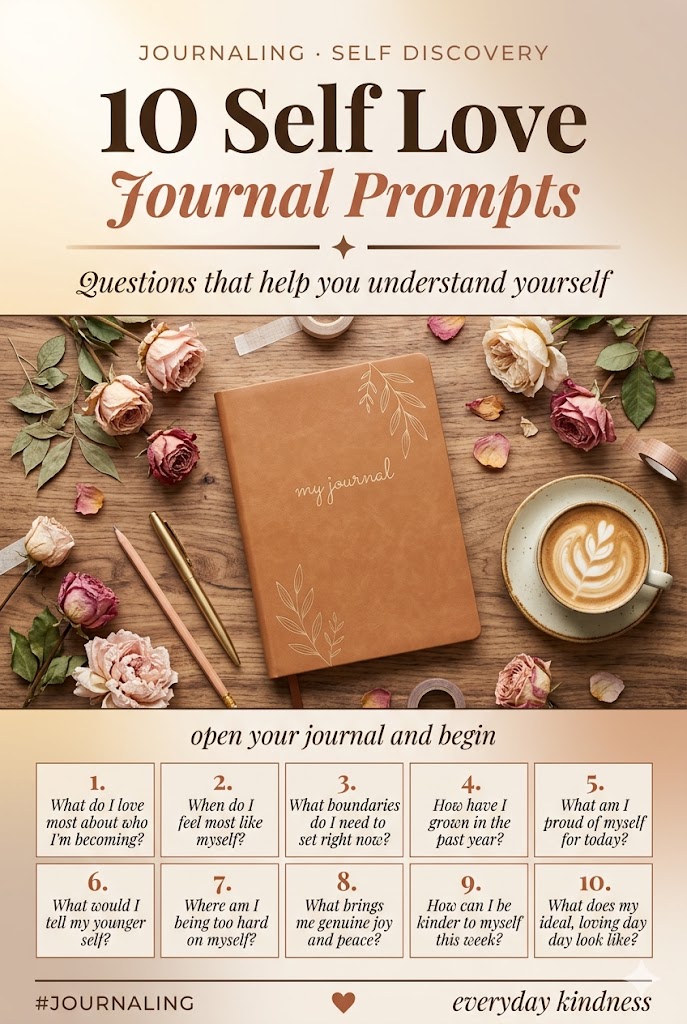
10 Self-Love Journal Prompts for Deeper Self-Awareness
Writing things down helps you get out of your head and see your thoughts more clearly. These prompts can help you connect with yourself on a deeper level.
- What do I criticise myself for the most, and where did that voice come from?
- When do I feel most like my true self?
- What would loving myself look like today, practically?
- What needs have I been ignoring, and why?
- What am I carrying right now that I did not choose but still blame myself for?
- How do I feel after spending time with the main people in my life?
- What would I tell a younger version of myself about worth and love?
- Where in my life am I pretending to be okay when I am not?
- What boundaries do I keep letting people cross, and what would it feel like to hold them?
- What small thing am I proud of that I never let myself fully acknowledge?
How to Start Loving Yourself When You Feel Broken
When you are going through something painful, self-love can feel almost impossible. You might feel like you do not deserve it or like you are too far gone. That feeling is not the truth. It is painful to talk.
Healing starts with just one small act of care. It might be drinking a glass of water when you are upset, rather than ignoring your body. It might be allowing yourself to cry instead of pushing feelings down. These small acts add up to something real over time.
Rebuilding your sense of self after loss, trauma, or hard times takes patience. You may not know who you are anymore, and that is okay. You are allowed to figure it out slowly. Self-love during this time means staying curious about yourself rather than giving up on yourself.
How Self-Love Improves Your Relationships
Healthy relationships start with self-love. When you value yourself, you don’t chase validation, tolerate disrespect, or lose yourself in others. Instead, you build connections based on mutual respect, honesty, and emotional security.
Self-love helps you:
- Choose healthier partners
- Communicate your needs clearly
- Avoid emotional dependency
- Maintain your identity in relationships
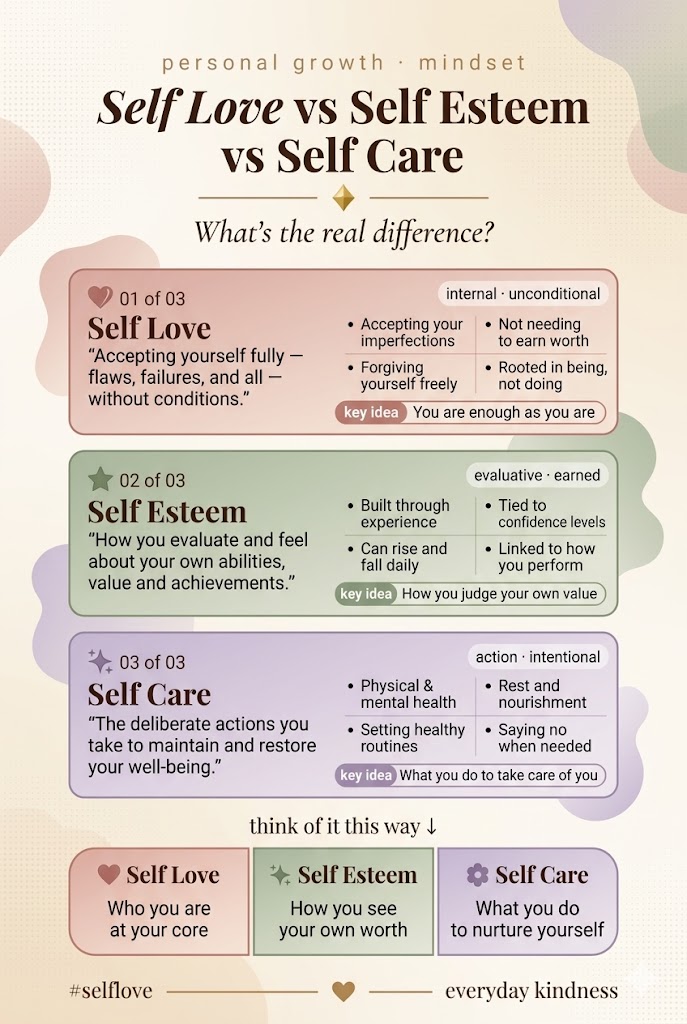
Self-Love vs Self-Esteem vs Self-Care
These three things are connected, but they are not the same, and knowing the difference helps you work on the right thing.
Self-love is about acceptance. It is the foundation. You accept that you are a full human being who is worth caring for, regardless of what you have done or not done. Self-love is steady and does not depend on how well you are performing.
Self-esteem is about evaluation. It is how you judge your own abilities and value. Self-esteem can go up and down based on your experiences. Someone can have low self-esteem in one area (like their career) and higher self-esteem in another (like their relationships).
Self-care is about actions. It is what you do to take care of your body, mind, and emotions. Bubble baths and face masks are only a tiny sliver of what self-care means. Real self-care also includes sleep, boundaries, therapy, honest conversations, and saying no when you need to.
You need all three. But self-love is where you start. Without it, self-care feels like a chore, and self-esteem stays fragile.
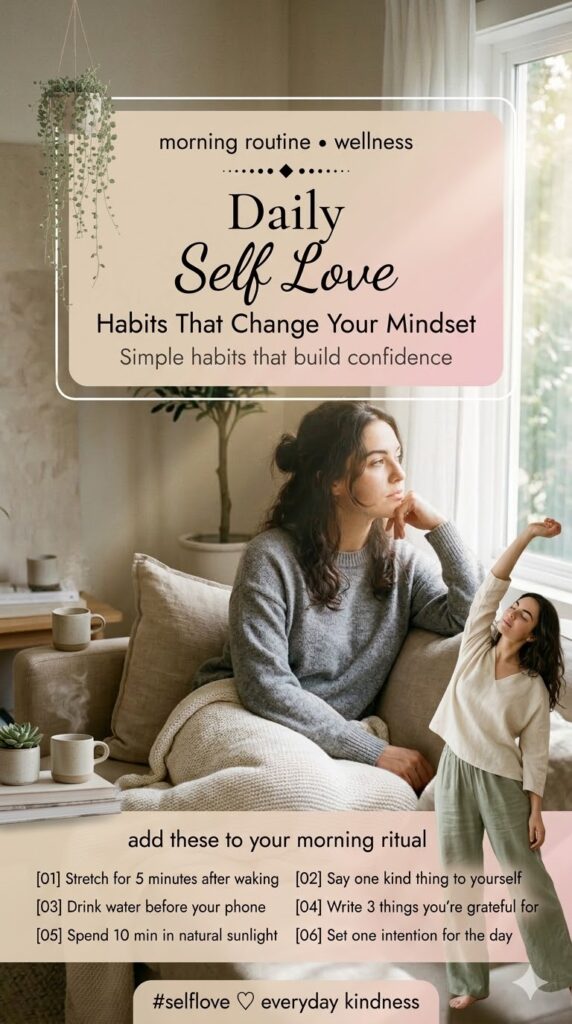
Daily Self-Love Habits That Change Your Mindset
You build self-love the same way you build any other skill. You practice it repeatedly until it becomes part of how you live. These small daily habits help shift your mindset over time.
Mindful self-talk means checking in on how you speak to yourself throughout the day. You do not have to be positive all the time. You have to stop being automatically cruel to yourself when things go wrong.
Gratitude does not have to be a big formal practice. It can be as simple as noticing one thing each day that went okay or one quality you used that helped you get through something. This trains your brain to look for proof that you are doing all right.
Reflection means taking a few minutes at the end of the day to check in with yourself. What felt hard today? What felt okay? What do you need tomorrow? This keeps you connected to your own experience instead of just running on autopilot.
Holding your own boundaries daily means practicing saying no, even to small things, so it does not always feel like a huge event. The more you practice, the easier it gets, and the more you trust yourself to follow through.
Creative practice, even a small one, is one of the most underrated daily self-love habits. Write a few sentences, doodle something, or make something with your hands without any goal other than the making. When you create, only hoping for approval, the joy disappears. Creating just for yourself is a reminder that you exist beyond what others need from you.
Spending intentionally is also a form of daily self-love. Once a week, take one minute to notice whether your money is going toward things that actually matter to you. Your spending is a record of your values. When it doesn’t match them, that’s information, not shame.
Start Loving Yourself Today: Final Thoughts
Learning how to love yourself is not a destination you arrive at. It is a practice you keep returning to, especially on the hard days. You will forget. You will be harsh with yourself. You will put everyone else first and wonder why you feel so empty. That is okay. You start again.
You deserve the same kindness you give to people you love. Not because you have earned it, not because you have healed enough, and not because you have finally fixed all your flaws. You deserve it because you are a person, and that is reason enough.
Explore our other articles on personal development, emotional healing, and inner growth to keep building a life rooted in self-respect and confidence.
FAQ Section
Why is self-love important?
Self-love is important because the way you treat yourself sets the tone for how you let others treat you. It also affects your mental health, your relationships, your decisions, and your ability to cope with hard times.
How do you start loving yourself?
You start by noticing how you talk to yourself and making one small shift toward kindness. You do not have to fix everything at once. One kinder thought, one boundary honoured, one moment of rest without guilt, those are real starting points.
Is self-love the same as self-care?
Self-care is part of self-love, but self-love goes deeper, encompassing how you speak to yourself, the standards you set, and the respect you show yourself daily.
How long does it take to learn self-love?
Self-love is a lifelong journey. With consistent practice, small changes can be felt within weeks, but deep self-love develops over time through patience and self-compassion.
Can self-love improve relationships?
Yes. When you love yourself, you communicate more effectively, set healthier boundaries, and build relationships based on respect rather than emotional dependence.
What are the different types of self-love?
Self-love shows up across eight dimensions: physical, mental, emotional, social, spiritual, creative, financial, and temporal. Most people focus on one or two and wonder why it doesn’t stick. Working across all eight, even in small ways, creates a more complete and lasting sense of self-worth.
What does self-love look like in daily life?
It looks like pausing before you speak harshly to yourself. It looks like resting without performing guilt. It looks like saying no to something that costs you too much, and yes to something that only serves you. Self-love is rarely dramatic; it’s made of small choices you make in ordinary moments.
Quick Summary:
To love yourself, practice self-acceptance and self-appreciation, speak kindly to yourself, set boundaries,
take care of your body, forgive your mistakes, enjoy your life, and choose positive influences.
Self-love is built through small, consistent actions, not perfection.

Mehwish Arshad is the founder of Grow With Meh, a personal growth platform that helps women build self-awareness, emotional resilience, and a deeper understanding of themselves. For over 10 years, she has studied psychology, mindfulness, and personal development through extensive reading, research, and lived experience.