

You can renew your mind from negative thoughts by identifying unhealthy thinking patterns, challenging them with evidence, replacing them with realistic affirmations, practicing gratitude and mindfulness, and building supportive habits that rewire your brain through neuroplasticity.
If you’ve ever wondered how to renew your mind from negative thoughts, the problem isn’t a lack of positivity or willpower. It’s how your brain has been trained through repetition.
The good news? Your mind is changeable. Neuroscience, psychology, and cognitive behavioural therapy (CBT) show that negative thinking patterns can be interrupted, rewired, and replaced with healthier mental habits.
In this guide, you’ll learn 7 evidence-based steps to stop negative thoughts and renew your mind, using proven techniques backed by brain science.
Why Do Negative Thoughts Take Over the Mind?
Your brain’s primary job is survival, not happiness. It scans for danger, remembers negative experiences more strongly than positive ones, and assumes worst-case scenarios to keep you alert. This is why:
- One criticism outweighs ten compliments
- You replay embarrassing moments for years
- Your mind jumps to the worst possible outcome
This doesn’t mean something is wrong with you. It means your brain has formed habits that once served a purpose but no longer do. The goal of mind renewal is not to eliminate negative thoughts. The goal is to change your relationship with them and reduce their power.
7 steps: How to Renew Your Mind From Negative Thoughts
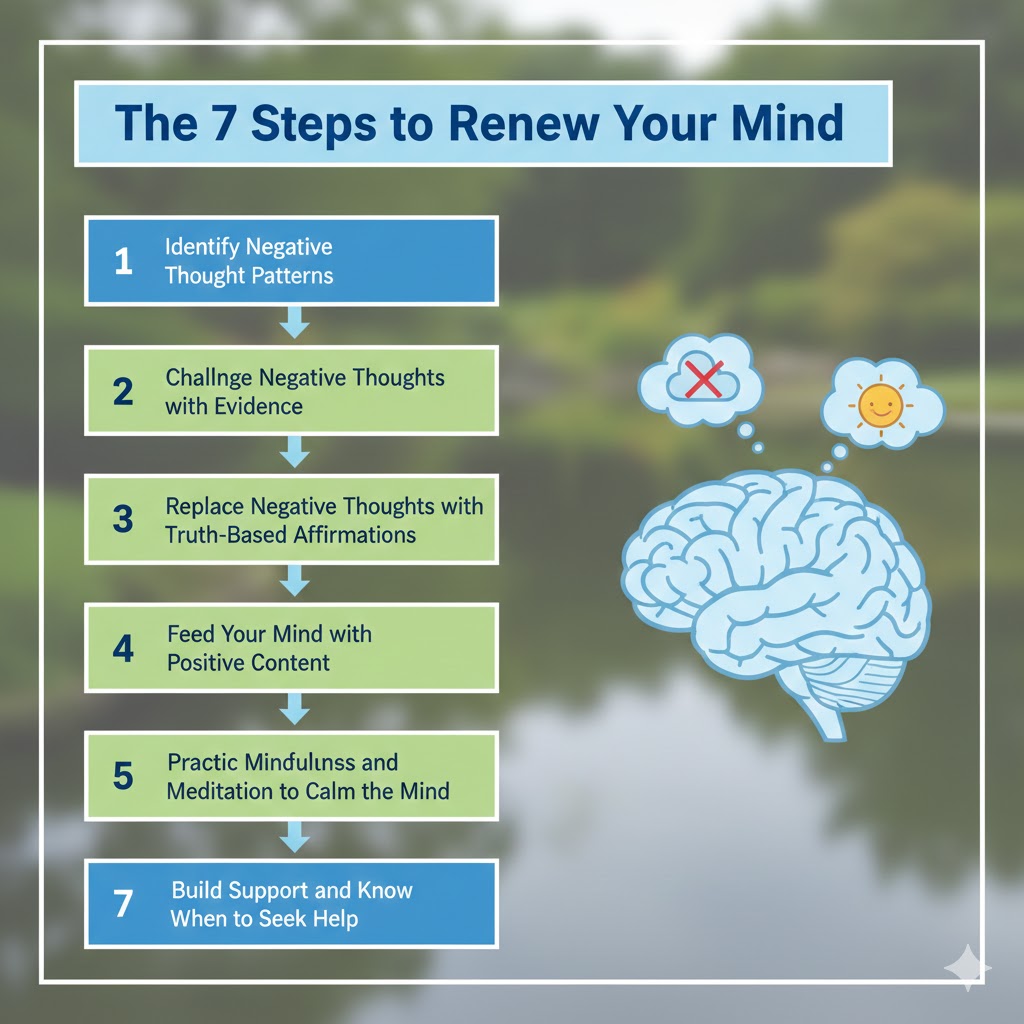
Step 1: Identify Negative Thought Patterns
You can’t change patterns you don’t notice, and negative thoughts often run automatically in the background. When you start paying attention to what’s happening in your mind, you create the first real opportunity for change. Awareness helps you step out of autopilot and respond more intentionally.
To build this awareness, track your thoughts for a few days in a notebook or on your phone. Write the exact thought, what triggered it, the emotion you felt, how intense it was, and how you reacted. This simple practice helps you see patterns clearly and understand how your thinking shapes your feelings and behavior.
Common negative thought patterns
- Self-worth thoughts: “I’m not good enough,” “I’m a failure.”
- Catastrophizing: “Everything will go wrong.”
- Rumination: “I should have done better.”
- Comparison: “Everyone else is ahead of me.”
Step 2: Question Your Thoughts (CBT Method)
Cognitive Behavioural Therapy teaches that thoughts are interpretations, not truths. Once you identify a negative thought, challenge it with structured questioning. Ask yourself these 5 questions:
- Is this a fact or a feeling?
“I feel like a failure” is not the same as “I failed at one task.” - What evidence supports and contradicts this thought?
Write both sides. Most people ignore evidence that contradicts negativity. - Am I mind-reading or predicting the future?
These are common cognitive distortions. - What would I say to a friend thinking this way?
Apply the same compassion to yourself. - What is the most realistic outcome?
Reality is usually between worst-case and best-case scenarios.
Step 3: Choose Supportive Self-Talk
Neuroscience confirms that affirmations and positive self-talk activate the brain’s reward centres and release dopamine. However, affirmations must be believable, not fantasy-based toxic positivity. Your brain will reject affirmations that feel entirely disconnected from your reality. Use this framework: “Even though ___, I ___.”
- “Even though I feel anxious, I can handle discomfort.”
- “Even though I’m imperfect, I am worthy of respect.”
- “Even though I made mistakes, I am learning.”
You get the most from affirmations when you center them on self-worth, capability, and inner peace. When you remind yourself that you are enough, that you can face challenges, and that difficult feelings pass, you shift your inner dialogue toward support instead of doubt. Practiced consistently, these messages help you feel more confident and emotionally steady.
To help them stick, speak your affirmations aloud, picture them as real, and repeat them every day. Keep them visible in places you look often so they become part of your routine. With repetition, your brain strengthens these positive pathways, making encouraging thoughts easier to believe.
Step 4: Consume Positive Content
What you consume becomes your mindset. Your brain absorbs patterns from repeated exposure, making your content diet as important as your food diet. As the old saying goes, “Garbage in, garbage out” or “Growth in, growth out.”
Start by auditing what you regularly consume, including social media, news, podcasts, TV, and everyday conversations. Notice which inputs drain your energy and which ones support your growth. When you become aware of your content habits, you can intentionally choose what shapes your mindset.
Instead of only cutting things out, replace them with better alternatives that move you forward. Swap doomscrolling for educational podcasts, comparison-driven feeds for growth-focused accounts, and constant negative news for limited updates. Aim for an 80/20 rule; most of what you consume should inspire growth, while a small portion can be pure entertainment.
Step 5: Notice & Celebrate Wins
Noticing the good in your life is one of the easiest and most effective ways to reduce negative thinking. Brain research shows that your mind cannot focus on fear and appreciation at the same time. When you pay attention to what’s going right, negative thoughts naturally lose their strength.
Make it a daily practice to notice the good by writing down three specific positive moments you experienced. When you describe details like how someone supported you or how you felt, those moments become more meaningful and easier to remember. This simple habit trains your attention to look for what’s working rather than what’s wrong.
You can strengthen the effect by noticing small wins and celebrating progress, even if it feels minor. Whether you caught a negative thought, stayed consistent for a day, or chose a healthier response, it all counts. When you take small steps regularly, you build motivation and create real, lasting change over time.
Step 6: Practice Mindfulness and Meditation
Mindfulness and meditation are proven tools for calming the mind. Just eight weeks of regular practice can create real changes in the brain, as seen on brain scans. This isn’t religious or mystical. It’s backed by neuroscience.
Meditation helps you manage stress by calming the brain’s fear response, reducing anxiety, and improving emotional control. With regular practice, you can interrupt overthinking patterns and feel more grounded in the present moment. Even a few minutes a day can create noticeable shifts in how you respond to stress.
You can start simple with mindfulness breathing, a short body scan, kindness meditation, or the 5-4-3-2-1 grounding exercise to anchor your attention. These techniques help you notice thoughts without getting stuck in them and gently bring your focus back to now. Remember, consistency matters more than duration, so small daily sessions are enough to build lasting benefits.
Step 7: Build a Strong Support System
Isolation breeds negativity. Humans are social creatures whose mental health depends on connection. Shame thrives in secrecy, and negative thoughts go unchallenged when unspoken.
Research shows that strong social ties increase the likelihood of survival by 50%, the equivalent of quitting smoking. The quality of your relationships directly impacts your mental health and thought patterns. Strengthen your support system:
- Find an accountability partner.
- Join a support group.
- Surround yourself with growth-minded people.
When to Seek Professional Help
As you begin implementing these steps, it’s crucial to recognize when professional support is needed. There’s absolutely no shame in seeking help; in fact, it’s a sign of strength and self-awareness. Seek immediate help if you experience:
- Thoughts of self-harm or suicide
- Plans to hurt yourself or others
- Hearing voices or experiencing hallucinations
- Complete inability to function in daily life for several days
- Severe panic attacks that feel uncontrollable
Types of therapy effective for negative thinking:
- Cognitive Behavioural Therapy (CBT)
- Acceptance and Commitment Therapy (ACT)
- EMDR (for trauma)
- DBT (for emotional regulation)
Frequently Asked Question
1. Why Do Negative Thoughts Take Over the Mind?
Negative thoughts take over the mind because the brain is wired with a negativity bias that prioritizes potential threats for survival. This bias causes the brain to focus more on negative experiences, remember them longer, and react to them more strongly than positive ones.
Stress, anxiety, past experiences, and emotional overload can further amplify this pattern, making negative thoughts feel automatic and hard to control.
2. What causes constant negative thinking?
Negative thinking is caused by stress, trauma, learned beliefs, anxiety, depression, and the brain’s natural negativity bias.
3. Do affirmations really work?
Yes—when affirmations are realistic, emotionally engaging, and repeated consistently, they strengthen positive neural pathways.
Final Thoughts
Renewing your mind from negative thoughts is possible by applying consistent, science-backed habits such as awareness, reframing, affirmations, and mindful practices. Over time, these small daily actions reshape your thinking patterns, strengthen emotional resilience, and create lasting behavioural change.
When you learn how to renew your mind, you don’t just change your thoughts; you change your direction. Your mindset influences your emotions, your actions, and ultimately your results, so investing in mental renewal is one of the most powerful steps you can take for long-term growth and well-being.

Mehwish Arshad is the founder of Grow With Meh, a personal growth platform that helps women build self-awareness, emotional resilience, and a deeper understanding of themselves. For over 10 years, she has studied psychology, mindfulness, and personal development through extensive reading, research, and lived experience.